In this guide
- What Counts as Legal Grounds for Eviction
- What Landlords Cannot Do (Self-Help Eviction Is Illegal)
- The Legal Eviction Process, Step by Step
- Which Court Handles Your Case
- How Long It Takes and What It Costs
- Holdover Tenants: Double Rent Under the Law
- FAQ
- Quick Summary: Grounds vs Notice vs Court Route
Your tenant stopped paying three months ago. Or the agreement expired and they're still sitting in your unit, refusing to hand back the keys. Or you just found out they sublet the whole place to strangers without asking. Whatever brought you here, the question is the same: can you just change the locks and move their things out yourself?
No — and doing it anyway is the fastest way to turn a landlord problem into a landlord lawsuit. Malaysia doesn't have a Residential Tenancy Act in force yet — the Bill is still being drafted by the Ministry of Housing and Local Government, with no date tabled in Parliament as of 2026. So eviction runs on the Contracts Act 1950, the Civil Law Act 1956, the Specific Relief Act 1950, and whatever your tenancy agreement actually says. That means the process is slower and more paperwork-heavy than most landlords expect — but it's also the only route that actually holds up if the tenant pushes back.
What Counts as Legal Grounds for Eviction
Before you can lawfully start the process, you need a valid reason recognised under your tenancy agreement or general contract law. The most common ones landlords in Malaysia actually rely on:
- Non-payment of rent. The most frequent trigger by far — arrears building up month after month with no realistic sign of catching up. (If you're still in the "chasing rent" stage, see our tenant tak bayar sewa guide first — eviction is usually the last resort after reminders and demands have failed.)
- Breach of the tenancy agreement. Unauthorised pets, damage beyond fair wear and tear, running a business from a residential unit — any clause your agreement specifically prohibits and the tenant has ignored.
- Illegal subletting. Most standard agreements ban subletting or "parting with possession" without your written consent. If your tenant is sub-renting rooms or the whole unit — Airbnb-style or otherwise — without asking, that's grounds to terminate. (See our short-term rental strata rules guide if the subletting is Airbnb-related.)
- Lease expiry with no vacant possession (holdover). The agreement ended, you didn't renew it, and the tenant simply stayed. This is more common than landlords expect, and it comes with its own legal consequence — covered further down.
- Illegal or nuisance activity. Running an unlicensed business, causing serious disturbance to neighbours, or harbouring occupants without your knowledge — including undocumented occupants, which can expose you personally to liability under Section 55E (see our Section 55E guide) — can justify termination even mid-lease.
Ringkasnya, "I just want them out" isn't a legal ground on its own — you need one of the above, and ideally a stamped tenancy agreement that spells out the exact notice period and breach clauses you're relying on. An unstamped agreement isn't admissible as evidence in court, so if you skipped stamping when you signed, get that sorted (our stamp duty guide covers how) before you go any further.
What Landlords Cannot Do (Self-Help Eviction Is Illegal)
However frustrated you are, and however clearly you're in the right, Malaysian law is unambiguous on this point.
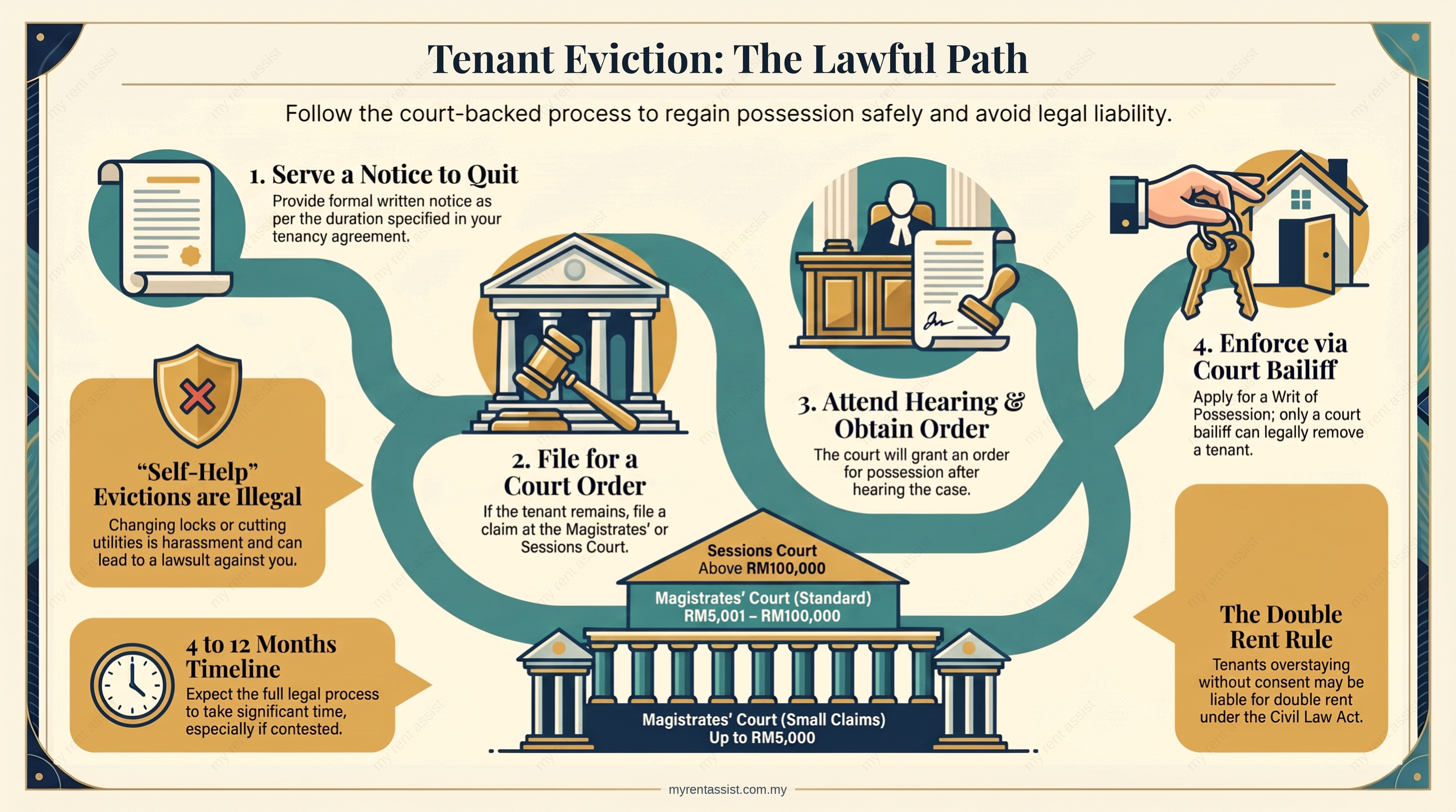
Obtaining a court order is the only lawful way to physically regain possession of your property. Even if a tenant stops paying rent entirely, or overstays well past the tenancy's expiry, you still cannot forcibly remove them without going through the proper process below.
The Legal Eviction Process, Step by Step
There's no shortcut here — but knowing the sequence in advance saves a lot of confusion once you're in it.
-
1Serve a Notice to Quit Give written notice per the length stated in your tenancy agreement — typically one month, sometimes shorter for arrears-specific clauses. This formally terminates the tenancy and starts the clock on the tenant's obligation to vacate.
-
2File for a court order if they still don't leave If the notice period lapses and the tenant hasn't vacated, you file an originating summons or writ for possession — and, if relevant, a separate claim for unpaid rent — at the Magistrates' or Sessions Court, depending on the amount involved.
-
3Attend the hearing and obtain the order The tenant is served and given a chance to respond. If undefended, this can move relatively quickly; if contested, expect multiple hearing dates before the court grants an order for possession.
-
4Enforce via the court bailiff (Writ of Possession) A court order alone doesn't physically remove anyone — you still need to apply for a Writ of Possession and have the court bailiff carry out the enforcement. This is the only lawful point at which a tenant can actually be made to leave.
Which Court Handles Your Case
Which court you file in depends on the value of your claim — usually the combined value of unpaid rent plus any damages, not just the possession claim itself.
| Claim value | Court | Notes |
|---|---|---|
| Up to RM5,000 | Magistrates' Court — Small Claims Procedure | Simplified, no lawyer strictly required, faster-moving |
| RM5,001 – RM100,000 | Magistrates' Court | Standard civil procedure applies |
| RM100,001 – RM1,000,000 | Sessions Court | Sessions Court also has unlimited jurisdiction specifically for landlord-and-tenant possession actions |
How Long It Takes and What It Costs
This is usually the part that surprises landlords most — eviction is rarely fast, even when the case is clear-cut.
An undefended, well-documented case can move from first default to a court order in around a month on some managed files, but the more realistic range for the full process — notice, filing, hearings, order, and bailiff enforcement — runs anywhere from 4 to 12 months, longer if the tenant contests it or can't be located for service.
On cost, a straightforward Sessions Court possession case typically runs in the low thousands of ringgit for legal fees, plus separate filing and bailiff enforcement fees. Contested cases, or ones requiring multiple hearings and re-service, run materially higher. None of this is usually recoverable in full even if you win — which is exactly why prevention (catching arrears early, verifying tenants properly) is cheaper than eviction every time.
Holdover Tenants: Double Rent Under the Law
If your tenant stays on after the tenancy has legally ended — expiry date passed, notice period lapsed, no renewal signed — without your consent, the law actually gives you extra leverage.
Frequently Asked Questions
Quick Summary: Grounds vs Notice vs Court Route
| Ground | Notice required first | Typical court route |
|---|---|---|
| Non-payment of rent | Notice to Quit per agreement (commonly 1 month) | Magistrates'/Sessions Court — possession + arrears claim |
| Lease expired, tenant holds over | Notice to Quit / demand for vacant possession | Sessions Court — possession + double rent claim (s.28(4)(a)) |
| Illegal subletting or breach of clause | Notice to remedy breach, then Notice to Quit if unresolved | Magistrates'/Sessions Court, per claim value |
| Illegal activity or nuisance | Notice to Quit per agreement's breach clause | Sessions Court, may support an expedited hearing |
What To Do Next?
Eviction is what happens when everything before it — reminders, records, proof of who paid what and when — has already broken down. Most landlords who end up in court wish they'd had cleaner records from month one. MyRentAssist keeps that trail automatically, so if it ever does come to this, you're not scrambling for evidence.
- Automated WhatsApp rent reminders sent every month, before arrears pile up
- Every payment timestamped with an official receipt — solid evidence if it ever goes to court
- Full payment history for every unit, always on record
- Nett rent transferred straight to your bank via DuitNow IBG
Try it free for 3 months, or WhatsApp us and we'll walk you through it — no pressure, no credit card.
This article is for general guidance only and does not constitute legal advice. Eviction laws and court procedures can change, and outcomes depend heavily on the specific facts of your case. Consult a qualified lawyer before taking any legal action against a tenant.