In this guide
- The Law Most Landlords Have Never Heard Of
- What Section 55E of the Immigration Act Actually Says
- The Penalties: What You're Actually Facing
- "But I Didn't Know" — Why That's Not Enough
- Who Counts as an "Occupier" Under This Law
- How to Verify a Tenant's Status Before You Sign
- What If You Suspect a Current Tenant Is Undocumented?
- FAQ
The Law Most Landlords Have Never Heard Of
Most Malaysian landlords worry about the usual things — late rent, damaged fixtures, tenants who disappear without paying the last month's utility bill. Almost none of them have read Section 55E of the Immigration Act 1959/63.
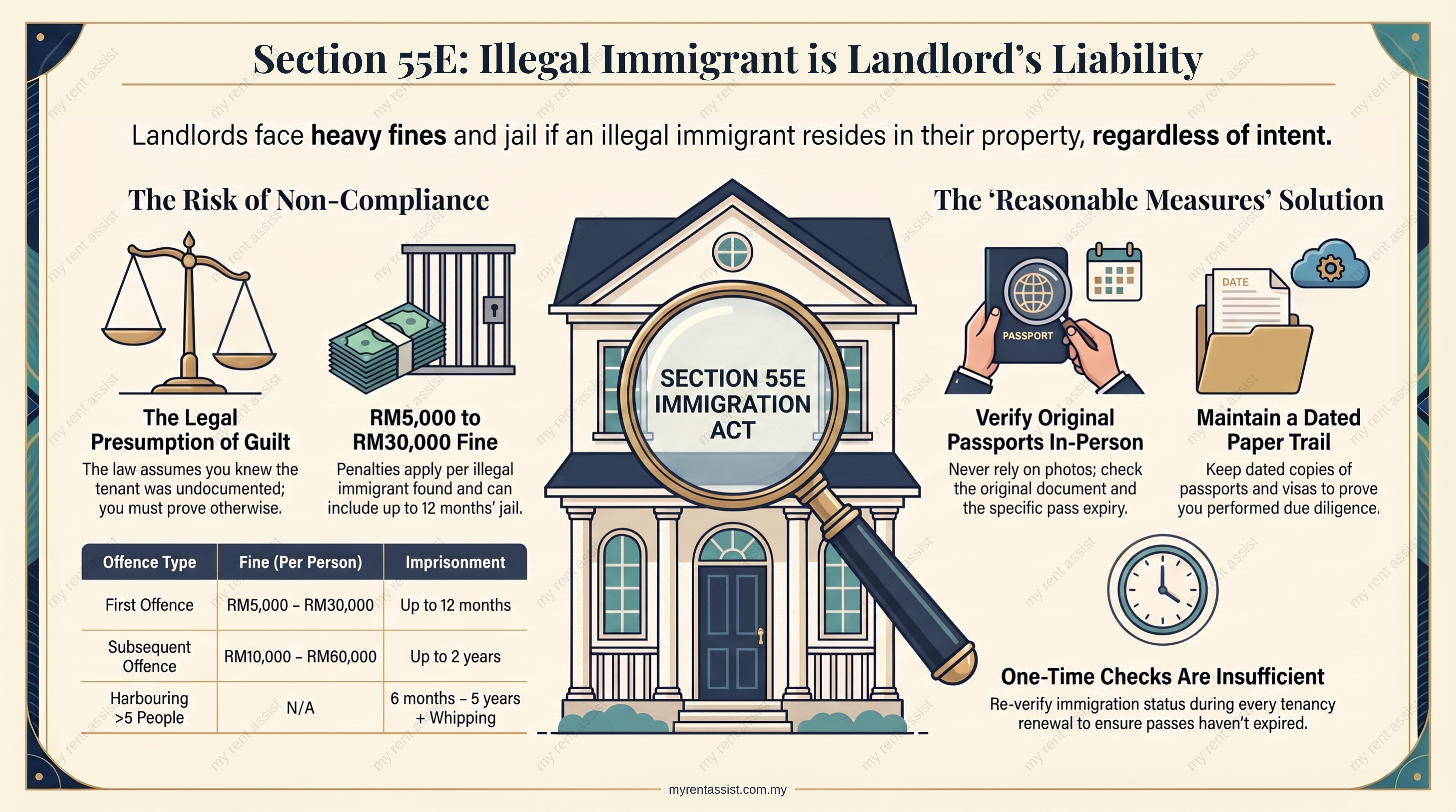
That's a problem, because Section 55E is not about the tenant at all — it's about you. It's the section that lets Immigration Department officers fine or jail a landlord, a managing agent, or anyone else "in charge" of a property if an undocumented migrant is found living there. Not the person who overstayed. The person who rented them the unit.
With enforcement raids continuing across the Klang Valley and authorities repeatedly urging homeowners to verify tenants properly before handing over keys, this isn't a theoretical risk. Landlords have been fined and, in some cases, jailed under this exact provision — including managers and property owners who insisted they didn't know their tenant's pass had expired.
What Section 55E of the Immigration Act Actually Says
Section 55E applies to the "occupier" of a premises — legally defined as any person who has "the charge, management, or control" of that property. In practice, this covers landlords, resident managers, and sometimes even letting agents who effectively control who moves in.
The section creates a legal presumption: if an illegal immigrant is found entering or staying at your premises, the law presumes that you permitted them to be there and knew they were undocumented. You don't get the benefit of the doubt — the burden is flipped onto you.
The only way to rebut that presumption is to prove you took "all reasonable measures" to prevent an undocumented person from entering or remaining on the property. What counts as reasonable is exactly what this guide covers below — and it's the difference between walking away clean and facing a fine.
The Penalties: What You're Actually Facing
The numbers below apply per illegal immigrant found — so if you're renting out a unit to several undocumented occupants at once, the exposure multiplies with each person.
| Offence | Fine | Imprisonment |
|---|---|---|
| First offence (per illegal immigrant found on premises) | RM5,000 – RM30,000 | Up to 12 months, or both |
| Second or subsequent offence | RM10,000 – RM60,000 | Up to 2 years, or both |
| Actively harbouring / concealing an illegal immigrant (a separate, more serious offence) | RM10,000 – RM50,000 | — |
| Harbouring more than 5 illegal immigrants at the same time | — | 6 months – 5 years, plus whipping of not more than 6 strokes |
For context, the person who is undocumented also faces their own penalty for staying without a valid pass — a fine of up to RM10,000 and/or up to 5 years' jail, plus whipping. But that's a separate charge against them. Your exposure under Section 55E stands entirely on its own.
"But I Didn't Know" — Why That's Not Enough
This is the part that catches landlords off guard. Because Section 55E presumes you knew and permitted it, simply saying "I didn't check, the agent handled everything" or "the tenant told me his pass was fine" is not a defence — it's often the exact opposite. It can look like you failed to take reasonable steps to find out.
Alamak — for a lot of landlords, that's the moment it sinks in: this isn't about intent. It's about whether you can show, with paperwork, that you actually checked.
Who Counts as an "Occupier" Under This Law
The Immigration Act's definition of "occupier" is broad by design. It generally covers whoever has the charge, management, or control of the premises — which in a typical Malaysian rental setup usually means:
- The registered owner/landlord, if they manage the tenancy directly
- A resident manager or on-site building manager who oversees who lives in a unit
- In some cases, a managing agent given authority to approve and place tenants
Subletting doesn't shift this responsibility away from you either. If your tenant sub-lets to someone else without your knowledge, you can still be treated as the occupier in control of the premises — which is exactly why tenancy agreements should explicitly prohibit unauthorised subletting, and why periodic checks matter even after the original tenant moves in.
How to Verify a Tenant's Status Before You Sign
None of this requires you to become an immigration lawyer. It requires a documented process you follow every single time — because "reasonable measures" is a paperwork test, not a good-intentions test.
-
1Request the original passport, not a photo forwarded by an agent Check it in person or via video call. Confirm the name matches every other document the prospective tenant provides.
-
2Identify the exact pass type and its expiry date Social visit pass, employment pass, PLKS (foreign worker permit), student pass, or MM2H — each has different validity periods and conditions. A pass that looks fine on the surface may already be near expiry.
-
3Keep dated copies on file Photograph or photocopy the passport bio page and the pass/visa page, and date-stamp the file. This is your evidence of "reasonable measures" if you're ever questioned.
-
4Don't rely solely on an agent's word Agents are focused on closing the deal, not on your legal exposure. Verify the documents yourself, even if an agent has already "checked".
-
5Re-check at renewal, not just at move-in Every time a tenancy is renewed or extended, ask to see the current pass again. Passes expire mid-tenancy far more often than landlords expect.
-
6Put it in writing in the tenancy agreement Include a clause requiring the tenant to hold a valid pass for the full tenancy term, to notify you of any change in status, and prohibiting unauthorised subletting or additional occupants.
What If You Suspect a Current Tenant Is Undocumented?
If you're already renting to someone and have reason to believe their pass has lapsed, don't panic — but don't ignore it either.
- Don't confront or detain anyone yourself. You have no authority to do so, and it can expose you to separate legal problems.
- Ask for updated documentation in writing, with a clear deadline, and keep a record of the request.
- Review your tenancy agreement for grounds to terminate if the tenant can no longer legally reside in Malaysia.
- Get proper legal advice before acting — the right next step depends heavily on your specific facts, and a lawyer can advise you on how to handle the situation in a way that protects you.
Ringkasnya — the goal isn't to turn every landlord into an immigration enforcer. It's to make sure that if Immigration Department officers ever do show up at your door, you can hand over a file that shows you checked, you documented it, and you acted the moment something looked off.
Frequently Asked Questions
Verification Is Step One. A Proper Paper Trail Is What Backs It Up.
Once you've checked your tenant's documents and got them into a proper tenancy agreement, the next thing that protects you is having everything after that — rent, receipts, records — organised and traceable. That's exactly what MyRentAssist automates every month, so you're never scrambling to reconstruct a paper trail after the fact.
- Automatic monthly rent collection & receipts
- Full payment history for every tenancy
- WhatsApp reminders sent on your behalf, automatically
- Everything organised in one place, ready if you ever need it
This article is for general guidance only and does not constitute legal advice. Immigration enforcement, liability, and available defences depend on the specific facts of each case. Consult a qualified lawyer for advice specific to your situation.