You check your bank notification. Nothing. Okay, maybe it's coming later. You check again after lunch — still nothing. By evening you open WhatsApp and hover over the tenant's name for ten seconds before closing the app. You tell yourself you'll give it until tomorrow.
Sound familiar? If you're a Malaysian landlord with one or two properties, this scenario is almost a rite of passage. Tenant tak bayar sewa — rent not paid — is the single biggest source of stress for landlords across KL and Selangor. And yet most landlords handle it the same way every time: wait, hope, follow up awkwardly, and lose weeks before doing anything decisive.
This guide is going to change that. We'll walk you through exactly what to do from Day 1, what your legal rights are, and — perhaps most importantly — why your own delayed reminders may be costing you more than a difficult tenant ever could.
Quick Note
Malaysia has no dedicated Residential Tenancy Act as of June 2026 — the bill is still in draft. Your rights as a landlord come from your tenancy agreement, the Contracts Act 1950, the Distress Act 1951, and the Specific Relief Act 1950. This makes having a solid written agreement and good documentation even more critical.
Why Tenants Stop Paying
Before you go into full panic or confrontation mode, it helps to understand what's actually going on. Most late payments fall into one of three categories:
They forgot. Studies on Malaysian rental payments show that the most common reason tenants pay 1–3 days late isn't financial difficulty — it's that they simply forgot. No reminder, no payment.
They're genuinely struggling. Job loss, medical bills, business failure. This requires a different approach — negotiation, payment plans, and compassion alongside firmness.
They're testing you. If you've been soft on late payments before, some tenants will push to see how long they can stretch it. This is more common than landlords like to admit.
Knowing which category you're dealing with shapes how you respond. But regardless of the reason, the action you take on Day 1 matters — a lot.
The Day-by-Day Action Plan
Here's the exact playbook. Stick to this timeline and you keep control of the situation — emotionally and legally.
D1
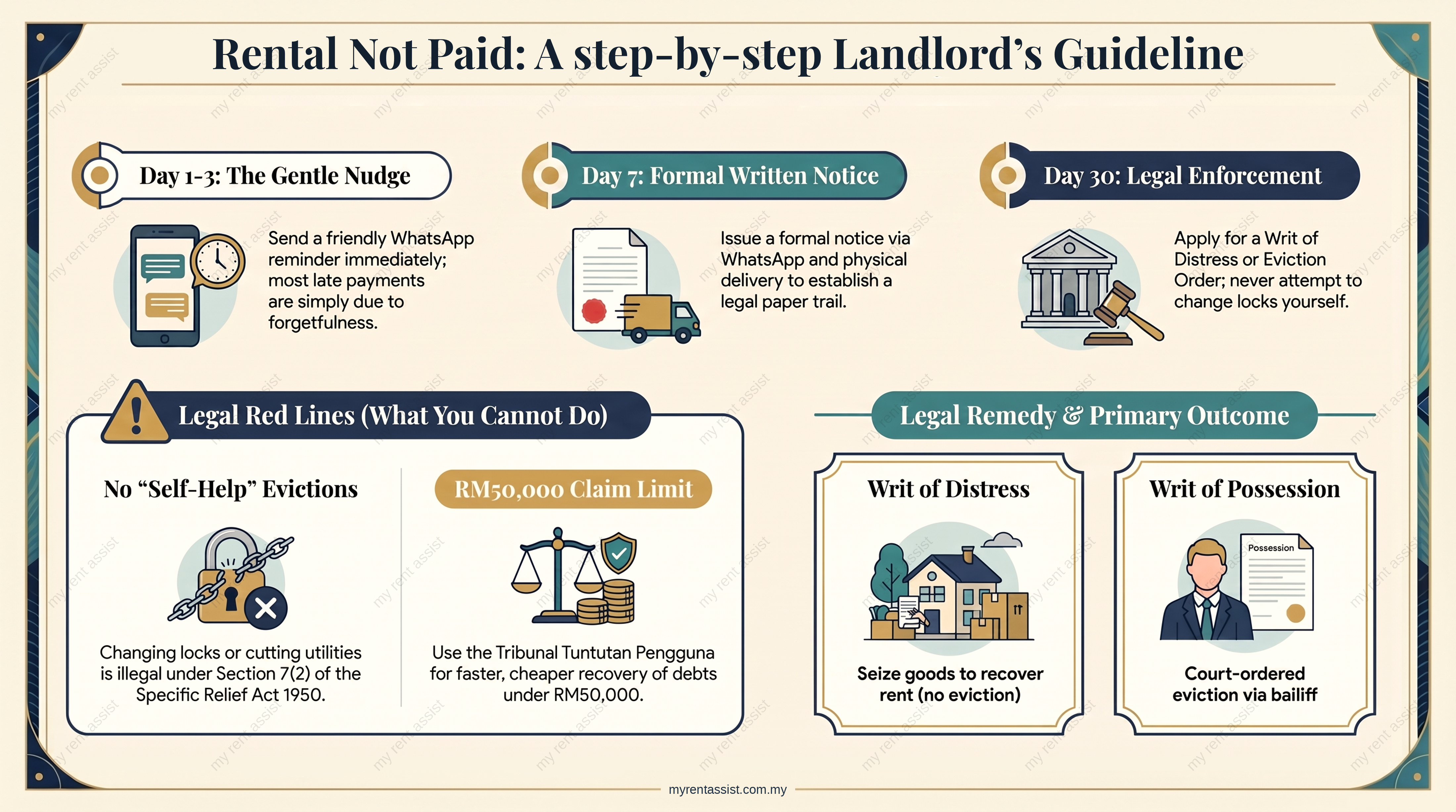
Day 1 — Send a Friendly Reminder (Same Day Rent is Due)
Don't wait. The moment rent doesn't arrive on the due date, send a short, polite WhatsApp message. Keep it warm — assume they forgot. Something like:
No drama, no threat — keep it warm and assume they forgot. Most tenants will settle within 24 hours of a well-worded reminder. MyRentAssist sends this automatically on your behalf, so the right message goes out on the right day without you having to think about it.
D3
Day 3 — Follow Up If No Response
Still no payment and they haven't replied? Send a second message that's slightly firmer but still respectful. Ask directly when they expect to pay. Getting a commitment — even a vague one — gives you something to hold them to.
The tone should be firm but not confrontational — ask directly for a confirmed payment date. Getting a commitment, even a vague one, gives you something to hold them to.
D7
Day 7 — Issue a Formal Written Notice
If seven days have passed with no payment and no credible explanation, it's time to move from WhatsApp to a formal written notice. Send via WhatsApp and deliver a physical copy to the property. This matters — it creates a paper trail.
Your notice should state: the amount owed, the original due date, a deadline to pay (typically 7–14 days from the notice), and a statement that failure to pay may result in legal action. Keep the tone firm and factual.
Pro Tip
Keep screenshots of all WhatsApp conversations and a record of all payment dates. If this escalates to legal action, your documentation is your evidence.
D14
Day 14 — Negotiate a Payment Plan or Issue Termination Notice
By now you have a clearer picture. Is this a genuine financial hardship case? Consider a structured payment plan — get it in writing, signed by both parties. A partial recovery is better than a prolonged legal battle.
If there's been no communication or effort to pay at all, issue a Notice of Termination citing breach of tenancy agreement due to non-payment. Your agreement should specify the notice period required (typically 14–30 days).
D30
Day 30 — Pursue Legal Remedies
If the tenant has not paid, has not vacated, and negotiation has failed, you now have two main legal routes:
Writ of Distress (Distress Act 1951) — Apply to the Magistrate's Court for a warrant to seize the tenant's movable goods on the premises, which can be sold to recover rent arrears. This recovers money but does not evict the tenant.
Eviction Order / Writ of Possession (Specific Relief Act 1950) — Apply to the Sessions or Magistrate's Court for a court order requiring the tenant to vacate. Only after the court grants this can the court bailiff legally remove the tenant.
Expect the legal process to take 2–4 months minimum. Engage a lawyer early — ideally by Day 14 if the situation is clearly headed this way.
D60+
Day 60+ — Enforce and Recover
With a court order in hand, the court bailiff executes the eviction. You can pursue the tenant for outstanding rent as a civil debt even after they've left. Document all losses — unpaid rent, utility arrears, damage — as you may deduct from their deposit and claim the remainder through the Small Claims Court (up to RM5,000, no lawyer needed) or the civil courts for larger amounts.
Your Legal Options — A Quick Reference
Legal Remedy
What It Does
Where to File
Outcome
Writ of Distress
Court-supervised seizure of tenant's movable goods on premises
Magistrate's Court
Recover rent arrears (does not evict)
Eviction / Writ of Possession
Court order requiring tenant to vacate
Sessions / Magistrate's Court
Vacant possession via court bailiff
Small Claims Court
Claim unpaid rent or deposit shortfall as a civil debt
Magistrate's Court
Financial award up to RM5,000 — no lawyer needed
Civil Suit
Sue for amounts exceeding RM5,000 or complex disputes
Sessions / High Court
Financial judgment, enforceable by court
Critical Warning
Under Section 7(2) of the Specific Relief Act 1950, self-help eviction is illegal. You cannot change the locks, cut utilities, remove the tenant's belongings, or physically block access — even if they owe you months of rent. Doing so exposes you to civil liability and potentially criminal charges. Always go through the courts.
The Hidden Cost: When YOU Are the Reason Rent Is Late
Here's something most landlord guides won't tell you: the problem isn't always the tenant.
Research consistently shows that the most common reason tenants pay 1–3 days late is simply that they forgot. No reminder, no payment. And when a landlord's own follow-up is inconsistent or delayed, it quietly trains the tenant that late is acceptable — until one month, it isn't.
Let's run through a real scenario. Assume your rent is RM1,800/month, due on the 1st.
The Forgetful Landlord Scenario — How 3 Delayed Reminders Erase a Month's Rent
Month 1: Rent due on the 1st. You're busy — remind on Day 3 instead of Day 1.+3 days lateRental delayed 4 days
Month 2: Tenant remembers "landlord usually reminds late" — delays payment. You remind on Day 7 this time.+7 more daysRental delayed 8 days
Month 3: Pattern is now set. Tenant waits. You're travelling, reminder slips another 7 days.+7 more daysRental delayed 15 days
Month 4: Tenant is 17 days into the habit of late payment. They hit a tight month. They don't pay at all.Day 30+No payment
Total delay caused by your own late reminders17 daysAnd counting...
17 days of delay looks small. But will the tenant use this as an opportunity to do the same next month — and the month after? No one knows. What we do know is this: once a tenant stops paying entirely, the legal eviction process takes around 60 days minimum. Add the 17 days of normalised delay you trained into them, and you're looking at more than 2.5 months of rent gone — not because you had a bad tenant, but because the reminders were never consistent.
The tenant didn't suddenly become difficult. You gradually signalled that the due date was flexible — and they responded accordingly. Your reminder discipline sets the payment culture of your tenancy.
The Real Cost of "I'll Do It Later"
If you're managing 3 units and each loses 1 month of rent per year due to delayed follow-up, that's RM5,400–RM7,200 lost annually — not from bad tenants, but from inconsistent systems. The fix isn't tougher tenants. It's a system that sends the reminder before you even think about it.
What You Cannot Do (No Matter How Frustrated You Are)
When rent stops coming and the tenant goes quiet, drastic action feels justified. It isn't — legally. Here's what landlords regularly do that puts them on the wrong side of the law:
Change the locks — illegal. Section 7(2) of the Specific Relief Act 1950 prohibits self-help eviction.
Cut water, electricity, or gas supply — illegal. Even if the utility is in your name, deliberately cutting access to force a tenant out is actionable.
Remove or throw out the tenant's belongings — illegal. Even abandoned goods must be handled through the court process.
Enter the property without permission or notice — unless there is a genuine emergency, entering without consent breaches the tenant's right to quiet enjoyment.
Threaten or harass the tenant — regardless of how much they owe, harassment (including online shaming) exposes you to civil and criminal liability.
Any of the above can result in the tenant taking legal action against you — even if they owe you money. Always let the courts handle enforcement.
Frequently Asked Questions
How many months of unpaid rent before I can evict a tenant in Malaysia?
There's no fixed number set by law — it depends on your tenancy agreement. Most agreements allow the landlord to terminate and seek eviction after one month of non-payment, provided the required notice has been given. Check your agreement's forfeiture clause. Once the notice period expires without payment, you can apply for an eviction order through the courts.
Can I use the security deposit to cover unpaid rent?
Yes — your tenancy agreement almost certainly allows this. However, you cannot unilaterally deduct from the deposit while the tenant is still in the property without their written consent. The deposit is typically applied at the end of the tenancy to cover outstanding rent, utility bills, and verified damage. Document everything before making deductions.
What if the tenant ignores my WhatsApp messages and avoids me?
Keep all messages, even unread ones — delivery and read receipts are evidence. Move to formal written notice delivered physically to the property. If you cannot reach the tenant at all, document your attempts and consult a lawyer about service of notice under the Contracts Act. Courts will want to see that you made reasonable attempts to communicate before escalating.
My tenant is struggling financially — what should I do?
A formal payment plan is often the most practical solution. Agree in writing on a catch-up schedule (e.g. RM500 extra per month until arrears are cleared), get both signatures, and keep records. This is faster and cheaper than eviction proceedings, and preserves the tenancy if the tenant is otherwise reliable. Set clear consequences in the agreement if the payment plan is broken.
How long does the eviction process take in Malaysia?
Realistically, 2–4 months from the date you file in court, assuming the tenant does not contest the order. Contested cases can take significantly longer. This is why acting early — sending formal notices by Day 7 and consulting a lawyer by Day 14 in serious cases — is so important. The clock only starts running once you take formal action.
Is there any tribunal for landlord-tenant disputes in Malaysia?
Not yet — Malaysia does not have a dedicated tenancy tribunal as of 2026 (the proposed Residential Tenancy Act has not been passed). The Tribunal Tuntutan Pengguna (Consumer Claims Tribunal) is for tenants making claims against landlords, not the other way around. As a landlord chasing unpaid rent, your options are: Small Claims Court (up to RM5,000, no lawyer needed), Magistrate's or Sessions Court for larger amounts, or a Writ of Distress to seize the tenant's goods while they're still occupying the unit.
Share this guide
Stop Chasing, Start Collecting
The Reminder That Goes Out Whether You Remember or Not
MyRentAssist sends automatic rent reminders on the exact date rent is due — every month, without you lifting a finger. No more delayed follow-ups, no more accidentally training your tenant that late is fine.
This article is for general guidance only and does not constitute legal or tax advice. For your specific situation, please consult a qualified Malaysian lawyer.