In this guide
- What Counts as a "Renewal" vs a Brand-New Agreement
- Can You Raise the Rent at Renewal — and By How Much?
- Notice Period: How Much Warning You Actually Need to Give
- The New Renewal Stamping Rule From January 2026
- Renewal Stamp Duty Calculator
- What If Your Tenant Doesn't Accept the New Terms?
- Penalties If You Skip Stamping the Renewal
- FAQ
- Quick Summary: Renewal Scenarios at a Glance
Your tenant's agreement expires in six weeks. Do you raise the rent, keep it the same, or risk them just walking away? And once both sides agree on the new terms — do you need a whole new tenancy agreement, or will a short renewal letter do? For most landlords, renewal is the part nobody ever properly explains, so it either gets skipped entirely (a verbal "sambung lah" and nothing on paper) or rushed through at the last minute.
Ringkasnya, renewal isn't just a formality between you and your tenant. Since January 2026, it comes with its own stamping requirement under LHDN's new self-assessment system — and getting the process wrong can leave you with an agreement that's worth nothing if a dispute ever reaches the Tribunal or the courts.
What Counts as a "Renewal" vs a Brand-New Agreement
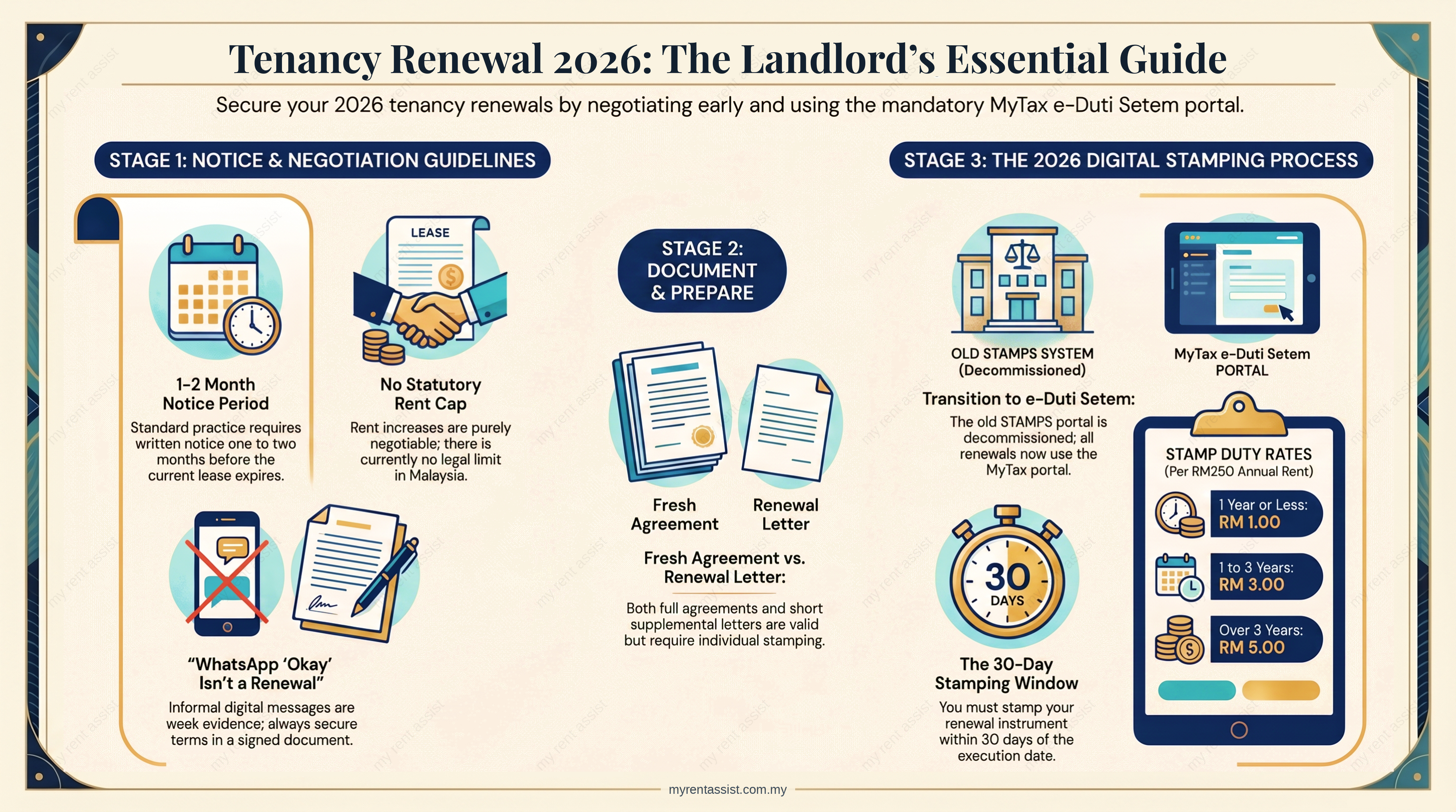
There are two ways landlords typically renew a tenancy, and both are treated the same way by LHDN for stamping purposes:
- A fresh tenancy agreement covering the entire new term — same structure as your original agreement, just with updated dates and (if applicable) a new rent figure.
- A short renewal or supplemental letter that references the original agreement and simply extends the term and/or updates the rent, without re-writing every clause from scratch.
Either approach is legally valid. The supplemental letter route is faster to draft and is what most landlords use when the existing agreement's other terms (deposit, house rules, maintenance responsibilities) haven't changed. But don't confuse a renewal with what happens when a completely new tenant moves in — that's a fresh tenancy from scratch, and our stamp duty guide covers that scenario in full.
Can You Raise the Rent at Renewal — and By How Much?
There's currently no legal cap on how much a landlord can raise rent in Malaysia — that's one of the gaps the proposed Residential Tenancy Act is expected to eventually address, but until it's passed and gazetted, rent increases are purely a matter of negotiation between you and your tenant. In practice, Klang Valley renewals tend to land somewhere between 0% and 10% per cycle, depending on how tight the rental market is in your area and how much your tenant wants to avoid the hassle of moving.
The critical point most landlords get wrong: you cannot unilaterally impose a rent increase mid-tenancy just because the market has moved. A new rent only becomes enforceable once your tenant agrees to it and it's reflected in the signed renewal instrument. If your original agreement has a rent review clause, it'll typically follow one of these structures:
- Fixed increase — e.g. "Rental shall increase by RM100 per month upon renewal."
- Percentage increase — e.g. "Rental shall increase by 5% per annum."
- Market review — rent is renegotiated based on prevailing market rates at the time of renewal, with no fixed formula.
If your agreement is silent on rent review (most are, especially older ones), renewal simply becomes a fresh negotiation — and either side is free to walk away if no agreement is reached.
Notice Period: How Much Warning You Actually Need to Give
Malaysia doesn't yet have a statutory notice period for tenancy renewal or non-renewal — again, something the pending Residential Tenancy Act would likely standardise once it's law. For now, whatever notice period is written into your original tenancy agreement governs, which is commonly one to two months before expiry. If your agreement is silent on this, general practice defaults to about one month's written notice, though two months is considered better practice on both sides — it gives you time to find a new tenant if yours is leaving, and gives your tenant time to find a new place if you're not renewing.
In practice, most landlords start the conversation earlier than any formal notice requires — a casual WhatsApp check-in two to three months out ("hi, your tenancy is ending in [month], want to continue?") does two things: it signals your intent without sounding like an eviction notice, and it gives you an early read on whether the tenant plans to stay, so you're not scrambling in the final weeks.
The New Renewal Stamping Rule From January 2026
This is the part that's genuinely new, and it catches out even landlords who've renewed tenancies before under the old system. The STAMPS portal — LHDN's previous online stamping platform — was fully decommissioned on 31 December 2025. From 1 January 2026, tenancy and lease instruments (including renewals) fall under Phase 1 of LHDN's Stamp Duty Self-Assessment System, and all stamping now goes through e-Duti Setem inside the MyTax portal at mytax.hasil.gov.my. There is no physical stamp duty counter fallback for this category anymore.
If your renewal letter or extension changes the rent, the duration, or any other key term, you submit it on e-Duti Setem the same way you would a brand-new tenancy agreement — using the new term's details. A fresh 30-day stamping window starts from the date the renewal is actually signed, not from the original agreement's execution date.
-
1Log in to MyTax at mytax.hasil.gov.my First-time users register using their MyKad IC number if they haven't set up a MyTax account before.
-
2Select e-Duti Setem from the Duti Setem menu This has fully replaced the old STAMPS portal — bookmark this if you renew tenancies regularly.
-
3Choose "Perjanjian Sewa / Tenancy Agreement" as the instrument type Even for a short renewal letter, this is still the correct category to select.
-
4Enter the execution date, new tenancy period, and monthly rent Use the date the renewal was actually signed as the execution date — this is what starts your 30-day clock.
-
5Pay via FPX and download your e-Stamp certificate Keep a digital and printed copy with the renewal document — this is your proof the instrument is legally admissible.
Renewal Stamp Duty Calculator
The stamp duty rate for a renewal is calculated exactly the same way as for a brand-new tenancy agreement, based on the annual rent and the length of the renewed term:
| Renewed term | Rate | Minimum duty |
|---|---|---|
| 1 year or less | RM1 per RM250 of annual rent | RM10 |
| More than 1 year, up to 3 years | RM3 per RM250 of annual rent | RM10 |
| More than 3 years, up to 5 years | RM5 per RM250 of annual rent | RM10 |
| More than 5 years, or indefinite | RM7 per RM250 of annual rent | RM10 |
Quick Renewal Stamp Duty Calculator
For example, a 2-year renewal on a RM1,800/month unit works out to an annual rent of RM21,600 — divided by RM250 and rounded up gives 87 chargeable units, multiplied by the RM3 rate for a 1–3 year term, for a total of RM261 in stamp duty.
What If Your Tenant Doesn't Accept the New Terms?
Your tenant is under no obligation to accept a rent increase — or any changed term — just because you've proposed it. If they don't agree, they're free to let the tenancy lapse and vacate at the end of the current term; this isn't a breach on their part, since renewal was never guaranteed in the first place unless your original agreement specifically included a binding option-to-renew clause.
This puts landlords at a genuine decision point worth thinking through properly, rather than defaulting to "just push for the increase anyway." Weigh the modest gain from a rent increase against the real cost of vacancy — lost rent while the unit sits empty, agent fees for finding a new tenant, and the admin of onboarding someone new (new tenancy agreement, new stamping, new Change of Tenancy for utilities). In a soft rental market, a smaller increase that keeps a reliable, long-staying tenant often beats a larger one that pushes them out.
Penalties If You Skip Stamping the Renewal
The consequences for an unstamped renewal are identical to an unstamped original agreement — it's simply treated as a fresh instrument that missed its stamping deadline. Under the Stamp Act 1949, late stamping penalties currently apply as follows:
| How late | Penalty |
|---|---|
| Stamped within 3 months after the 30-day deadline | RM50 or 10% of the duty payable, whichever is higher |
| Stamped more than 3 months after the 30-day deadline | RM100 or 20% of the duty payable, whichever is higher |
Beyond the monetary penalty, an unstamped renewal instrument is inadmissible as evidence in civil proceedings until the duty and penalty are fully paid. That means if your tenant disputes the new rent amount, or a disagreement over the renewal terms ends up at the Tribunal for Homeowner and Tenant Claims or in court, you may find your own renewal letter can't be relied on to prove what was agreed — precisely when you need it most.
Frequently Asked Questions
Quick Summary: Renewal Scenarios at a Glance
| Your situation | What you need to do | Stamp duty required? |
|---|---|---|
| Extending the same rent & terms via a short letter | Sign and submit via e-Duti Setem within 30 days | Yes — still a new period |
| Raising rent at renewal | Get written agreement to the new rent before treating it as final | Yes |
| Tenant declines and moves out at term end | No renewal needed — proceed with move-out and deposit process | No |
| Tenant keeps paying old rent, nothing signed | Risk of implied periodic tenancy — get something signed as soon as possible | Only once something is signed |
What To Do Next?
Sorting out one renewal correctly is manageable. Remembering to do it — on time, with the right notice, stamped within 30 days — for every single unit before every single expiry date is where most landlords slip. That's exactly the kind of recurring admin MyRentAssist is built to take off your plate, alongside the monthly rent collection itself.
- WhatsApp rent reminders sent every month, automatically
- Official receipts and full payment history always on record
- Utility bill monitoring across TNB, water, and IWK
- Annual tax summary ready for your LHDN declaration
Try it free for 3 months, or WhatsApp us and we'll walk you through it — no pressure, no credit card.
This article is for general guidance only and does not constitute legal advice. Stamp duty procedures, rates, and portals can change — confirm current requirements directly on MyTax (mytax.hasil.gov.my) before relying on any step described here, and consult a qualified professional for advice specific to your situation.