In this guide
The Scenario: Tenant's Gone, House Is a Mess
You get the keys back. You walk in expecting a quick handover — and instead you're greeted by: a stove caked in a year of unwiped grease, black mould creeping up the bathroom grout, a wall covered in kid's crayon graffiti, cigarette burns on the sofa, three unpatched holes where a TV bracket used to be, a broken door hinge, and a fridge someone clearly forgot was still running with expired food inside.
Every landlord who's rented out a unit for more than a year has some version of this story. Your first instinct is fair: this is coming out of the deposit. But here's the part that trips up a lot of Malaysian landlords — not everything you're annoyed about is legally something you can deduct for. Deposit disputes are the single most common source of conflict between landlords and tenants in Malaysia, and getting this wrong is exactly how a straightforward move-out turns into a Tribunal claim against you.
So ringkasnya — before you start subtracting numbers from that deposit, let's go through what's actually fair game.
Malaysia's Deposit Structure — the "2+1" (or "2+0.5") Rule
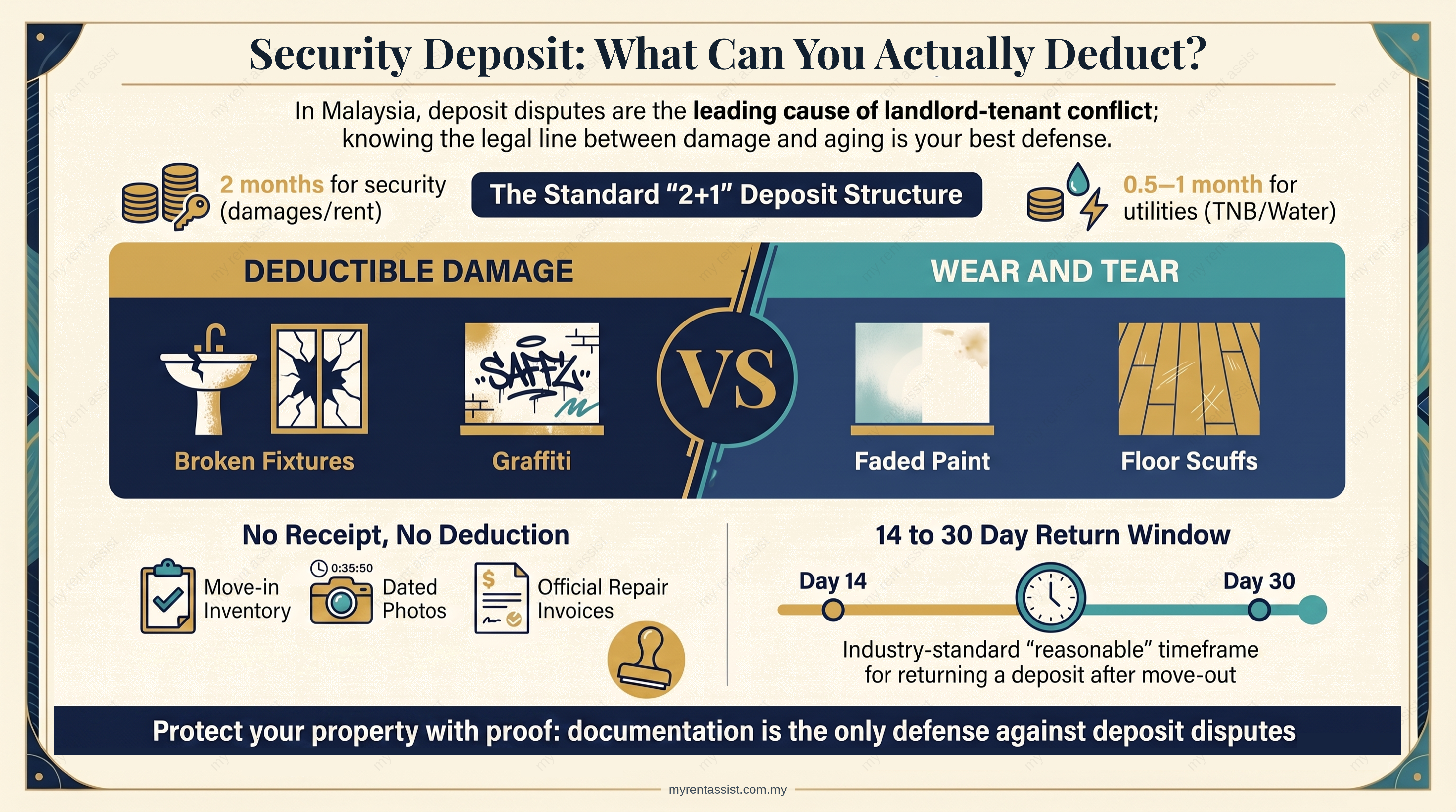
Most Malaysian tenancy agreements follow the standard "2+1" structure: two months' rent as a security deposit, plus a utility deposit on top. In practice, many landlords — especially for residential units — collect only half a month's rent as the utility deposit rather than a full month, so you'll often see this written as "2+0.5" in real agreements. The full 2+1 structure is more common for commercial or higher-value units, while residential units typically settle at 2+0.5. There's currently no law capping this amount — it's whatever both parties agree to in the tenancy agreement, which today is governed by ordinary contract law (the Contracts Act 1950), since Malaysia still has no dedicated Residential Tenancy Act.
The two deposits serve different purposes, and mixing them up is a common mistake:
- Security deposit (2 months) — covers damage to the unit beyond normal wear and tear, and unpaid rent
- Utility deposit (typically 0.5–1 month) — covers unpaid TNB, water, or management fee bills left in your name at handover
Deducting a utility bill from the security portion (or vice versa) isn't illegal, but it makes your itemised breakdown messier and harder to defend if the tenant disputes it. Keep them separate on paper.
What You CAN Deduct
Malaysian landlords can lawfully deduct from a security deposit for:
Genuine breaches of the agreement
- Unpaid rent owed at move-out
- Unpaid TNB / water / management fee bills still in your name
- Damage beyond normal wear and tear (broken fixtures, crayon or marker graffiti on walls, cigarette-burned furniture, holes from unauthorised drilling)
- Cleaning or repair costs the tenancy agreement specifically obliges the tenant to cover at handover
- Missed contractual obligations, such as annual aircon servicing — many Malaysian tenancy agreements require the tenant to service the air-conditioning unit(s) once a year, and if they never did, the cost of the overdue service (or resulting repair) can typically be deducted
- Missing items listed on the signed move-in inventory
Every deduction needs a receipt
A vague "cleaning fee: RM500" line item won't survive a Tribunal claim. You need an actual quote or receipt showing what was done, why, and what it cost — tied back to a specific, documented condition problem.
What You CANNOT Deduct — Even If It Annoys You
This is where most landlord frustration lives, and where most disputes are actually lost. Normal wear and tear cannot be deducted — full stop, regardless of how it looks to you. This includes:
- Faded paint from sunlight exposure
- Minor scuff marks on floors or walls from everyday living
- Small nail holes from hanging pictures or curtains
- Slight discolouration of bathroom or kitchen grouting over time
- General carpet flattening or minor fading from foot traffic
The Documentation That Actually Wins Disputes
If a deposit dispute ever reaches the Tribunal Tuntutan Pengguna (for claims up to RM50,000) or civil court, the outcome usually comes down to one thing: who has the paper trail. The move-in and move-out condition report is the single most important document in any tenancy — without it, proving pre-existing damage versus tenant-caused damage is nearly impossible for either side.
-
1Move-in inventory with dated photos Every wall, floor, appliance, and fixture — photographed and, ideally, signed off by both parties before the tenant gets the keys.
-
2Move-out walkthrough with dated photos Do this with the tenant present whenever possible. A joint walkthrough is far harder for either side to dispute later.
-
3Receipts or quotes for every charge Not an estimate in your head — an actual invoice from the contractor, cleaner, or supplier for each specific repair or replacement.
-
4A written, itemised deduction list Each deduction with its own amount and reason, given to the tenant — not a single lump-sum figure.
-
5Final utility bills showing the unpaid amount If you're deducting for TNB or water, attach the actual bill showing the outstanding figure in your name.
On timing: Malaysia has no legally mandated deadline for returning a deposit today. The industry norm — and what courts have generally treated as "reasonable" — is 14 to 30 days after move-out and final inspection. Put a specific number in your tenancy agreement so there's no ambiguity later.
What Happens If You Skip the Paperwork
Here's the honest comparison. A landlord who documents properly spends maybe 20 minutes at move-in and 20 minutes at move-out taking photos and filling in a checklist. A landlord who skips it is betting that the tenant will simply accept whatever number gets deducted — and increasingly, tenants don't.
| Situation | Landlord who documented | Landlord who didn't |
|---|---|---|
| Tenant disputes a deduction | Shows dated photos + receipts — dispute usually ends there | No proof of "before" condition — deduction is hard to defend |
| Tenant files a Tribunal claim | Walks in with a clean, itemised paper trail | Relies on memory and "trust me" — Tribunal favours documented evidence |
| Time and cost | ~30–40 minutes total, near-zero cost | Potential Tribunal hearing, lost deposit, damaged relationship with future referrals |
The maths isn't close. A dispute at the Tribunal Tuntutan Pengguna doesn't cost much to file, which means tenants who feel wronged have a genuinely low-friction way to challenge you — and undocumented deductions are exactly the kind of claim that doesn't hold up well without evidence.
What the Draft RTA Could Change
Worth flagging: the still-unpassed Residential Tenancy Act has reportedly discussed capping security deposits (commonly cited in the region of 1–2 months' rent, down from today's uncapped norm) and having deposits held by a neutral third party rather than the landlord directly. As covered in our full RTA guide, none of this is law yet — it's still a Bill in drafting. But it's a strong signal of where deposit practices are headed, and one more reason to get your documentation habits right now rather than later.
Frequently Asked Questions
Every Deposit Deduction Is Easier to Defend With a Paper Trail
MyRentAssist keeps your rent history, receipts, and unit records organised automatically — so when move-out day comes, you're not scrambling to remember what was already broken.
- Automatic rent collection & receipts
- Full payment history, always on record
- Utility bill monitoring, per unit
- Documentation ready if a dispute ever comes
This article is for general guidance only and does not constitute legal advice. Malaysia currently has no dedicated Residential Tenancy Act; deposit terms are governed by the individual tenancy agreement under the Contracts Act 1950. Consult a qualified lawyer for advice specific to your situation.