In this guide
What Is the Residential Tenancy Act?
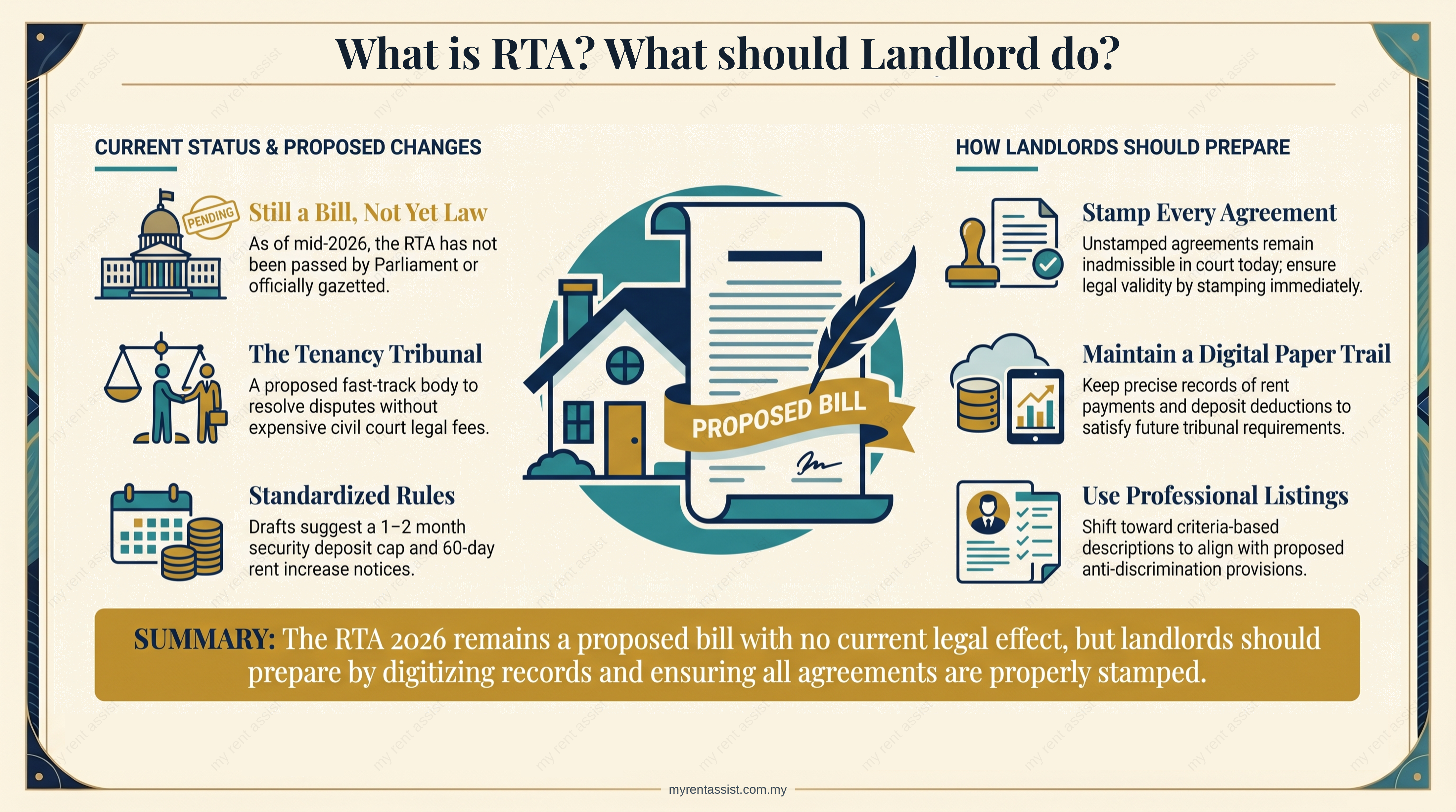
If you've been renting out a unit in KL or Selangor for a while, you've probably heard landlord friends mention "the RTA is coming" — for years now. The Residential Tenancy Act (RTA) is a proposed law that would, for the first time, give Malaysia a dedicated statute governing residential rentals. Right now, there isn't one.
Every tenancy dispute today — a tenant who won't move out, a deposit fight, a broken aircon nobody wants to fix — gets settled using general contract law (the Contracts Act 1950), whatever your tenancy agreement says, and civil court if it escalates. There's no dedicated tribunal, no standard deposit rules, no fast-track process built specifically for rental disputes. The RTA is meant to fix that.
Current Status: Still a Bill, Not Yet Law
As of mid-2026, here's where things actually stand — based on statements from the Ministry of Housing and Local Government (KPKT) and reporting from established Malaysian business press:
Minister confirms "final drafting" stage
Housing and Local Government Minister Nga Kor Ming said the RTA is in its final drafting stage and is expected to be tabled this year — pending Cabinet approval before it goes to the Dewan Rakyat.
Still not tabled as of writing
Despite the minister's statement, no bill text has been formally tabled in Parliament as of this article's last update. There has been no confirmed gazette date.
In plain terms: a minister has publicly said the government wants this passed in 2026. That's a genuine signal of momentum — more concrete than previous years' vague promises. But "final drafting" and "expected to be tabled" are not the same as "law." Until Parliament actually debates and passes it — and it's officially gazetted — it has zero legal effect.
Why It Keeps Getting Delayed
If this feels like déjà vu, that's because it is. The RTA has been "in development" since 2017. It's been announced, paused, revised, and re-announced multiple times since then — through several changes of government and housing ministers. Landlords who've heard "it's coming soon" before are right to be a little skeptical.
This history matters for one practical reason: don't make major decisions today based on the assumption that specific RTA provisions will definitely apply, or apply exactly as currently drafted. Draft bills get amended during the parliamentary process. The version eventually passed — if it's passed in 2026 at all — could differ from what's being discussed now.
What the Draft RTA Proposes
With that caveat firmly in place, here's a summary of the provisions most consistently referenced across ministry statements, published consultation drafts, and analysis from Malaysian law firms. Treat every row as "proposed," not "confirmed final."
| Proposed area | What's being discussed | Status |
|---|---|---|
| Written tenancy agreements | A standardised template agreement setting out baseline terms for both parties | Proposed — not yet mandatory |
| Security deposit cap | Early drafts reportedly discuss a cap in the region of 1–2 months' rent | Proposed — exact figure not finalised |
| Rent increase notice | Reports point to a minimum 60-day written notice period before a tenancy renews at a new rate | Proposed — subject to change |
| Tenancy Tribunal | A dedicated tribunal for rental disputes, separate from the ordinary civil courts | Proposed — see next section |
| Anti-discrimination provisions | Rules addressing exclusionary rental listing practices | Proposed — details not public |
| Digitalisation / registration | Discussion of e-Contracts, a possible landlord/tenancy registration system, and a national rental database | Proposed — earliest-stage concept |
Two things are worth calling out directly. First, none of this is enforceable today — your existing tenancy agreements and current practices remain governed by ordinary contract law until the RTA actually becomes law. Second, the specific numbers (deposit cap, notice days) are the parts most likely to shift between now and final passage, since they're the details usually negotiated hardest during the parliamentary process.
The Tenancy Tribunal, Explained
Of everything proposed, the Tenancy Tribunal is arguably the change landlords should care about most — because it directly addresses the biggest current pain point: disputes are slow and expensive. Right now, a landlord-tenant dispute that can't be settled privately has to go through the ordinary civil court system, which can take 4–12 months and cost anywhere from RM8,000 to RM25,000 in legal fees.
The proposed tribunal is intended to work more like the existing Tribunal for Consumer Claims — faster hearings, lower or no filing fees, and a process designed for people without lawyers. Reports on the draft suggest a claim value ceiling (commonly cited around RM250,000), above which disputes would still go to the regular courts.
What This Means for Landlords Right Now
Here's the honest, practical answer: nothing changes legally today. Your current tenancy agreements remain valid and enforceable exactly as written. You are not required to adopt any RTA provision — because there isn't one yet to adopt.
What has changed is the direction of travel. The government has been consistent about the broad themes even as the timeline has slipped: standardisation, a dedicated dispute mechanism, and more structured deposit and notice rules. Whether the RTA passes in 2026, 2027, or later, these are the areas most likely to eventually be regulated. That's useful information for planning — even if it's not yet a compliance deadline.
What landlords should NOT do
- Don't rewrite your existing tenancy agreements to "comply" with draft RTA terms — there's nothing to comply with yet, and the final version may differ
- Don't tell tenants "the new law says..." — it isn't a law, and misrepresenting it could undermine your credibility in a dispute
- Don't delay stamping or documenting a tenancy agreement while "waiting to see" what the RTA requires — your obligations under existing law (like the Finance Act 2024's stamp duty rules) apply regardless of the RTA's status
How to Prepare Before It Becomes Law
Pendek kata — the smartest move isn't to guess at future rules. It's to get the basics right now, in a way that would hold up whether the RTA passes as drafted, gets watered down, or gets delayed another two years.
-
1Get every tenancy agreement properly written and stamped An unstamped agreement is inadmissible in court today — RTA or no RTA. This is the single most common mistake that costs landlords money in disputes.
-
2Keep a clean paper trail on rent and deposits Payment dates, receipts, and deposit deduction records. If a tribunal eventually exists, this is exactly the documentation it will expect from you.
-
3Review your notice and renewal practices You're not bound by a 60-day rule today, but giving reasonable written notice before any rent change is already good practice and reduces disputes regardless of what the RTA eventually mandates.
-
4Avoid discriminatory listing language Regardless of what the RTA eventually enforces, exclusionary listing practices are already reputationally and increasingly legally risky. Write listings based on tenancy criteria, not protected characteristics.
-
5Follow credible sources, not forwarded WhatsApp messages Track RTA updates via established outlets like The Edge Malaysia, EdgeProp, or statements directly from KPKT — not secondhand summaries. The details change, and getting them wrong in a dispute won't help you.
Frequently Asked Questions
Whatever the RTA Ends Up Requiring, Good Records Always Win You the Case
Stamped agreements, dated receipts, a clean rent history — that's the foundation any future tribunal, or any court today, will expect from you. MyRentAssist keeps all of it organised automatically, every month, without you having to chase it down later.
- Automatic rent collection & receipts
- Full payment history, always on record
- Utility bill monitoring, per unit
- Annual tax summary for LHDN
- Documentation ready if a dispute ever comes
This article is for general guidance only and does not constitute legal advice. The Residential Tenancy Act discussed in this article is a proposed Bill and, as of this article's last update, has not been passed by Parliament or gazetted — it is not yet law. Details of the draft may change before (or if) it is enacted. Consult a qualified lawyer for advice specific to your situation and check official Ministry of Housing and Local Government (KPKT) sources for the current legislative status.