In this guide
- Why Landlords Are Targets Too, Not Just Tenants
- The Three Rental Scams Every Landlord Should Know
- Red Flags That Signal a Fake Tenant or Fake Agent
- How to Verify a Genuine Tenant Before Handing Over the Keys
- Protecting Your Listing From Being Stolen and Reused
- What to Do If You've Been Scammed or Impersonated
- FAQ
- Quick Summary: Scam Type vs Protection Measure
Why Landlords Are Targets Too, Not Just Tenants
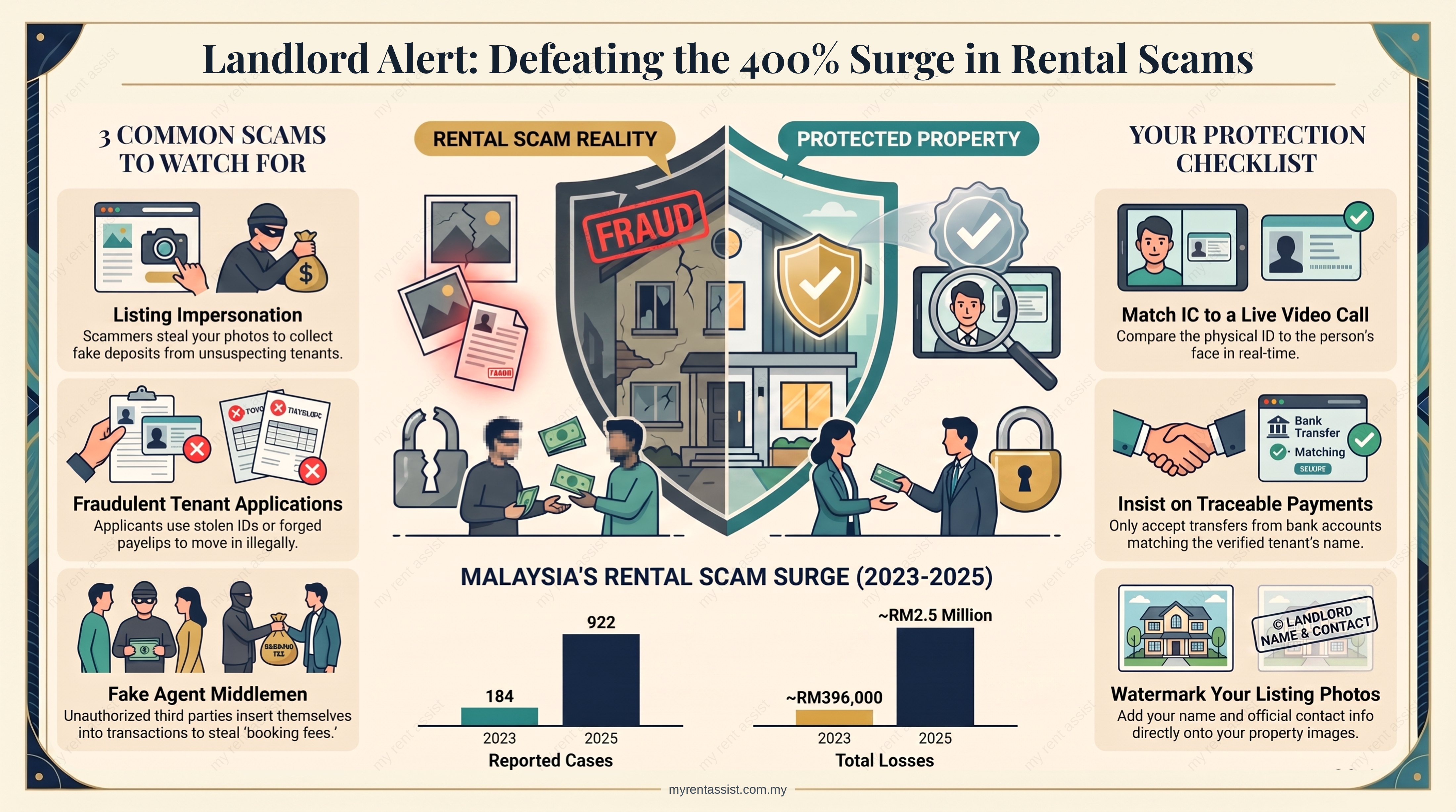
Most rental scam coverage in Malaysia focuses on the tenant's side — someone transfers a deposit for a unit that was never really for rent, and loses their money. That's real, and it's getting worse. Reported property rental scam cases jumped from 184 in 2023 to 922 in 2025, a surge of more than 400% in just three years, with losses escalating from roughly RM396,000 in 2023 to around RM2.5 million by 2025.
What often gets missed is that landlords sit right in the middle of this. Your real unit, your real photos, and sometimes your real name end up being used by a scammer to trick someone else — and you only find out when an angry "tenant" turns up at your gate asking why the unit they already paid a deposit for is occupied by someone else. Alamak. On the flip side, some of the applicants messaging you directly aren't genuine tenants either — they're testing whether you'll accept a fraudulent payment, a stolen identity, or a fast move-in before you've verified anything.
Ringkasnya, this isn't just a "be careful who you rent from" problem anymore. It's a "be careful who you rent to, and who's using your listing" problem — and it takes almost no effort from a scammer to turn a landlord's genuine advertisement into bait.
The Three Rental Scams Every Landlord Should Know
1. Listing impersonation
A scammer copies your unit's photos and description — often lifted straight from Mudah, PropertyGuru, or a Facebook group — and reposts it slightly below market rate to move fast. They pose as the "agent" or "owner," collect a booking fee or deposit from an eager renter via WhatsApp or Telegram, then disappear. The victim shows up expecting to move in; you're the one left explaining that you never received any deposit and don't know this person.
2. Fraudulent tenant applications
Here the scam runs the other way. Someone applies to rent your actual unit using a fake or stolen IC, forged payslips, or a fabricated employer reference. The first month's rent might be paid with a cheque that later bounces, a stolen credit card, or a bank transfer from an account that isn't theirs — sometimes traceable to a separate fraud case entirely. By the time it unravels, they've already moved in, and getting them out means going through the same slow court eviction process as any other tenant dispute — Writ of Possession, court order, bailiff enforcement, no shortcuts. (See the eviction steps in our tenant tak bayar sewa guide.)
3. Fake "agent" middlemen
A third party inserts themselves into a genuine transaction — sometimes contacting an interested tenant who found your real listing, claiming to represent you, and asking for a "booking fee" or "reservation deposit" before a viewing even happens. You never authorised them, may never even know they exist, but your listing and reputation take the hit when the tenant realises they've been had.
Red Flags That Signal a Fake Tenant or Fake Agent
- Urgency without a viewing. A "tenant" who insists on paying a deposit today, sight unseen, because they're "relocating urgently" or "already have the cash ready" — real tenants almost always want to see the unit first.
- Payment to a personal account under a different name. If a self-described agent asks you to route payment discussions through a personal bank account instead of a proper channel, or asks a prospective tenant to pay them directly rather than you, treat it as a scam attempt.
- Documents that don't quite line up. An IC photo that looks slightly mismatched to the person on a video call, a payslip with inconsistent formatting, or an employer who can't be reached at any publicly listed number.
- Reluctance to video call. Genuine tenants relocating from out of state or abroad are usually happy to do a live video walkthrough or verification call. Scammers avoid it.
- Your unit appears on rental ad portals you never posted to. Most Malaysian landlords don't advertise directly — an agent usually handles the posting on their behalf. If your unit shows up on a portal or Facebook group and you never appointed any agent to list it, someone has copied it. The same applies if your unit is genuinely listed for short-term rental (Airbnb-style) but those same photos start turning up in long-term rental ad portals — a strong sign your images have been lifted and reused without your knowledge.
How to Verify a Genuine Tenant Before Handing Over the Keys
You don't need to run a private investigation on every applicant — but a few specific checks catch almost every fraudulent application before it costs you anything.
-
1Match the IC to a live video call Ask to see the physical IC on camera during a short video call, and compare the photo and details in real time — not just a photo sent over WhatsApp, which can be edited or belong to someone else entirely.
-
2Call the employer through a number you find yourself Don't call the number the applicant gives you for "HR" — look up the company's official line independently and confirm employment and salary range through that channel instead.
-
3Insist on traceable payment, from an account in the tenant's own name Deposits and rent should come via bank transfer or DuitNow from an account matching the named tenant — never cash-only, never a third party's account "on their behalf," and never a cheque you haven't confirmed has actually cleared before handing over keys.
-
4Get a second, independently reachable contact A family member or emergency contact whose number you verify separately gives you a real point of contact if the tenant later becomes unreachable — genuine applicants rarely hesitate to provide one.
Protecting Your Listing From Being Stolen and Reused
Prevention here is mostly about making your listing harder to copy convincingly and easier to trace back to you.
- Watermark your own photos with your name or a short reference code before posting — it doesn't stop copying entirely, but it makes a stolen listing visibly suspicious to anyone who looks closely.
- State your official payment channel directly in the listing text — e.g. "all payments made only via [your name] through [platform]" — so a genuine inquiry has something to check against if a "different agent" contacts them instead.
- Search your own address and unit number periodically on Mudah, PropertyGuru, and relevant Facebook groups to catch duplicate listings early. This works especially well because genuine agents usually avoid publishing the exact unit number — it lets rival agents identify and approach the owner directly, so real listings tend to stay vague ("Level 12" instead of "A-12-3"). Scammers do the opposite: naming the exact unit number makes a fake listing look more credible and helps them win a prospective tenant's trust faster. If you find your specific unit number posted publicly by someone other than your own appointed agent, treat it as a strong signal the listing isn't genuine.
- Never share your IC number or full bank account details in listing replies — legitimate verification during a real tenancy signing doesn't require broadcasting that information to every inbound message.
What to Do If You've Been Scammed or Impersonated
If you discover your listing has been copied and used to defraud someone, or you've personally lost money to a fake tenant or fake agent, acting quickly matters.
- Lodge a police report at the nearest station, or via the Commercial Crime Investigation Department (CCID) for online fraud — bring screenshots of the fake listing, chat records, and any bank details the scammer used.
- Report the fake listing to the platform (Mudah, PropertyGuru, or the relevant Facebook group admins) with a link to your original listing as proof, so it can be taken down.
- Flag the receiving bank account to the National Scam Response Centre (NSRC) at 997 if you or a victim can identify the account the scammer used — fast reporting improves the chance of freezing funds before they're withdrawn.
- Warn genuine inquiries directly by pinning a note on your real listing or replying to inbound messages confirming your only official contact details, to cut off any confusion before it costs someone else money.
Frequently Asked Questions
Quick Summary: Scam Type vs Protection Measure
| Scam type | Who it targets | Best protection |
|---|---|---|
| Listing impersonation | Prospective tenants (you take the reputational hit) | Watermark photos, state official payment channel, search your unit periodically |
| Fraudulent tenant application | Landlords directly | Video-call IC check, independent employer verification, cleared traceable payment |
| Fake agent middleman | Both landlords and tenants | Verify REN number against BOVAEP, never authorise third-party fee collection |
| Any of the above, after the fact | — | Police report / CCID, platform takedown request, NSRC 997 for bank freeze |
What To Do Next?
Verifying tenants and watching for impersonation is step one — but the same discipline that catches a scam early also fixes the everyday admin gap that lets fraud slip through in the first place: payments you can't trace and records you don't have. MyRentAssist keeps every ringgit accounted for automatically.
- Rent collected via Billplz FPX — every payment traceable to a real bank account
- Official receipts generated and sent automatically
- Full payment history for every unit, always on record
- Nett rent transferred straight to your bank via DuitNow IBG
Try it free for 3 months, or WhatsApp us and we'll walk you through it — no pressure, no credit card.
This article is for general guidance only and does not constitute legal advice. Always verify counterparties independently and report suspected fraud to the police or the National Scam Response Centre. Consult a qualified lawyer for advice specific to your situation before making decisions based on this information.