In this guide
- What Is the Stamp Duty Voluntary Disclosure Programme
- Who Qualifies for the Penalty Waiver
- What You Get If You Come Forward Now
- What Happens If You Miss the Deadline
- How to Regularise Your Agreement, Step by Step
- Why This Matters Even If Nobody Has Asked Yet
- FAQ
- Quick Summary: Does the Waiver Apply to You?
You signed the tenancy agreement, collected the deposit, handed over the keys — and the stamping bit quietly slipped down the to-do list. Maybe it was 2023, maybe last year. You've been collecting rent fine ever since, so it hasn't really come up. Alamak, but if that agreement is still unstamped, LHDN has just made this the cheapest possible moment to fix it.
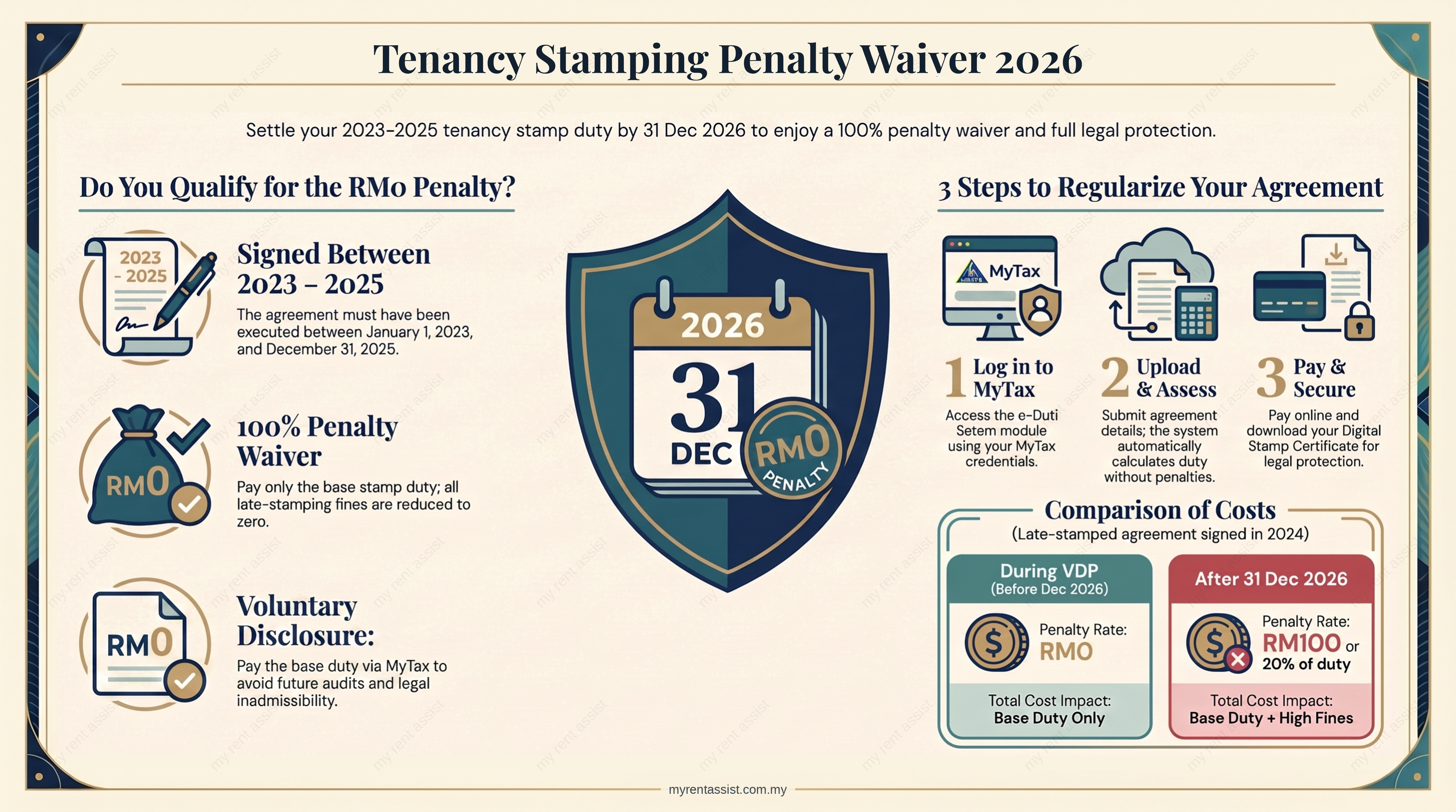
The Inland Revenue Board (LHDN) is running a Special Voluntary Disclosure Programme (VDP) for stamp duty, and it applies directly to landlords sitting on old, unstamped tenancy agreements. Come forward during the programme window and the penalty — normally a real cost on top of the duty itself — is waived in full. Miss it, and you're back to the standard late-stamping penalty the moment LHDN (or a court) ever asks to see the document.
What Is the Stamp Duty Voluntary Disclosure Programme
The VDP is LHDN's amnesty-style initiative letting taxpayers regularise stamp duty on documents they never got around to stamping — without paying the penalty that would normally apply for stamping late. It was originally scheduled to run for six months from 1 January to 30 June 2026, but LHDN announced on 26 June 2026 that the programme has been extended to 31 December 2026, giving landlords significantly more runway than first planned.
Tenancy agreements are a "stampable instrument" under the Stamp Act 1949, same as sale and purchase agreements or loan documents. Ringkasnya, if the paper (or PDF) says who's renting what, at what rent, for how long — it needed to be stamped within 30 days of signing. If that didn't happen, this programme is LHDN's way of saying: settle it now, no penalty, no questions about why it took this long.
Who Qualifies for the Penalty Waiver
The scope is specific, so check your dates carefully before assuming you're covered:
- The instrument must have been signed (executed) between 1 January 2023 and 31 December 2025. Agreements signed before 2023, or newly signed in 2026, fall outside this particular window.
- It must still be unstamped as of today. If you've already paid duty and a penalty on it, the VDP doesn't refund what's already settled.
- No fraud involved. The waiver is for landlords who simply never got around to it — not for cases involving falsified documents or deliberate evasion.
What You Get If You Come Forward Now
Two concrete benefits, beyond just "peace of mind":
- Full penalty waiver. You still pay the stamp duty itself (the actual amount owed doesn't change — see our stamp duty calculator guide to work out your figure), but the late-stamping penalty on top of it is reduced to zero.
- No follow-up audit on that document. LHDN has stated that instruments settled under the VDP won't be subject to future audit — meaning once it's done, it's genuinely done, not a ticking clock waiting for a query letter later.
- No appeal letter or separate application needed. You don't write in to request the waiver — it applies automatically when you regularise through the correct channel, covered below.
What Happens If You Miss the Deadline (or Fall Outside the Window)
Outside the VDP — whether because you missed the 31 December 2026 cutoff, or your agreement was signed before 2023 or after 2025 — the standard late-stamping penalty under Section 47A of the Stamp Act 1949 applies. These rates have been in effect since 1 January 2025:
| When you stamp | Penalty | Notes |
|---|---|---|
| Within 30 days of signing | None | The standard deadline — no penalty if you meet it |
| Within 3 months after the 30-day deadline | RM50 or 10% of the deficient duty, whichever is higher | Applies outside the VDP window |
| Later than 3 months after the deadline | RM100 or 20% of the deficient duty, whichever is higher | Applies outside the VDP window |
| Any time during the VDP (executed 2023-2025) | RM0 — fully waived | Only until 31 December 2026 |
An unstamped agreement isn't just a paperwork gap, either — it's inadmissible as evidence in Malaysian courts until the duty and any applicable penalty are paid. If a dispute ever lands you in front of a Tribunal or judge (deposit deductions, an eviction, a rent arrears claim), an unstamped agreement can quietly sink a case that should have been straightforward. Our renting without a proper tenancy agreement guide goes into what else can go wrong when the paperwork isn't in order.
How to Regularise Your Agreement, Step by Step
From January 2026, all tenancy agreement stamping — VDP or not — goes through the same digital channel. Physical counter stamping at LHDN branches is no longer accepted for this.
-
1Log in to e-Duti Setem via MyTax Head to mytax.hasil.gov.my and access the e-Duti Setem module using your MyTax credentials.
-
2Submit the tenancy agreement for assessment Upload the agreement details as you normally would — rental amount, tenancy period, parties involved. There's no separate VDP application form; the system assesses the duty owed the same way it would for a brand-new agreement.
-
3Check the assessment before paying Confirm the assessed duty matches what you expect (compare against our stamp duty guide if the figure looks off) before proceeding to payment.
-
4Pay the assessed duty online If your instrument qualifies for the VDP, no penalty should be added to the amount payable. Pay through the portal to finalise stamping.
-
5Download and keep the digital stamp certificate This is now your admissible legal proof of the agreement — keep it alongside your original signed copy, not just in your email inbox.
Why This Matters Even If Nobody Has Asked Yet
It's tempting to leave a sleeping dog lying — the agreement's been unstamped for two years and nothing bad has happened. But "nothing has happened yet" and "nothing will happen" aren't the same thing. The moment you actually need the agreement — a tenant disputes a deposit deduction, stops paying and you need to go to court, or you're mid-eviction process — is exactly the moment an unstamped document becomes a real problem, not a theoretical one. Fixing it now, penalty-free, costs you nothing extra beyond the duty you already owed. Fixing it later, mid-dispute, costs you the penalty and possibly the case.
Frequently Asked Questions
Quick Summary: Does the Waiver Apply to You?
| Your situation | Does the VDP waiver apply? | What to do |
|---|---|---|
| Agreement signed 2023-2025, still unstamped | Yes | Stamp via e-Duti Setem before 31 Dec 2026 — penalty waived |
| Agreement signed before 2023, still unstamped | Unclear — outside stated scope | Check with LHDN or a tax agent before assuming either way |
| Agreement signed in 2026 | No | Stamp within 30 days as usual — standard penalty applies if late |
| Agreement already stamped, penalty already paid | No — nothing to reclaim | No action needed |
What To Do Next?
Getting your tenancy agreement properly stamped is a good moment to sort out the rest of your rental paperwork too — because the same "I'll do it later" habit that delays stamping is usually the same one that leaves rent tracking and receipts messy. MyRentAssist keeps that side automatic, so nothing quietly piles up the way this stamp duty did.
- Official receipts generated and sent automatically every month
- Full payment history kept on record for every unit
- Annual tax summary ready for your LHDN declaration
- WhatsApp rent reminders sent every month, automatically
Try it free for 3 months, or WhatsApp us and we'll walk you through it — no pressure, no credit card.
This article is for general guidance only and does not constitute tax or legal advice. Stamp duty rules, programme deadlines, and eligibility criteria can change — confirm your specific situation with LHDN or a licensed tax agent before relying on any figure or deadline stated here.