In this guide
- Malaysia's Illegal Crypto Mining Problem, By the Numbers
- Who Actually Pays — You or Your Tenant?
- Warning Signs Your Tenant Might Be Mining Crypto
- What the Law Says — and What Happens to the Miner
- What To Do If You Suspect It
- How to Protect Yourself Before It Happens
- FAQ
- Quick Summary: Bill Spike vs What It Might Mean
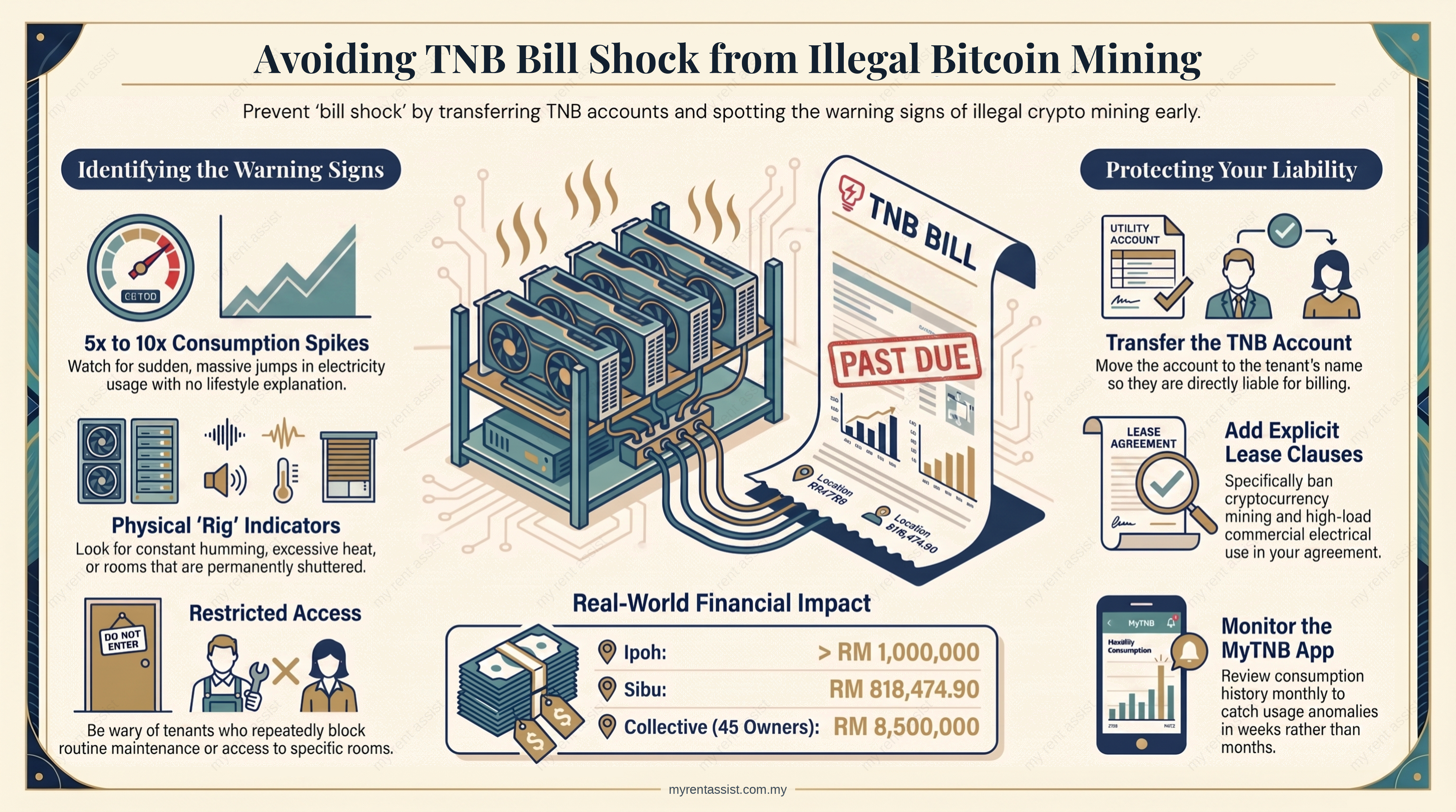
Imagine opening your TNB bill and seeing a number with six figures on it — for a single rented-out unit that usually costs you RM150 a month to run. That's exactly what happened to a landlord in Ipoh, who was slapped with an electricity bill running past RM1 million after her tenant secretly ran a Bitcoin mining operation out of the unit. She spent two years fighting it in court, and was still ordered to pay RM825,000. In Sibu, another landlord is facing a bill of RM818,474.90 for the same reason. Alamak.
These aren't isolated horror stories. Illegal crypto mining has become one of the fastest-growing sources of TNB bill shock for Malaysian landlords — precisely because a rental unit is the perfect place to hide a rig: the electricity account is usually still in your name, the tenant has no long-term stake in the property, and by the time anyone notices, months of consumption have already piled up. Here's how it happens, how to catch it early, and who actually ends up footing the bill.
Malaysia's Illegal Crypto Mining Problem, By the Numbers
This isn't a rare, one-off scam — it's a nationwide enforcement problem. TNB has confirmed losing more than US$1.1 billion (roughly RM5 billion) to illegal electricity use by crypto miners between 2020 and 2026, with over 13,800 premises caught siphoning power to run mining rigs, primarily for Bitcoin. In Melaka alone, TNB estimated RM30 million in losses from illegal mining operations.
Enforcement has picked up sharply through 2025 and 2026. In Kota Bharu, a trader was fined RM80,000 in January 2026 after pleading guilty to tapping illegally into the electricity supply to power a mining operation. In Johor, police raided 16 premises between January 2025 and June 2026, seizing 158 mining machines and uncovering losses of nearly RM1 million. Authorities are now using smart meters, AI-driven consumption analytics, and even drones with thermal cameras to spot mining operations from the pattern of heat and power they give off.
Rental units are a particularly attractive target for miners. A rig needs a steady electricity supply and a place nobody's watching closely — a tenanted unit with the TNB account still under the landlord's name ticks both boxes, and the miner can simply move on once the bill catches up.
Who Actually Pays — You or Your Tenant?
This is the part that catches most landlords off guard: if the TNB account is under your name, the bill is your problem first — regardless of what your tenancy agreement says about who's responsible for utilities. TNB bills whoever the account holder is, and it's on you to then chase your tenant for reimbursement, which is a much harder fight once they've disappeared with the rig.
The single biggest protective move available to you is simple: keep the TNB account in your tenant's name for the duration of the tenancy, not yours. That way, TNB's claim for unpaid or tampered electricity goes directly against the person who actually used it — not you. Several recent advisories to landlords have made exactly this point: don't pay for your tenant's bitcoin mining — transfer your TNB account into their name from day one.
Warning Signs Your Tenant Might Be Mining Crypto
Mining rigs are noisy, hot, and power-hungry — which means there are usually signs before the bill ever arrives, if you know what to look for.
- A sudden, unexplained spike in consumption. Not a gradual 20–30% rise from a new tenant using more appliances — a jump of 5 to 10 times the usual reading, with no lifestyle change to explain it.
- Constant humming or fan noise from one room. Mining rigs run 24/7 and need heavy cooling, which usually means multiple fans running non-stop.
- A room that's noticeably warmer than the rest of the unit, even with air-conditioning on, or curtains permanently drawn in one specific room.
- Extra wiring, extension cords, or unusual electrical modifications — miners sometimes tamper with the meter or wiring directly to bypass billing altogether.
- The tenant resists routine maintenance visits or is unusually protective about access to a specific room, especially a store room or spare bedroom.
Any one of these on its own isn't proof. But several together, especially alongside a bill that's suddenly multiples of what it used to be, is worth taking seriously.
What the Law Says — and What Happens to the Miner
Illegal electricity use for crypto mining is a criminal offence in Malaysia, prosecuted under the Electricity Supply Act 1990. Tampering with electrical installations or meters carries a fine of up to RM1 million, imprisonment of up to 10 years, or both. Illegal use of electricity more broadly can attract fines from RM20,000 to RM1 million, imprisonment of up to 5 years, or both. Offenders can also be charged under Sections 379 and 427 of the Penal Code, covering theft and mischief.
What To Do If You Suspect It
If you notice the warning signs above, resist the urge to confront your tenant directly or attempt to inspect the wiring yourself — this can be dangerous, and it can also compromise any enforcement action that follows.
-
1Check your consumption history first Review your last few TNB bills or the MyTNB app for a sudden, sustained jump. Rule out ordinary explanations — more occupants, a new air-conditioner — before assuming the worst.
-
2Report it to TNB directly TNB has dedicated enforcement teams for illegal electricity use and will investigate suspected tampering or abnormal consumption — this is safer and more effective than trying to confirm it yourself.
-
3Involve the police if a crime is suspected Illegal mining is a police matter, not just a billing dispute. A police report also creates a paper trail that supports your position if TNB later disputes your liability.
-
4Move to end the tenancy if it's confirmed Illegal activity on the premises is valid grounds for termination. See our eviction guide for the lawful process — you still can't just change the locks yourself.
How to Protect Yourself Before It Happens
Prevention is far cheaper than a court fight over a six-figure bill. A few practical steps make a real difference:
- Transfer the TNB account into your tenant's name at the start of every tenancy — this alone shifts direct billing liability away from you.
- Add an explicit clause banning cryptocurrency mining and any commercial or high-load electrical use in your tenancy agreement, with a clear breach-and-termination consequence attached.
- Review your electricity consumption periodically, not just when the bill lands — a pattern is easier to catch early than a single shocking number three months in.
- Do a reasonable, notice-given check-in visit for new tenants or units that have sat unattended for a while, particularly if a tenant seems unusually reluctant to have you enter.
Frequently Asked Questions
Quick Summary: Bill Spike vs What It Might Mean
| What you're seeing | Likely cause | What to do |
|---|---|---|
| Gradual 20–30% rise, matches new tenant / more devices | Normal lifestyle usage | No action needed — keep monitoring monthly |
| Sudden 5–10x spike with no lifestyle explanation | Possible illegal mining or meter tampering | Check MyTNB app history, report to TNB directly |
| Constant noise/heat from one room, tenant blocks access | Physical warning sign of a hidden rig | Document quietly, do not confront alone, report to TNB/police |
| TNB flags illegal connection or tampering on your account | Confirmed unauthorised use | Cooperate with investigation, keep all records, consider eviction |
What To Do Next?
The landlords in the cases above found out in month six, seven, sometimes later — by which point the bill was already six or seven figures and the tenant was long gone. The whole point of catching this early is that a mining rig's power draw shows up in your consumption data almost immediately, weeks before it ever becomes a court case. MyRentAssist's utility monitoring watches your TNB, Air Selangor, and IWK usage for exactly this kind of anomaly, so you find out in week two, not month six.
- Utility bill monitoring across TNB, Air Selangor, and IWK — flags unusual spikes early
- Bills tracked and paid on your behalf, so nothing sits quietly unnoticed under your name
- Full payment and consumption history for every unit, always on record
- Annual LHDN-ready summary — clean records if you ever need to prove what you knew and when
Try it free for 3 months, or WhatsApp us and we'll walk you through it — no pressure, no credit card.
This article is for general guidance only and does not constitute legal advice. Electricity theft and tampering are criminal offences with penalties that can change, and liability depends on the specific facts of your case. Consult a qualified lawyer, or contact TNB directly, if you suspect illegal electricity use on your property.