In this guide
- What Is a TNB Change of Tenancy (and Why It's Not Optional)
- Why Landlords Skip It — and What It Actually Costs Them
- Who's Liable If You Never Do a COT
- Documents You Need for a Change of Tenancy
- How to Do a TNB Change of Tenancy, Step by Step
- What Happens If Your Tenant Still Doesn't Pay After COT
- What About Water and IWK Accounts?
- FAQ
- Quick Summary: Are You Protected?
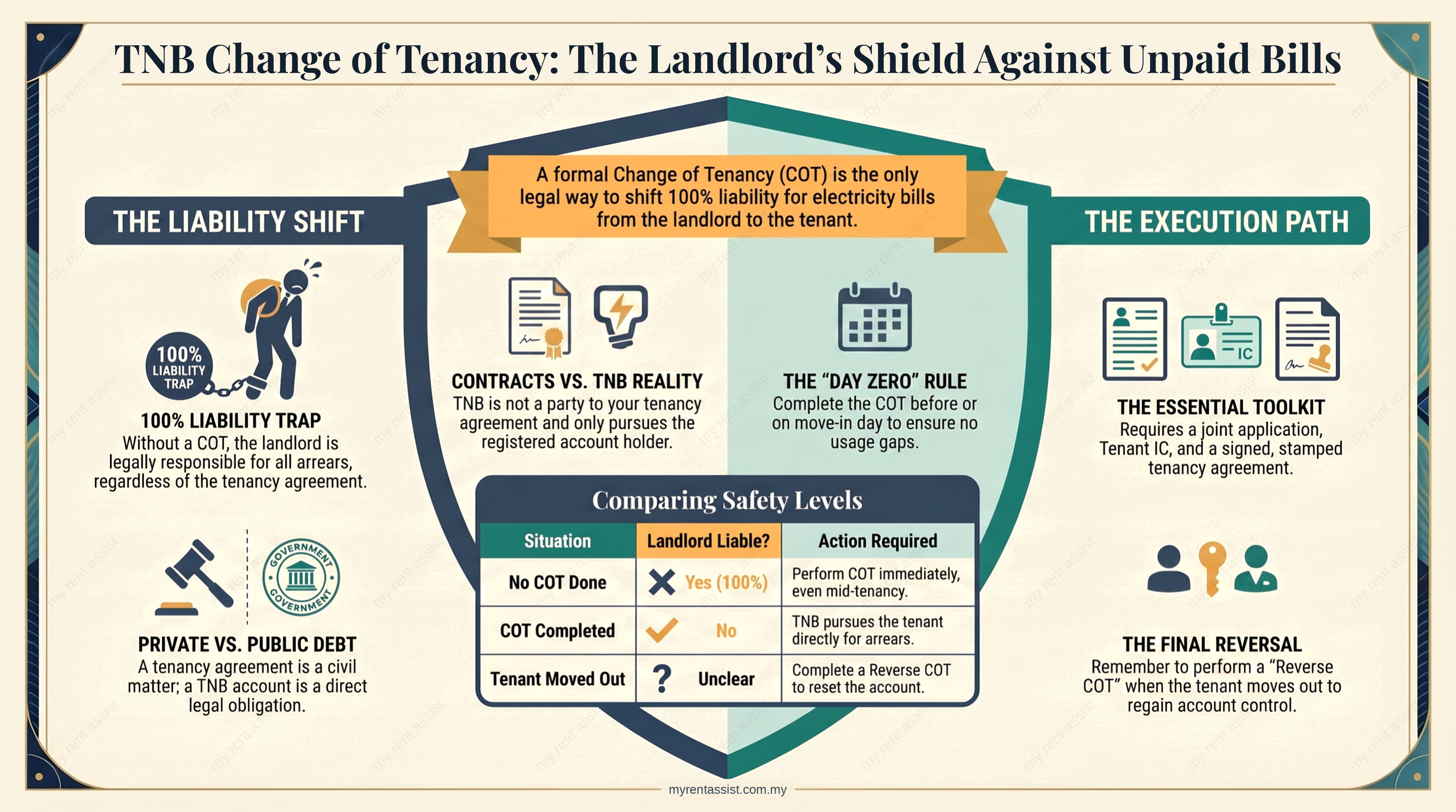
Handing over the keys feels like the finish line — deposit collected, agreement signed, tenant moved in. But there's one small government form that decides whether a runaway electricity bill six months from now becomes your tenant's problem or yours: the TNB Change of Tenancy, or COT. Skip it, and your tenancy agreement's electricity clause is worth nothing the moment TNB comes knocking, because TNB was never a party to that agreement in the first place.
Pendek kata, TNB doesn't read your tenancy agreement. TNB only looks at whose name is on the account. If that's still you, you're the one who pays — no matter what your contract says.
What Is a TNB Change of Tenancy (and Why It's Not Optional)
A Change of Tenancy is the formal process of transferring the electricity account at your rental unit from your name into your tenant's name for the duration of their stay — and then transferring it back to you (or to the next tenant) when they leave. It's a TNB administrative process, separate from your tenancy agreement, and it's the only thing that actually shifts TNB's billing relationship away from you.
Landlords often assume that because the tenancy agreement states "tenant is responsible for utility bills," that clause alone protects them. It doesn't — not with TNB. That clause is enforceable between you and your tenant in a civil dispute, but it means nothing to TNB, who will simply pursue whoever's name is registered on the account. If that's you, TNB comes after you, full stop.
Why Landlords Skip It — and What It Actually Costs Them
Nobody skips the COT on purpose. It usually happens one of a few ways:
- "The agreement already covers it." The landlord assumes the electricity clause in the tenancy agreement is enough protection on its own.
- "My last tenant was fine, so this one will be too." A good experience with a previous, low-usage tenant creates a false sense that it's not worth the hassle.
- "The tenant said they'd handle it." The tenant promises to do the COT themselves after moving in — and then never gets around to it, because there's no urgency on their end. It's still your account, not theirs.
- Genuine unfamiliarity with the process. Some landlords, especially first-timers, simply don't know COT exists as a distinct step from signing the agreement.
The cost of skipping it isn't hypothetical. A tenant running aircon around the clock, operating a home business, or — in more extreme but real cases — running unauthorised equipment, can quietly rack up an electricity bill far beyond what a normal household uses. If the account is in your name, that entire balance is yours to settle before TNB will reconnect supply for a new tenant, regardless of what your tenancy agreement says about who "should" have paid it.
Who's Liable If You Never Do a COT
This is the single fact that trips up most landlords. A tenancy agreement is a private contract between you and your tenant — it can absolutely say the tenant must pay all utilities, and you could sue them for reimbursement afterwards. But that's a separate civil claim, on top of the bill TNB has already collected from you or disconnected your unit over. A completed COT avoids that entire chain of events by making the tenant the account holder from day one, so TNB pursues them directly.
Documents You Need for a Change of Tenancy
The process is straightforward once you have the paperwork ready. Have these on hand before move-in day:
| Document | Who provides it | Notes |
|---|---|---|
| Completed TNB application form | Landlord & tenant, jointly | Available via the myTNB app, myTNB portal, or at a Kedai Tenaga |
| Tenant's IC copy | Tenant | Must be marked "Untuk Kegunaan TNB Sahaja" (for TNB use only) |
| Signed and stamped tenancy agreement | Landlord | TNB may reject an unstamped agreement — see our stamp duty guide if yours isn't stamped yet |
| Security deposit for the account | Tenant | Refundable when the tenancy ends and the account reverts |
| RM10 stamp duty + processing fee | Either party | Nominal cost to complete the transfer |
How to Do a TNB Change of Tenancy, Step by Step
-
1Gather the documents above before move-in day Chase this at the same time you're finalising the tenancy agreement, not after the tenant has already collected the keys.
-
2Submit via myTNB app, the TNB website, or a Kedai Tenaga Online submission is faster for most cases; a physical visit may be needed if the account has any existing arrears or irregularities.
-
3Pay the security deposit and processing fee The deposit amount depends on the tariff category and expected usage — TNB will confirm the exact figure during submission.
-
4Get confirmation and the new account details Keep a copy of the confirmation — this is your proof that the account changed hands on a specific date, useful if any dispute over usage timing ever comes up.
-
5Do a reverse COT when the tenant moves out The account needs to transfer back to your name (or straight to the next tenant) — don't assume this happens automatically when a tenant leaves.
What Happens If Your Tenant Still Doesn't Pay After COT
This is exactly the gap that catches landlords out even after doing everything "right." COT protects your personal liability, but it doesn't alert you the moment a bill starts climbing — you'd typically only find out when the tenant complains about a warning letter, or when you're trying to re-let the unit and discover an unresolved balance sitting on the account.
What About Water and IWK Accounts?
The same underlying principle — whoever's name is on the account is who the utility provider chases — applies to Air Selangor and other state water operators, though the transfer process and documentation differ slightly from TNB's. Sewerage charges under IWK follow their own quieter rules again, and are easy to lose track of since bills rarely draw attention the way a disconnection notice does. We'll cover both in a dedicated guide soon — for now, treat every utility account attached to your unit, not just TNB, with the same "change it before move-in" discipline.
Frequently Asked Questions
Quick Summary: Are You Protected?
| Your situation | Are you liable for tenant's unpaid bill? | What to do |
|---|---|---|
| COT completed before move-in | No | TNB pursues the tenant directly — you're covered |
| Account still in your name, no COT done | Yes — 100% | Do a COT immediately, even mid-tenancy, to stop further exposure |
| COT done, but you never monitor usage | No personal liability, but re-letting can be delayed | Keep an eye on consumption patterns so surprises don't surface at move-out |
| Tenant moved out, account not reverted | Unclear — creates confusion for the next tenancy | Complete the reverse COT before your next tenant moves in |
What To Do Next?
A completed Change of Tenancy stops you from being personally liable for a tenant's unpaid electricity — but it's a one-time form, not an ongoing safety net. The gap it leaves is exactly what MyRentAssist's utility monitoring is built to close: catching unusual usage or unpaid bills early, across every utility account tied to your unit, not just after something's already gone wrong.
- Utility bill monitoring across TNB, water, and IWK
- Pay-on-behalf for bills, deducted from tenant collection
- WhatsApp rent reminders sent every month, automatically
- Annual tax summary ready for your LHDN declaration
Try it free for 3 months, or WhatsApp us and we'll walk you through it — no pressure, no credit card.
This article is for general guidance only and does not constitute legal advice. TNB procedures, required documents, and fees can change — confirm current requirements with TNB directly (myTNB app, website, or your nearest Kedai Tenaga) before relying on any step described here.