In this guide
Why "SST on Rental" Is Suddenly Everywhere
If you've seen a headline somewhere along the lines of "rental services now subject to service tax" and felt your stomach drop a little, you're not alone. The Royal Malaysian Customs Department (RMCD) released an updated Rental & Leasing Services Guide in May 2026, and the coverage that followed made it sound like every landlord in the country suddenly owes SST on top of their rent.
Ringkasnya — for the vast majority of landlords reading this, that headline doesn't apply to you. Service tax on rental was built for commercial leasing — office space, shop lots, warehouses — not for the apartment or terrace house you're renting out to a family to live in. But the rules do apply to some landlords, and the line between "exempt" and "taxable" isn't always obvious, especially if you also recharge tenants for utilities or hold a SOHO-titled unit. This guide walks through exactly where that line sits.
What Actually Changed: A Quick Timeline
Service tax on rental and leasing services isn't brand new — it's been building since mid-2025 as part of the broader expansion of Malaysia's Sales and Service Tax (SST 2.0). Here's the sequence that got us to where we are now:
| Date | What happened |
|---|---|
| 1 July 2025 | Rental and leasing services entered the scope of Service Tax for the first time, at 8%, under a new "Group K" category. |
| 1 January 2026 | Rate reduced to 6%, later formalised via the Service Tax (Rate of Tax) (Amendment) Order 2026, gazetted 13 March 2026. |
| 14 May 2026 | RMCD released the Rental & Leasing Services Guide (2nd Edition), replacing the 1st Edition and clarifying exactly what counts as "housing accommodation" — the source of most of the confusion. |
That last update is the one responsible for the fresh round of anxious WhatsApp forwards. In reality, the 2nd Edition mostly did landlords a favour — it spelled out, in plain terms, which types of rental are exempt.
The Big Question: Is Your Rental Exempt?
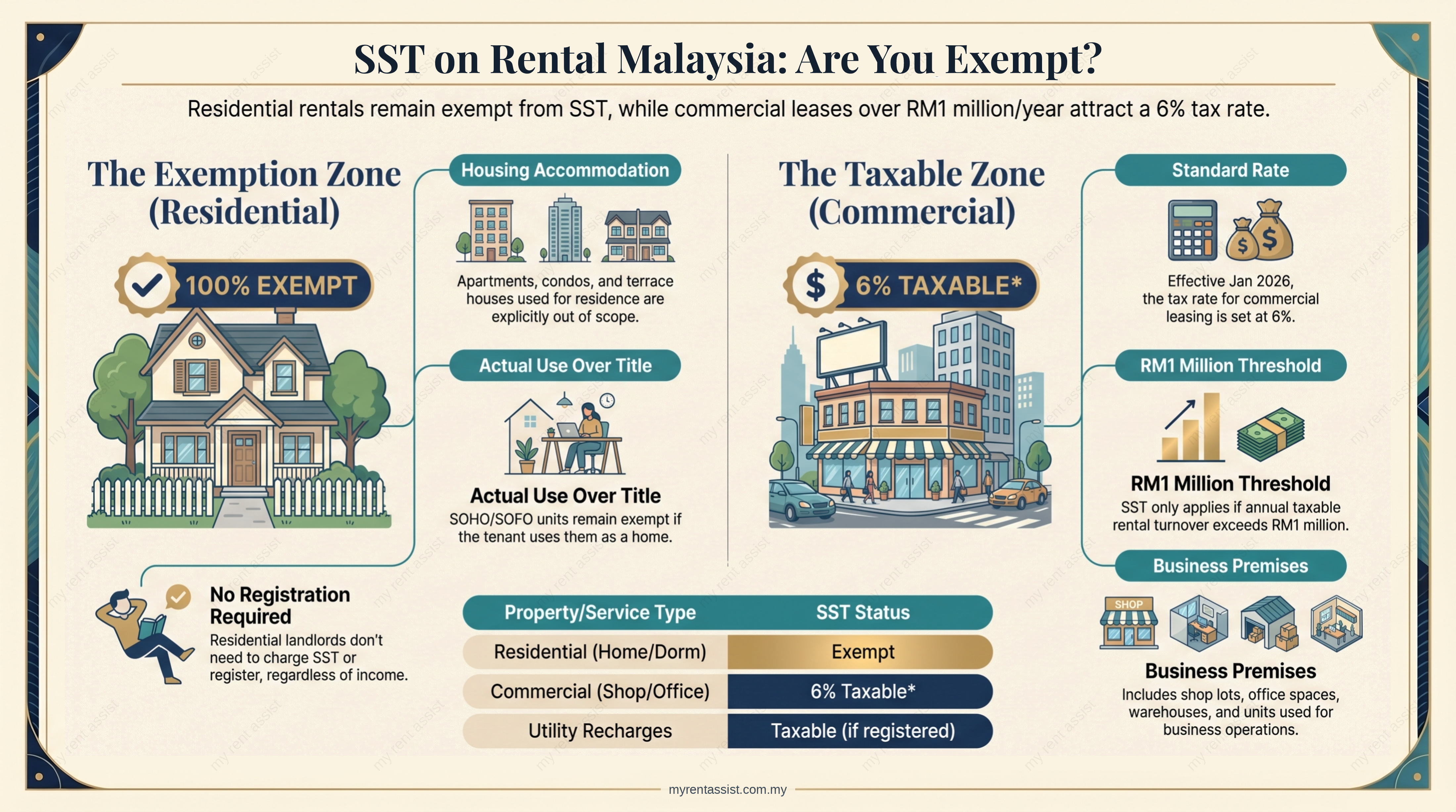
Here's the part that matters most: rental of residential property for someone to live in is exempt from Service Tax. This isn't a grey area or a loophole — it's explicitly out of scope under the updated Guide.
This covers the overwhelming majority of MyRentAssist's landlords — people with one to five residential units, renting to families, working professionals, or students. The service tax expansion was never really aimed at you; it targets commercial leasing, which is a different animal entirely.
| Exempt (no SST) | Taxable (SST may apply) |
|---|---|
| Apartment, condo, or house rented out for someone to live in | Office space, shop lots, retail units |
| Serviced suite used as a residence | Same serviced suite used as a registered office (SOFO) |
| SOHO unit used residentially | SOHO/SOFO unit used for business operations |
| Worker dormitories, affordable housing (Rumah Mampu Milik) | Warehouses, factories, industrial space |
When Renting Out Property Actually Becomes Taxable
There is a smaller group of landlords who do need to pay attention. Service Tax on rental applies when two conditions are both true: the property is being used for a commercial purpose (not housing), and the landlord's taxable rental turnover crosses RM1 million in any 12-month period.
Where this actually bites
- Commercial units. If you own a shop lot, office suite, or retail space and lease it out, that income counts toward the RM1 million registration threshold — separate from any residential rent you collect.
- SOFO units used as offices. The Guide draws a clear line here: a SOHO/SOFO-titled unit is exempt when the tenant lives in it, but becomes taxable the moment it's used as office or administrative space. Same four walls, different tax outcome, purely based on how the tenant actually uses it.
- Landlords who also run a leasing business at scale. If you're managing a portfolio big enough that your commercial rental turnover alone exceeds RM1 million a year, you'd need to register for Service Tax on that portion.
The Utility Recharge Trap
This is the one nuance worth flagging even for otherwise-exempt residential landlords, because it trips people up. The updated Guide states that where a landlord who is registered for Service Tax recovers or recharges utility bills — TNB, water, and so on — from a tenant, the full amount recovered is treated as part of the taxable rental service. This applies even if the landlord charges the tenant exactly what the utility bill cost, with zero mark-up.
Only Service Tax-registered landlords
If your residential rental is exempt (which covers most landlords), this rule doesn't switch on for you — there's no Service Tax to apply to the utility recharge in the first place.
Commercial landlords passing on bills
If you're already registered because of commercial rental income and you recharge tenants for utilities on those units, that recharge counts toward your taxable turnover — even at cost.
Good news for residential landlords using a platform like MyRentAssist to monitor and pay TNB or water bills on the tenant's behalf: this is a pass-through arrangement on an exempt residential rental, not a commercial leasing setup, so it sits outside this particular trap. If you're unsure which side of the line your specific arrangement falls on, that's exactly the kind of question worth a five-minute call with a tax agent rather than a guess.
Others Managing Your Property?
If your tenant is an individual living in the unit, there's genuinely nothing to do here — you already know your own setup, and none of it changes. The one blind spot worth checking is when you don't rent directly to the person who ends up living there.
Renting to a property management company or co-living operator?
This is a common setup — you sign the lease with a company, and they place staff, guests, or subtenants into the unit. The exemption follows how the property is actually used, not who signed the lease. If that company is putting people into your unit to live there — staff housing, co-living, corporate housing — it's still housing accommodation, and still exempt, even though your direct tenant on paper is a Sdn Bhd rather than a person.
Frequently Asked Questions
Quick Summary: Are You Affected?
If you just want the short answer for your specific situation, here it is in one table.
| Your situation | Does SST apply? |
|---|---|
| Renting a house, apartment, condo, or terrace to a tenant to live in | No — exempt (housing accommodation) |
| SOHO unit used residentially by your tenant | No — exempt |
| Serviced suite used as a residence | No — exempt |
| Worker dormitories / affordable housing (Rumah Mampu Milik) | No — exempt |
| Recharging a tenant for TNB/water bills on an exempt residential unit | No — the exemption covers the whole arrangement |
| Master-leasing to a property management company or co-living operator that houses people in the unit | No — exempt, since the unit is still used as housing |
| That same operator instead runs the unit as a serviced office or commercial premises | Possibly — the housing exemption may not apply |
| SOFO unit used as an office, or any unit used for business premises | Possibly — taxable if turnover exceeds RM1 million/year |
| Shop lot, office space, or warehouse leased commercially | Possibly — 6% SST if turnover exceeds RM1 million/year |
| Recharging utilities on a unit you're already SST-registered for | Yes — folded into the taxable rental service, even at cost |
| Commercial rental turnover under the RM1.5 million MSME threshold | No — exempt under the MSME mechanism |
What To Do Next?
Now that SST is sorted, the next thing most landlords end up chasing is the monthly admin — rent reminders, utility bills, receipts, and keeping records straight for LHDN. That's what MyRentAssist handles automatically, so none of it sits on your plate.
- Automated WhatsApp rent reminders
- Full payment history & receipts for every unit
- TNB, water & IWK bills monitored for you
- Annual LHDN-ready rental summary
Try it free for 3 months, or WhatsApp us and we'll walk you through it — no pressure, no credit card.
This article is for general guidance only and does not constitute legal or tax advice. Service Tax rules for rental and leasing services are still being refined by the Royal Malaysian Customs Department through 2026. Consult a qualified tax agent or RMCD directly before making decisions based on this information.