In this guide
- Two Court Cases That Decided This For Every Landlord
- Is Short-Term Rental Actually Legal in Malaysia's Strata Buildings?
- Can Your JMB or MC Ban Short-Term Rental?
- What's Changing in 2026: Selangor's Cap & the National Guidelines
- Short-Term Rental vs Long-Term Tenancy: Which Actually Makes Sense Now?
- Before You List: A Landlord's Compliance Checklist
- What Happens If You Get It Wrong
- FAQ
Two Court Cases That Decided This For Every Landlord
If you've ever listed a unit on Airbnb, Agoda Homes, or Booking.com while living in a condo or serviced apartment, you've probably wondered — technically, am I even allowed to do this? For years the answer was "depends who you ask." In 2026, it's a lot clearer, thanks to two court decisions that landlords in stratified buildings really need to know.
Innab Salil & Ors v Verve Suites Mont' Kiara MC
Malaysia's apex court confirmed that a management corporation can lawfully ban short-term rental building-wide — provided the ban is passed as a proper special resolution by the owners, not just imposed by the management committee.
Wawasan Raya Sdn Bhd v MARC Service Residence MC
The Court of Appeal clarified that short-term guest stays are a "licence," not a "lease" — and that short-term rental is not automatically illegal under the Strata Management Act. But it also confirmed the flip side: MCs and JMBs do have the legal power to restrict it.
Put together, these two rulings give you the clearest picture yet: short-term rental is not banned by national law, tapi your own building can still lawfully shut it down — if the owners vote for it the right way. Everything below explains exactly what that means for you in practice.
Is Short-Term Rental Actually Legal in Malaysia's Strata Buildings?
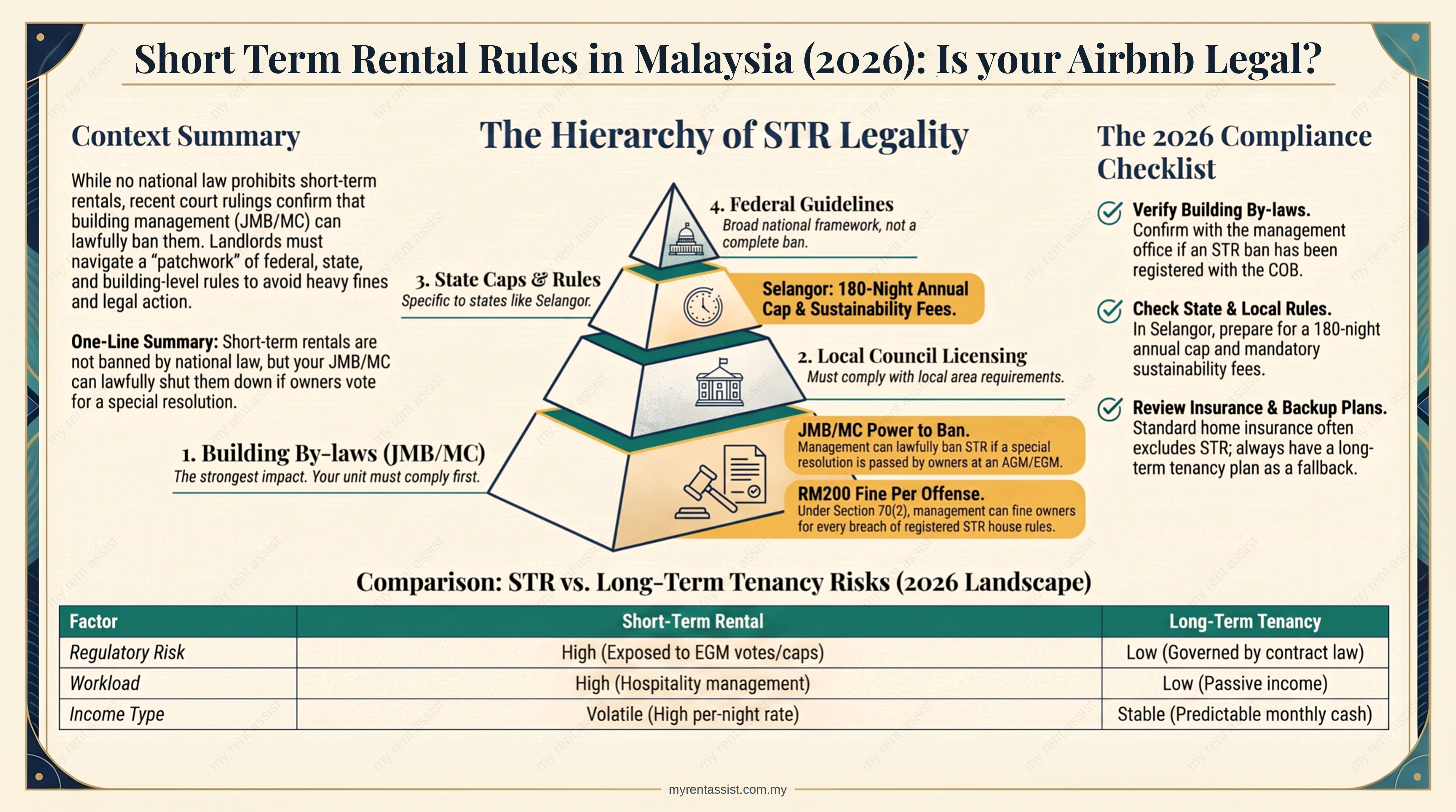
Here's the honest, unsatisfying-but-true answer: there's no single national law that says yes or no. Malaysia doesn't yet have a nationwide short-term rental law. Neither the Strata Management Act 2013 nor the Strata Management Regulations 2015 explicitly prohibits it — the Court of Appeal confirmed this directly in the Wawasan Raya decision.
What exists instead is a patchwork of rules layered on top of each other:
- Federal level — no dedicated short-term rental law yet, though national guidelines are being finalised (more on this below)
- State level — some states, like Selangor, are drafting their own operating caps and fees
- Local council level — business licensing requirements vary by council, and enforcement differs significantly from one area to another
- Building level — your own JMB or MC's house rules and by-laws, which can be stricter than anything above
This means the legality of your short-term rental unit isn't really one question — it's four separate questions stacked on top of each other, and your building's own rules are usually the one that bites first.
Can Your JMB or MC Ban Short-Term Rental?
Yes — but not however they like. This is the part most landlords get wrong.
A JMB or MC cannot simply send a WhatsApp announcement or put up a notice board memo saying "no more Airbnb" and expect it to be enforceable. To lawfully restrict or ban short-term rental, the building must pass a special resolution — a formal vote by the owners, typically at an Annual General Meeting or Extraordinary General Meeting, that then gets filed with the Commissioner of Buildings (COB) to become an official by-law.
This is exactly what happened at Verve Suites Mont' Kiara — the owners voted, the resolution passed, and the Federal Court upheld it as lawful. Once a by-law like this is properly registered, it applies to every owner in the building, including ones who voted against it or bought their unit after the vote.
The practical takeaway: before you list a unit, don't just check what the tenancy agreement or sales and purchase agreement says — call your building's management office and ask directly whether a short-term rental by-law has been passed, and ask to see it in writing. "Nobody's complained yet" is not the same as "it's allowed."
What's Changing in 2026: Selangor's Cap & the National Guidelines
On top of building-level rules, two bigger regulatory changes are moving through the system right now — and neither has fully landed yet.
Selangor's proposed 180-night annual cap
In late 2025, Selangor's state government announced plans to limit short-term rental operations — Airbnb and similar platforms — to a maximum of 180 nights per year per unit, starting from 2026. Operators who want to exceed that limit would need to apply for special planning permission from the local authority. Selangor also introduced a statewide sustainability fee on paid accommodation, including short-term rental units, from 1 January 2026.
As of writing, this cap is still described as a proposal awaiting final confirmation — the state government has indicated the final decision will follow the release of the national guidelines below. If you're operating in Selangor, treat the 180-night figure as the number to plan around, but don't assume it's locked in stone yet.
The national Short-Term Residential Accommodation (STRA) guidelines
At the federal level, the Ministry of Housing and Local Government (KPKT), working with PLANMalaysia, has been preparing national guidelines meant to bring consistency to short-term rental rules across the country. The proposed framework covers which types of residential premises can be used for short-term rental, registration and business licensing requirements through local authorities, safety standards, permitted duration of stay, and enforcement mechanisms.
Short-Term Rental vs Long-Term Tenancy: Which Actually Makes Sense Now?
With all of this regulatory movement, it's worth stepping back and asking honestly: is short-term rental still worth the hassle compared to a normal long-term tenancy? There's no universal answer, tapi here's how the trade-offs actually stack up in 2026.
| Factor | Short-Term Rental | Long-Term Tenancy |
|---|---|---|
| Income potential | Higher per-night rate, but occupancy swings with demand and season | Lower per-night equivalent, but stable and predictable monthly income |
| Regulatory risk | Exposed to building by-laws, state caps, licensing rules — all still shifting | Governed by long-standing contract law and tenancy agreement terms |
| Workload | Guest turnover, cleaning, check-in coordination — effectively a small hospitality business | Monthly collection and occasional maintenance — far more passive |
| Eviction risk from your own building | A single EGM vote can end your income stream with little notice | Not applicable — you're not operating a business the JMB can vote against |
| Best suited for | Landlords in buildings with no ban, tourist-heavy locations, and appetite for hands-on management | Landlords who want passive income and predictable cash flow |
If your building already has a registered by-law against short-term rental, or sits in a state tightening the rules, the decision is largely made for you. If it doesn't — the honest question to ask yourself is whether the extra yield is worth being one EGM vote away from losing the income entirely.
Before You List: A Landlord's Compliance Checklist
Pendek kata — here's the practical sequence to run through before you put a unit up on any short-term rental platform.
-
1Check your building's by-laws with the management office Ask directly whether a special resolution restricting or banning short-term rental has been passed and registered with the Commissioner of Buildings. Get it in writing.
-
2Check your local council's licensing requirements Requirements and fees differ by local authority. Some already require a business licence for short-term rental operators — don't assume your area is exempt.
-
3Check your state's operating rules If you're in Selangor, plan around the proposed 180-night cap and the sustainability fee. Other states may introduce similar rules — check for local announcements.
-
4Review your insurance Standard home or landlord insurance policies often exclude commercial or short-term guest use. Confirm with your insurer that short-term rental activity is covered.
-
5Have a long-term rental plan as a backup Given how quickly building-level votes or state rules can change, it's worth knowing what your unit would rent for as a normal long-term tenancy — just in case you need to pivot fast.
What Happens If You Get It Wrong
Ignoring a validly passed short-term rental ban doesn't just risk an awkward conversation with your JMB — it has real financial and legal consequences.
On top of the legal risk, there's a quieter cost: reputational friction with your neighbours and your MC. Landlords who keep operating after a ban tend to become the subject of every AGM complaint session going forward — not a position you want to be in if you own multiple units in the same building.
Frequently Asked Questions
If Short-Term Feels Like Too Much Regulatory Roulette, Long-Term Just Got More Attractive
No EGM votes that can end your income overnight, no guest turnover, no chasing licences across three levels of government. Just a tenant who pays monthly — and MyRentAssist handling the reminders, collection, and receipts automatically, so the income actually stays passive.
- WhatsApp rent reminders sent automatically
- Utility bills monitored and paid on your behalf
- Official receipts sent to your tenant automatically
- Nett rent transferred straight to your bank account
- Annual tax summary ready for LHDN
This article is for general guidance only and does not constitute legal advice. Short-term rental rules vary by building, local authority, and state, and are actively changing in 2026. Consult your JMB/MC, local council, and a qualified lawyer before making decisions based on this information.