In this guide
- Why So Many Landlords Skip the Paperwork
- Is a Verbal Tenancy Agreement Even Legal in Malaysia?
- What You're Actually Risking Without a Written Agreement
- The Stamp Duty Trap Most Landlords Don't Know About
- What a Proper Tenancy Agreement Must Actually Cover
- Renting Through an Agent or a Company? Same Rules Apply
- FAQ
- Quick Summary: With Agreement vs Without
Why So Many Landlords Skip the Paperwork
It usually starts innocently enough. The tenant is a friend of a friend, or a colleague's cousin, or someone who seemed genuinely nice at the viewing. "Ah, no need lah, we trust each other" — a deposit changes hands, a move-in date is agreed over WhatsApp, and that's it. No stamp duty, no lawyer, no proper document. It feels efficient. It saves a few hundred ringgit. And for the first few months, it usually works out fine.
The problem only shows up when something goes wrong — a late payment, a disputed deposit deduction, a tenant who won't move out, or a landlord who wants to raise the rent and gets pushback. At that point, "we trust each other" isn't a legal position. It's just a memory, and memories don't hold up well when two people remember the same conversation differently.
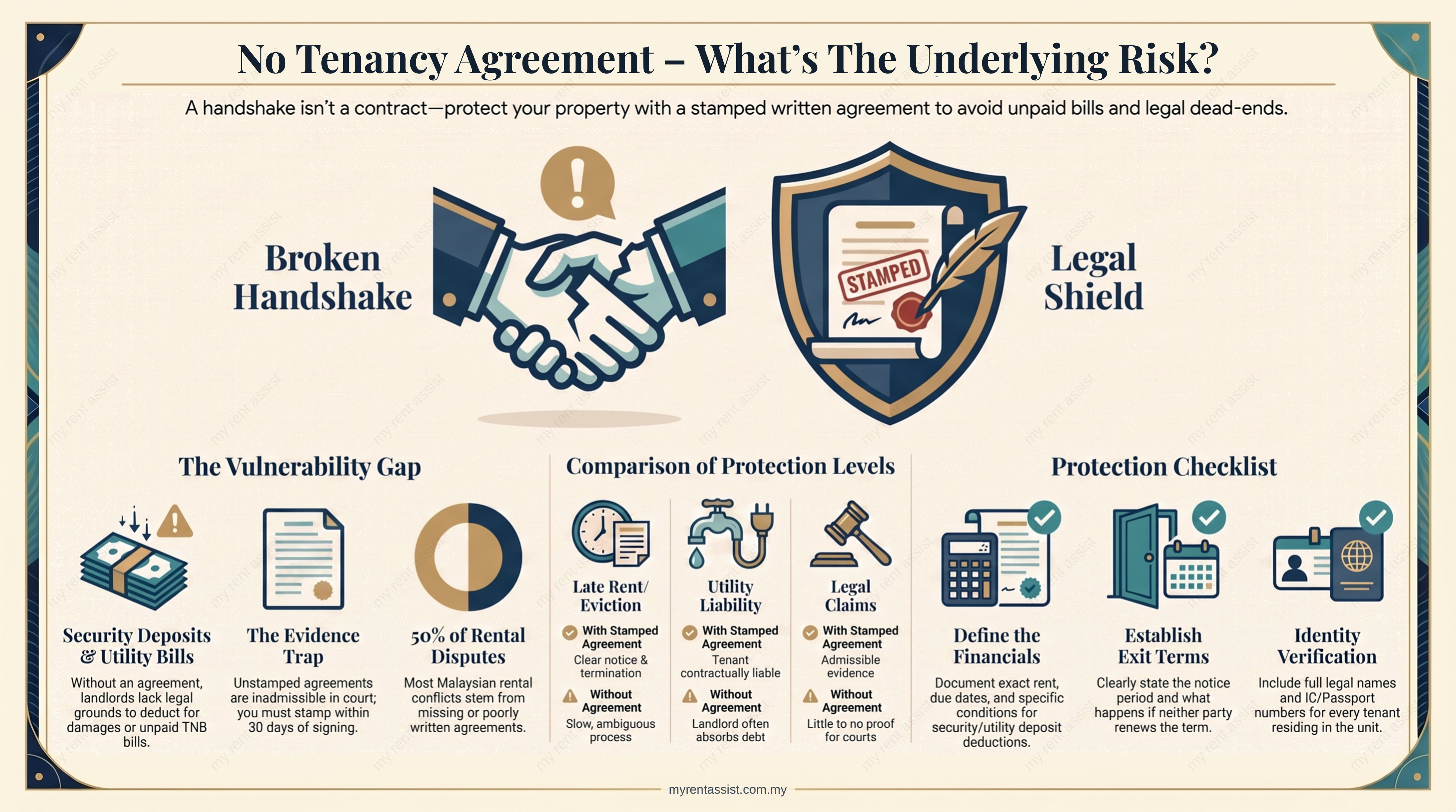
This isn't a small or rare problem. A large share of rental disputes in Malaysia — most estimates put it at well over half — trace back to poorly written, incomplete, or completely missing tenancy agreements. And with the Residential Tenancy Act still sitting in draft form as of mid-2026, not yet tabled or passed in Parliament, there's currently no statutory safety net standing behind you. The agreement you sign (or don't sign) is, in practice, the only thing governing your relationship with your tenant.
Is a Verbal Tenancy Agreement Even Legal in Malaysia?
Yes — technically. Under the Contracts Act 1950, a tenancy formed through a verbal offer, acceptance, and an exchange of rent for occupation is a valid contract. Malaysian law doesn't require every contract to be in writing to exist.
But legality was never really the issue. The issue is proof. If your tenant disputes the rental amount, the notice period, who's responsible for a repair, or what the deposit was meant to cover, a verbal agreement gives the Tenancy Tribunal or the civil courts nothing solid to work with beyond two conflicting accounts of what was said. Whoever tells the more convincing story — not necessarily whoever is right — tends to have the advantage.
What You're Actually Risking Without a Written Agreement
Ringkasnya, an unwritten tenancy shifts almost every point of friction in your favour on paper — and against you in reality. Here's where it actually bites.
Deposit disputes
Without a written figure and clear deduction terms, a tenant can reasonably argue they're owed the full deposit back, and you have nothing documented to justify a deduction for damage, unpaid utilities, or cleaning. This is already the single most common tenancy dispute in Malaysia — going in without an agreement makes it far harder to win. (Full breakdown of what's actually deductible in our security deposit rules guide.)
Eviction and notice period confusion
No agreement means no agreed notice period, which means you're left relying on general contract principles that usually default to a reasonable notice period rather than anything fast. Landlords who try to skip this — changing the locks, cutting the water, physically blocking a tenant from re-entering — aren't speeding things up; self-help eviction is illegal in Malaysia and can expose the landlord to police reports and civil claims, turning a slow problem into a much bigger one.
Utility bill liability
If there's no clause saying the tenant must transfer the TNB or water account, or reimburse you for usage, the account very often just sits under your name indefinitely — and you're on the hook if the tenant disappears owing money on it.
Rent increases and renewals
No agreed renewal terms means every year becomes a fresh negotiation with no reference point, which is exactly the kind of situation that turns a good tenant relationship sour.
Getting help from the Tribunal or courts
Malaysia's Tribunal for Homes and the civil courts both work off documentary evidence. Turning up with no agreement — or an unstamped one — puts you at a real disadvantage before your case is even heard.
The Stamp Duty Trap Most Landlords Don't Know About
Here's the part that surprises a lot of landlords: many assume "no formal agreement means no stamp duty to worry about." It's actually the opposite risk. The moment you put anything in writing and both parties sign it — even a simple one-page memo, not a lawyer-drafted document — it legally needs to be stamped within 30 days under the Stamp Act 1949, now processed through the e-Duti Setem portal.
What a Proper Tenancy Agreement Must Actually Cover
You don't need an expensive lawyer-drafted contract for a straightforward residential let, but you do need these specifics captured in writing and signed by both parties before anyone moves in.
- Full legal names and IC/passport numbers of the landlord and every tenant on the agreement — not just one representative if it's a shared unit.
- Rental amount, due date, and payment method — spelled out precisely, not "around RM1,800."
- Security deposit and utility deposit amounts, plus the specific conditions under which either can be deducted.
- Tenancy period and renewal terms — start date, end date, and what happens automatically if neither party gives notice.
- Termination and notice clauses — how much notice either side must give, and under what conditions early termination is allowed.
- Utility bill responsibility — who transfers the TNB, water, and IWK accounts, and by when.
- House rules and subletting terms — pets, renovations, number of occupants, whether subletting is allowed at all.
- Notice-to-enter clause — how much notice you must give before entering the unit for inspection or repairs.
- Signatures of both parties, ideally witnessed, then stamped within 30 days.
Renting Through an Agent or a Company? Same Rules Apply
If a real estate agent hands you a "standard template" to sign, that template still needs to be filled in properly with your actual tenant's details, your actual rental terms, and it still needs to be stamped — an agent providing the form doesn't make any of that optional.
The edge case worth flagging: if you're renting to a property management company or a co-living operator that then places staff, guests, or subtenants into your unit, your direct tenant on paper is a company, not a person. That still requires a proper tenancy agreement between you and that company — email confirmations or a purchase order aren't enough, and the deposit, notice, and liability terms need to be just as specific as they would be with an individual tenant.
Frequently Asked Questions
Quick Summary: With Agreement vs Without
| Situation | With a proper stamped agreement | Without one |
|---|---|---|
| Deposit dispute | Protected — documented amount and deduction terms | Weak position — tenant can claim full refund |
| Late rent or eviction | Protected — clear notice and termination clause | Slow, ambiguous — no agreed notice period |
| Unpaid utility bills | Protected — tenant contractually liable | Landlord often absorbs the bill |
| Tenancy Tribunal or court claim | Admissible evidence, once stamped | Little or no documentary proof to rely on |
| Rent increase or renewal | Protected — pre-agreed terms | Fresh, often awkward negotiation each year |
| Renting to a company or operator | Protected — corporate tenancy agreement in place | Email confirmations rarely hold up as proof |
What To Do Next?
Getting the agreement right is step one — keeping the monthly reality of that agreement enforced is step two, and that's the part that quietly slips even for landlords who did everything correctly on paper. MyRentAssist automates the parts that usually erode over time: reminders, records, and receipts.
- Automated WhatsApp rent reminders
- Full payment history & receipts for every unit
- TNB, water & IWK bills monitored for you
- Annual LHDN-ready rental summary
Try it free for 3 months, or WhatsApp us and we'll walk you through it — no pressure, no credit card.
This article is for general guidance only and does not constitute legal advice. Tenancy law in Malaysia is still evolving, including the still-unpassed Residential Tenancy Act. Consult a qualified lawyer for advice specific to your situation before making decisions based on this information.