In this guide
- Why IWK Is Different From TNB and Water
- Who's Legally on the Hook: The Account Holder Rule
- The 2026 Rate Hike — What You're Actually Paying
- How to Make Sure Your Tenant Actually Covers It
- What Happens If the Bill Gets Ignored
- Buying or Selling? Watch for Old IWK Arrears
- FAQ
- Quick Summary: IWK Responsibility at a Glance
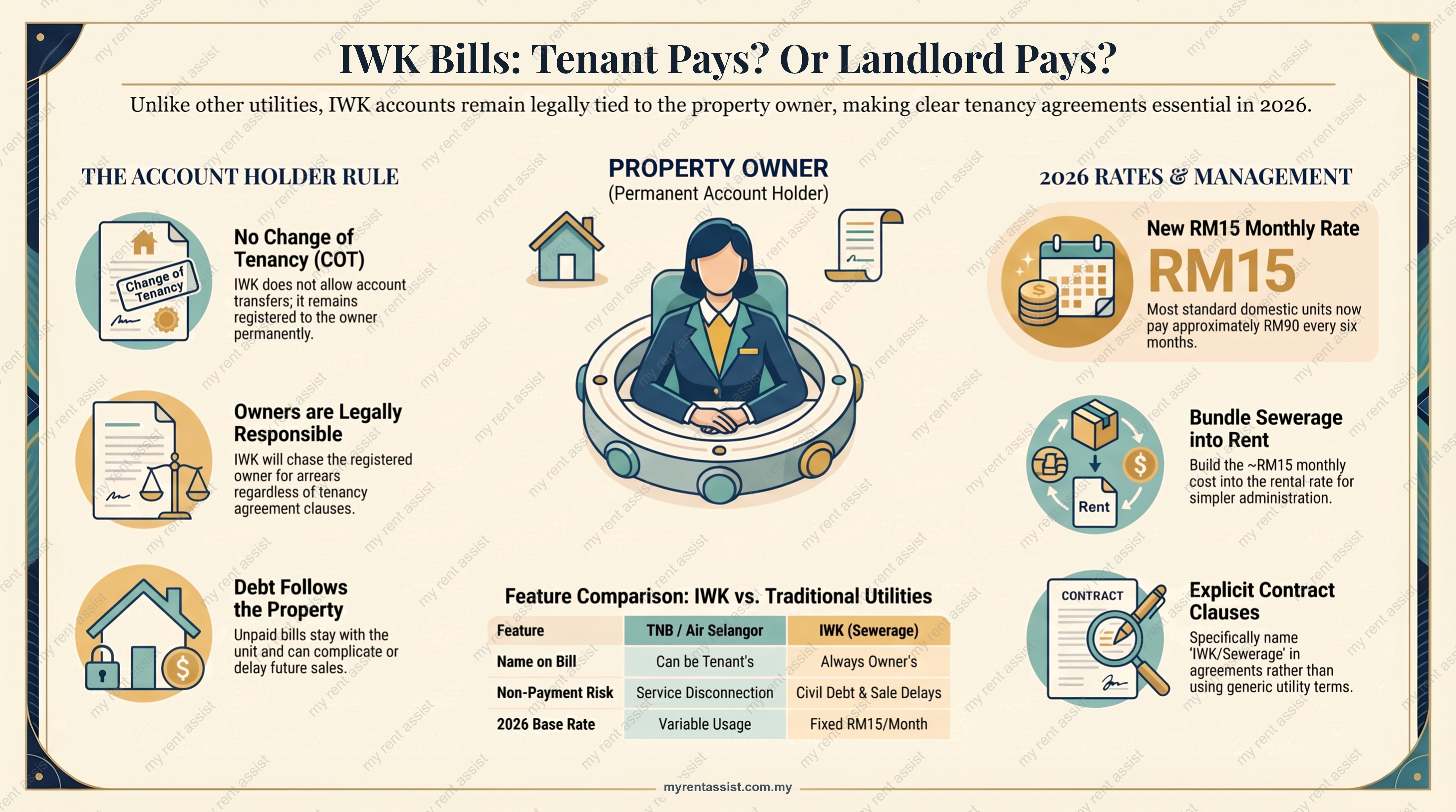
Most landlords only think about three bills: rent, TNB, and maybe water. Then an IWK notice turns up addressed to you — not your tenant — months after it was due, and suddenly you're staring at a sewerage bill for a unit you haven't set foot in since the tenancy started. It feels like it should be a tiny, forgettable line item. It isn't, and the reason is structural, not a mistake anyone made.
Ringkasnya, IWK works completely differently from every other utility your tenant touches. TNB and Air Selangor both let you shift the account into a tenant's name through a proper Change of Tenancy process. IWK doesn't offer that option at all — the account is tied to the property and its registered owner, full stop. Here's exactly what that means for you, what it costs in 2026, and how to stop it becoming a silent arrears problem.
Why IWK Is Different From TNB and Water
Indah Water Konsortium (IWK) is the national sewerage services operator for Peninsular Malaysia and Labuan, responsible for maintaining the sewer network and treatment plants that every connected property pays into. When landlords hear "utility bill," they usually picture TNB or Air Selangor — both of which have a well-known Change of Tenancy (COT) process that formally transfers billing responsibility into the tenant's name for the duration of the rental.
IWK has no equivalent process. There is no COT form, no portal option, no way to have the sewerage account legally billed to your tenant instead of you. The account stays registered to the property owner from the day it's opened until the property is sold — tenancy changes simply don't touch it.
Who's Legally on the Hook: The Account Holder Rule
Because the account can't move, the registered owner is always the one IWK will chase for payment — regardless of who's actually living in the unit, and regardless of what your tenancy agreement says about who "should" pay it. Your tenancy agreement can absolutely require your tenant to cover the cost, but that clause only creates an obligation between you and your tenant. It has zero effect on who IWK sends the bill to and who IWK can take action against if it isn't paid.
This distinction trips up a lot of landlords, especially ones managing more than one unit. Some tenants are genuinely happy to pay IWK directly on the landlord's behalf once they know the account details — a few landlords on property forums mention tenants logging into the IWK portal and settling it themselves each cycle. That's fine as a practical arrangement, but it doesn't change who's legally responsible. If that tenant moves out and stops paying, or simply forgets for a few cycles, the arrears still land on you.
Where the bill actually goes
IWK sends bills to whatever address or email is on file for the account — which, for most landlords, is either the property address itself (where your tenant might not think to forward it) or an old email/mailing address you registered years ago and haven't checked since. This is usually the real reason bills go unnoticed, not carelessness.
The 2026 Rate Hike — What You're Actually Paying
IWK's domestic sewerage tariff has been rising in stages since 2022 as part of a broader tariff restructuring. From 1 January 2026, the standard domestic rate reached its final phase at RM15 per month for most residential properties — up from RM10 previously — meaning a typical six-month bill now runs around RM90 rather than RM60.
| Property category | Monthly rate (2026) | Typical 6-month bill |
|---|---|---|
| Standard domestic (most rented units) | RM15 | ~RM90 |
| Low-cost housing (annual value under RM600) | RM4 | ~RM24 |
| Village / new village / estate housing | RM5 | ~RM30 |
RM15 a month sounds trivial next to a TNB bill that can run into the hundreds. That's exactly why it's the one landlords stop paying attention to — and why arrears on a "small" IWK account can quietly stack up over several cycles, across several units, before anyone notices.
How to Make Sure Your Tenant Actually Covers It
Since you can't legally hand the account over, the only real options are to absorb IWK into the rent you already charge, or to build a clear reimbursement clause into the tenancy agreement. Leaving it unaddressed is the most common cause of disputes — your tenant assumes it's included in rent, you assume they're paying it separately, and nobody actually is.
-
1Decide upfront: bundled into rent, or billed separately Bundling is simpler to administer since there's nothing to chase — just build the ~RM15/month into your rental rate. Billing separately requires you to actually forward the bill and collect it each cycle.
-
2Write the decision into the tenancy agreement explicitly Don't rely on a generic "tenant pays all utilities" line — name IWK/sewerage specifically, since it's easy to assume it's covered under "utilities" and just as easy to assume it isn't.
-
3Update your IWK account's contact details to something you check often If bills are going to an old email or an address you rarely visit, you won't catch a missed payment until the arrears letter arrives — by which point several cycles may already be owing.
-
4Check the account periodically, not just when a letter shows up A quick login to the IWK customer portal every few months confirms the account is current, whether or not you've delegated payment to your tenant.
What Happens If the Bill Gets Ignored
IWK doesn't control your water supply, so unlike an unpaid TNB bill, it can't cut off your electricity or water over a missed sewerage payment. That doesn't mean it's harmless to ignore. Unpaid charges can be pursued as a civil debt against the registered account holder, with IWK's own account statement typically standing as evidence of the amount owed. On top of that, unresolved arrears follow the property — not the tenancy — which becomes a real problem the moment you try to sell.
Buying or Selling? Watch for Old IWK Arrears
Because the IWK account is tied to the property rather than a specific ownership period, it doesn't automatically close or reset when a property is sold. Old arrears — sometimes going back to a previous owner or an earlier tenancy — can surface during or after a sale, which is why property lawyers typically request an up-to-date IWK statement as part of the standard pre-completion checks, alongside assessment tax and quit rent.
If you're selling, request an itemised statement from IWK before completing the transaction so you can confirm exactly which billing cycles are outstanding. If a demand covers a period before you owned the property, or one you're confident was already settled, that's a legitimate point to dispute with IWK directly rather than simply paying to make it go away.
Frequently Asked Questions
Quick Summary: IWK Responsibility at a Glance
| Your situation | Who's responsible to IWK | What to do |
|---|---|---|
| Tenancy agreement is silent on IWK | Landlord (default) | Add an explicit clause — bundle into rent or require reimbursement |
| Agreement says "tenant pays all utilities" | Landlord (to IWK) — tenant reimburses landlord | Forward each IWK bill to your tenant for reimbursement |
| Tenant pays IWK directly via the portal | Landlord (still, legally) | Check the account periodically — don't assume it's being paid |
| Selling or buying the property | Landlord / seller (account holder) | Request an itemised IWK statement before completing the sale |
What To Do Next?
A single RM15 IWK bill is nothing to lose sleep over. Ten units, ten IWK accounts, ten TNB accounts, and ten sets of rent to chase every month — that's where things slip through the cracks. That's exactly the kind of recurring admin MyRentAssist is built to take off your plate, alongside the rent collection itself.
- Utility bill monitoring across TNB, Air Selangor, and IWK
- WhatsApp rent reminders sent every month, automatically
- Official receipts and full payment history always on record
- Annual tax summary ready for your LHDN declaration
Try it free for 3 months, or WhatsApp us and we'll walk you through it — no pressure, no credit card.
This article is for general guidance only and does not constitute legal advice. IWK rates, procedures, and account policies can change — confirm current details directly with Indah Water Konsortium (iwk.com.my) before relying on any information here, and consult a qualified professional for advice specific to your situation.