In this guide
Two Fires. Two Landlords. Same Question.
On the night of 10 December 2025, a fire tore through a unit on the 26th floor of Tiffani Kiara condominium in Mont Kiara. Videos went viral. When firefighters finally reached the unit, they found a 38-year-old man dead on the balcony. The building's fire prevention system had malfunctioned, forcing the team to haul portable water pumps up 26 floors. The unit — completely destroyed.
Six months later, on 14 June 2026, another fire broke out at The Legacy OUG along Jalan Klang Lama. This time, no casualties — but 80% of the apartment unit was gutted. The living room was already engulfed when firefighters arrived. Cause: still under investigation by BOMBA's forensics unit.
Tiffani Kiara Condo Fire
26th floor unit completely destroyed. One fatality. Fire suppression system malfunctioned. Investigation found no foul play.
The Legacy OUG Fire
Unit 80% destroyed. No casualties. Fire started in the living room. Cause still under BOMBA forensic investigation.
Both landlords are now facing the same situation: a destroyed or heavily damaged unit, a disrupted tenancy, and the looming question — who pays for this?
If you own a rental unit in Malaysia, this is exactly the scenario you need to understand before it happens to you. Because when the smoke clears, the answer depends on a combination of fire cause, tenancy agreement clauses, and — most critically — what insurance you actually have in place.
Who Is Legally Liable for Fire Damage in Malaysia?
Here's the honest answer: it depends on who caused the fire.
Malaysia has no single Residential Tenancy Act (the bill is still in draft as of mid-2026). That means fire liability in a tenanted property is governed by a patchwork of the Contracts Act 1950, the Specific Relief Act 1950, and most importantly — whatever is written in your tenancy agreement.
Scenario A: Tenant negligence caused the fire
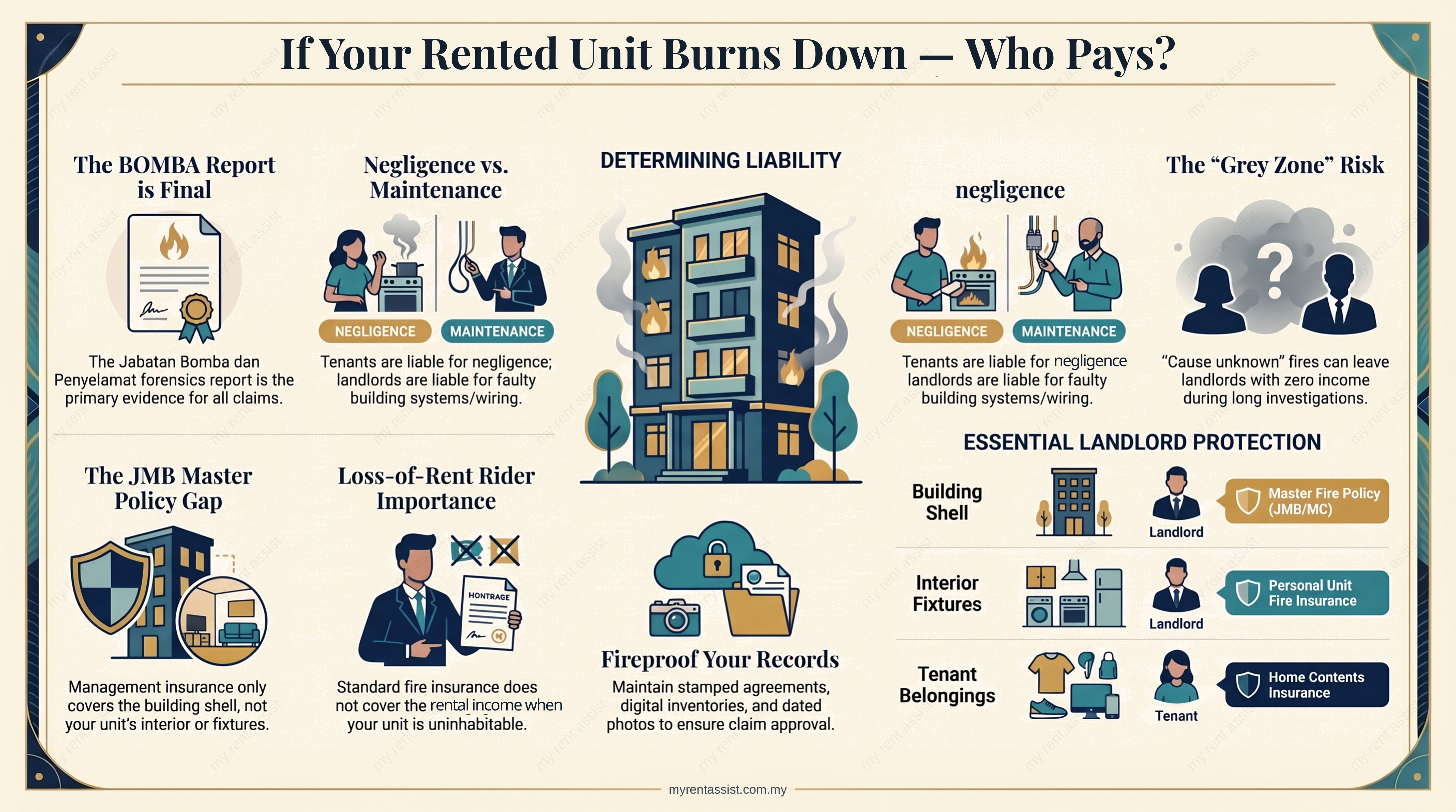
If the fire was caused by the tenant's negligence — leaving a stove unattended, using faulty electrical equipment, improper storage of flammable materials — the tenant can be held liable for the cost of repairs and restoration. This applies to the tenant directly, or anyone they permitted into the unit (sub-tenants, workers, guests).
A real example: in February 2026, an eighth-floor apartment in Kajang was destroyed after a fire broke out in a unit that the tenant had been using to stockpile firecrackers — clearly in breach of the tenancy agreement. In a case like this, the landlord has strong legal grounds to claim against the tenant, especially if the agreement explicitly prohibits dangerous goods storage.
Scenario B: Faulty building systems or structural defects
If the fire originated from electrical wiring in the walls, faulty plumbing, or defective building infrastructure — things that are the landlord's responsibility to maintain — then the landlord carries the liability. You cannot pass on maintenance negligence to a tenant.
Scenario C: Cause unknown or accidental
This is the grey zone — and as the Legacy OUG case shows, "cause under investigation" can take weeks or months to resolve. During this period, nobody knows who pays. If you don't have proper insurance, you're sitting on a destroyed unit with zero income and mounting legal uncertainty.
The BOMBA Report: How Liability Gets Determined
Whenever a fire occurs, the Jabatan Bomba dan Penyelamat Malaysia (BOMBA) conducts a forensic investigation to determine the cause. This report becomes the key document in any liability or insurance claim.
-
1Get the BOMBA report Submit a formal request to the relevant fire station for the investigation report. This is your primary evidence for any insurance claim or legal action.
-
2Document all damage immediately Photograph and video every part of the affected unit before any cleanup. Include fixtures, fittings, walls, ceilings, and all damaged items. Date-stamp everything.
-
3Notify your insurer Contact your fire insurance provider as soon as possible. Delayed notification can complicate or invalidate your claim.
-
4Review the tenancy agreement Check exactly what obligations were placed on the tenant regarding fire safety, prohibited activities, and liability for damage. This determines whether you have grounds to claim against them.
-
5Seek legal advice if tenant negligence is confirmed If BOMBA's report points to tenant negligence, consult a lawyer on whether to pursue the tenant directly or let your insurer handle subrogation (where they claim from the tenant on your behalf).
Landlord vs Tenant Insurance: What Covers What
Most Malaysian landlords assume their fire insurance covers everything. It doesn't. Here's how coverage actually splits between landlord and tenant:
| What's damaged | Who's responsible | Typical coverage |
|---|---|---|
| Building structure (walls, roof, floors, columns) | Landlord | Landlord's fire/building insurance |
| Original fixtures & fittings (kitchen cabinets, built-in wardrobes, bathroom fittings) | Landlord | Landlord's fire insurance (if declared in sum insured) |
| Tenant's furniture & belongings (sofa, bed, appliances they brought in) | Tenant | Tenant's home contents insurance |
| Tenant's renovations & improvements (feature walls, false ceilings, added lighting) | ❓ Grey area | Often NOT covered by either party — see below |
| Loss of rental income while unit is being repaired | Landlord's loss | Only if landlord has loss-of-rent rider/extension |
The division sounds straightforward, but in practice it gets complicated fast. Your insurer will want to know exactly what was in the unit and what it was worth. If you don't have a proper inventory — with photos and receipts — you'll be arguing with your adjuster with no evidence.
The Coverage Gap Most Landlords Don't Know About
This is the part that catches landlords by surprise, and it's worth reading slowly.
Gap 1: Tenant renovations are nobody's coverage
When your tenant puts up a feature wall, installs a false ceiling, adds track lighting, or tiles the balcony — those improvements physically become part of your unit. But here's the problem: they're not covered by your building insurance, because they weren't part of the original building valuation. And they're not covered by the tenant's contents insurance either, because they're fixed to the structure.
If a fire destroys those renovations, nobody pays — unless there's a specific clause in the tenancy agreement or a separate rider on one of the policies.
Gap 2: Your sum insured is probably outdated
Most landlords set their fire insurance sum insured once — when they first bought the property — and never update it. Construction costs in Malaysia have risen significantly since 2020. If your unit burns down and the rebuild cost has increased, you could be underinsured and bear the shortfall yourself.
Gap 3: The MPOB / strata management blind spot
In a strata property like a condo or apartment, the Joint Management Body (JMB) or Management Corporation (MC) holds a master fire insurance policy for the building's common areas and external structure. But this does NOT extend to your individual unit's interior. You need your own separate policy for everything inside your unit boundary.
Many landlords assume the JMB's policy covers them. It doesn't. The building's master policy covers the shell — your interior is your own responsibility.
How to Protect Yourself Before a Fire Happens
Pendek kata — you can't fireproof your unit. But you can fireproof your landlord position. The landlords who recover quickly from fire incidents are those who had the right documentation and coverage in place before anything happened.
1. Get the right insurance (and review it annually)
- Building fire insurance — ensure the sum insured reflects current rebuild costs, not your purchase price 5 years ago
- Loss-of-rent rider — non-negotiable if your mortgage relies on rental income
- Public liability extension — covers you if the fire spreads to neighbouring units and they claim against you
- Consider a landlord insurance package — some insurers now bundle all of the above into a single policy
2. Write a proper tenancy agreement
Your tenancy agreement is your first line of legal protection. At minimum, it should include:
- A clause prohibiting storage of flammable, hazardous, or illegal goods
- A requirement that the tenant maintains the unit in safe and habitable condition
- Tenant liability for damage caused by their negligence or breach of the agreement
- A requirement that the tenant discloses and insures their own contents
- Landlord's right to inspect the unit (with reasonable notice) to assess fire safety compliance
3. Do a proper move-in inventory
Before handing over keys, do a detailed walkthrough with the tenant. Document every fixture, fitting, and item in the unit — with photos, ideally with both parties present. This inventory becomes crucial if you later need to prove what was damaged, what was already there, and what the tenant may have altered.
4. Keep a paper trail of everything
Rent payment records, utility bills, maintenance requests, correspondence with the tenant — all of this becomes relevant if a dispute reaches court or an insurer's loss adjuster. The landlords who get shortchanged after a fire are typically those who managed everything informally, via WhatsApp, with nothing documented properly.
✓ Fire insurance with current rebuild value (not purchase price)
✓ Loss-of-rent rider added to your policy
✓ Stamped tenancy agreement with fire liability clause
✓ Signed move-in inventory with dated photos
✓ Digital copies of all documents stored safely
✓ Tenant's contact details and emergency contact on file
Frequently Asked Questions
You Can't Fireproof Your Unit. But You Can Fireproof Your Records.
When fire strikes, the landlords who come out okay are those with a proper paper trail — stamped agreements, documented inventories, organised rent history. MyRentAssist keeps all of it in one place, so when you need it most, it's already there.
- Digital rent receipts & payment history
- Tenancy agreement storage & reminders
- Utility bill tracking per unit
- Maintenance log & communication records
- Everything a loss adjuster or court would want to see
This article is for general guidance only and does not constitute legal or insurance advice. Fire liability situations vary depending on individual circumstances, tenancy terms, and applicable law. Consult a qualified lawyer or insurance professional for advice specific to your situation.