In this guide
- Why Every Landlord Is Suddenly Talking About This
- What Is E-Invoice, Actually, and Why LHDN Wants Landlords On It
- Do You Need to Issue an E-Invoice? Individual vs Business Tenant
- Self-Billed E-Invoices: When Your Tenant Invoices Themselves
- How to Issue a Consolidated E-Invoice, Step by Step
- What Happens If You Skip This
- FAQ
Why Every Landlord Is Suddenly Talking About This
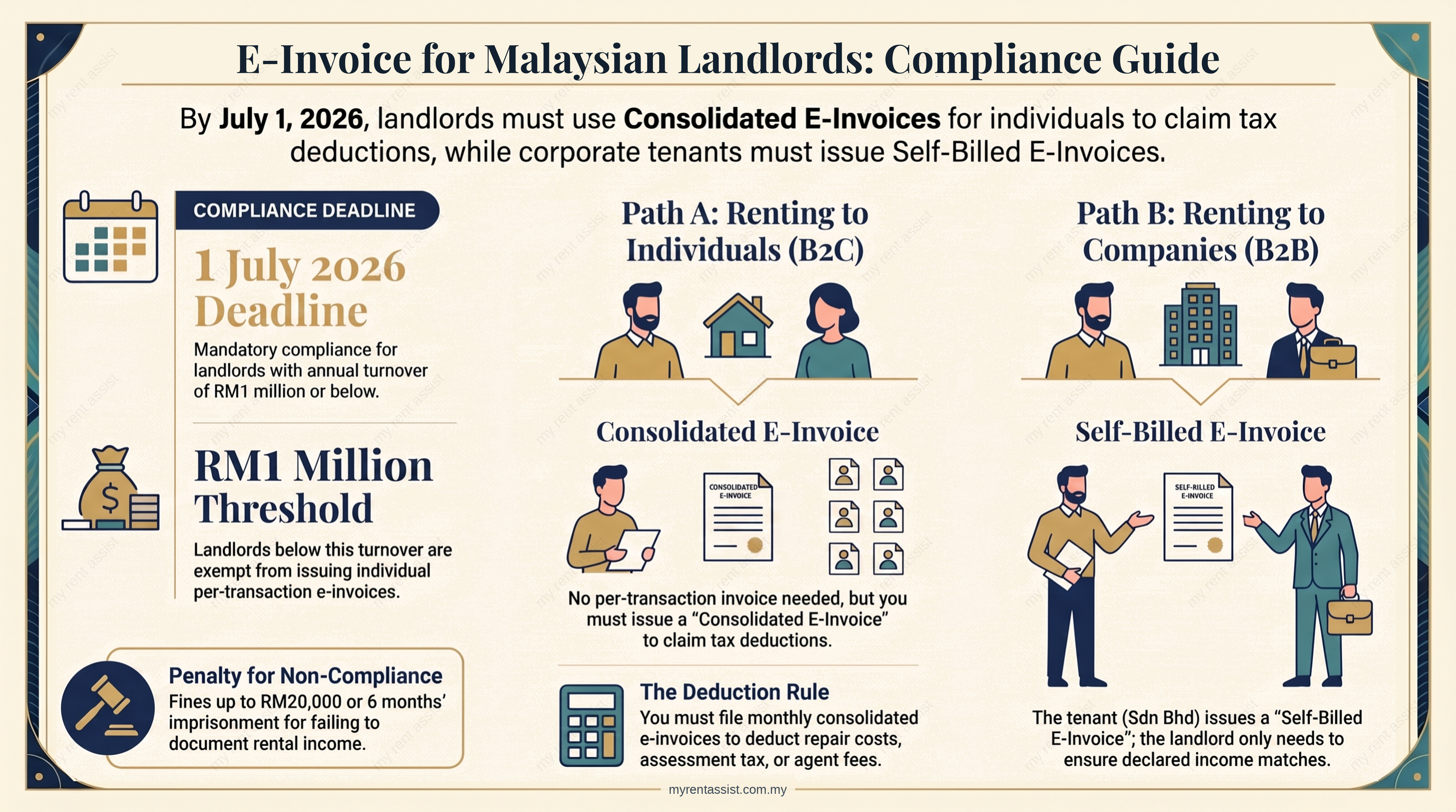
If you've been seeing "e-invoice" pop up in landlord WhatsApp groups more than usual lately, there's a reason. LHDN's e-invoicing rollout has been creeping toward smaller taxpayers in stages since 2024, and two dates just landed back to back: the grace period for Phase 3 taxpayers — the group individual landlords fall into — ended on 31 March 2026, and the formal compliance deadline for taxpayers with annual turnover of RM1 million or below hits 1 July 2026, with a relaxation period running until 31 December 2026.
Ringkasnya — if you're a landlord with one or two units and you've never touched MyInvois in your life, this is the part where it stops being someone else's problem. The good news is that most landlords with a handful of units are not required to issue a full e-invoice for every rent transaction. The part that catches people out is everything in between "exempt" and "required" — and that's exactly what this guide sorts out.
What Is E-Invoice, Actually, and Why LHDN Wants Landlords On It
E-invoice is LHDN's national digital invoicing system, run through a platform called MyInvois. Instead of a normal receipt or invoice you type up yourself, an e-invoice is validated in real time by LHDN and given a unique identification number the moment it's issued. Think of it as LHDN getting a live copy of every invoice as it happens, instead of only seeing your numbers once a year at tax filing time.
For landlords specifically, this matters for one blunt reason: rental income has historically been one of the easiest income types to under-declare, because there was no independent paper trail LHDN could cross-check against. E-invoicing closes that gap — especially through something called a self-billed e-invoice, which we'll get to shortly. If a document with your name on it as the rental recipient exists in LHDN's system and your tax return doesn't match it, that mismatch gets flagged automatically.
| Taxpayer group (annual turnover) | Mandatory e-invoice start |
|---|---|
| Above RM100 million | 1 August 2024 |
| RM25 million – RM100 million | 1 January 2025 |
| RM5 million – RM25 million | 1 July 2025 |
| RM1 million – RM5 million | 1 January 2026 |
| RM1 million and below (most individual landlords) | 1 July 2026 (relaxation until 31 Dec 2026) |
That bottom row is the one that applies to almost every landlord reading this. The exemption threshold itself was also raised, from RM500,000 to RM1 million in annual turnover, specifically to ease compliance for micro and small taxpayers — which is good news if your rental income is nowhere near that figure.
Do You Need to Issue an E-Invoice? Individual vs Business Tenant
This is the question that actually determines what you need to do, and the answer splits cleanly into two paths depending on who your tenant is.
Path A: You're an individual landlord, renting to another individual
If you're renting out a residential unit to a person — the normal setup for most landlords with 1–5 units — you're generally exempt from issuing a per-transaction e-invoice for every month's rent. This is treated as a B2C (business-to-consumer) transaction, and individual passive landlords under the RM1 million threshold don't need to issue one invoice per tenant per month.
Path B: Your tenant is a company
If your tenant is a Sdn Bhd — a common setup for units rented out for staff housing, or commercial space leased to a registered business — the rules flip. Because the tenant is conducting business and claiming rent as a tax-deductible expense, a proper e-invoice trail is required. But here's the part that surprises most landlords: you don't issue it — your tenant does. That's the self-billed e-invoice, covered next.
Self-Billed E-Invoices: When Your Tenant Invoices Themselves
A self-billed e-invoice is exactly what it sounds like — the buyer (your tenant) issues the invoice instead of the supplier (you), because you as an individual, non-business landlord aren't set up to issue one yourself. Your tenant's finance team generates it through MyInvois, validates it with LHDN, and it stands in as the official record of the rent paid to you that month.
This also applies to utility bills. If the TNB or water account is still under your name — a very common Malaysian landlord situation — and your tenant is reimbursing or paying those bills as part of the arrangement, that gets folded into the same self-billed e-invoice too.
You don't need MyInvois software
If your tenant is the one self-billing, you're not required to register or issue anything yourself for that tenancy. It's paperwork that happens on their end.
Declare the matching amount
That self-billed e-invoice is filed under your TIN. If the amount you declare to LHDN doesn't match it, the mismatch gets flagged automatically — no need to wait for a manual audit.
How to Issue a Consolidated E-Invoice, Step by Step
If you're an individual landlord renting to individuals and you want to keep claiming your rental expense deductions, here's the actual sequence — it's genuinely not complicated once you've done it once.
-
1Confirm your Tax Identification Number (TIN) is active Most individual taxpayers already have one through LHDN's e-Daftar system. You'll need it to log in to MyInvois.
-
2Log in to the MyInvois portal Available free at myinvois.hasil.gov.my. No accounting software needed for a handful of units — manual entry through the portal is enough.
-
3Total up your B2C rental collections for the month If you have more than one unit rented to individuals, you can combine all of it into a single consolidated e-invoice — you don't need to file separately per property.
-
4Submit the consolidated e-invoice for that reporting period LHDN's guidance sets a short submission window after each month closes — treat it the same way you'd treat a monthly bill deadline, not something to leave until year-end.
-
5Keep the generated document with your tax records This becomes your supporting evidence when you file your annual return and claim deductions like cukai tanah, assessment tax, or repair costs against the rental income.
What Happens If You Skip This
Alamak moment aside, this isn't a "maybe LHDN will notice" situation — the consequences are specific and they stack.
The other risk is the quieter one: a self-billed e-invoice sitting in LHDN's system under your TIN, showing rental income you never declared. That's not a penalty for skipping e-invoice — that's now a rental income declaration problem, which is a different and more serious conversation with LHDN entirely.
Frequently Asked Questions
Appoint MyRentAssist as Your Rental PA — We'll Settle This For You
You don't have to become an e-invoice expert overnight. Appoint us as your PA and we'll settle it for you — rent collection, receipts, utility monitoring, and e-invoicing via MyInvois, all handled on your behalf. By the time e-invoice becomes fully mandatory for landlords, you'll already be fully prepared, without having lifted a finger.
- E-invoicing via MyInvois built in
- WhatsApp rent reminders sent automatically
- Official receipts sent to your tenant
- Annual tax summary ready for LHDN
This article is for general guidance only and does not constitute legal or tax advice. E-invoicing rules are still being refined by LHDN through 2026. Consult a qualified tax agent or LHDN directly before making decisions based on this information.