In this guide
- Why Landlords Reach for This — And Why It Backfires
- The Law: Section 7(2) of the Specific Relief Act 1950
- What Actually Counts as Illegal Self-Help
- What Happens If You Do It Anyway
- The Lawful Alternatives: Distress and Eviction
- What To Actually Do When a Tenant Stops Paying
- FAQ
- Quick Summary: What's Legal and What Isn't
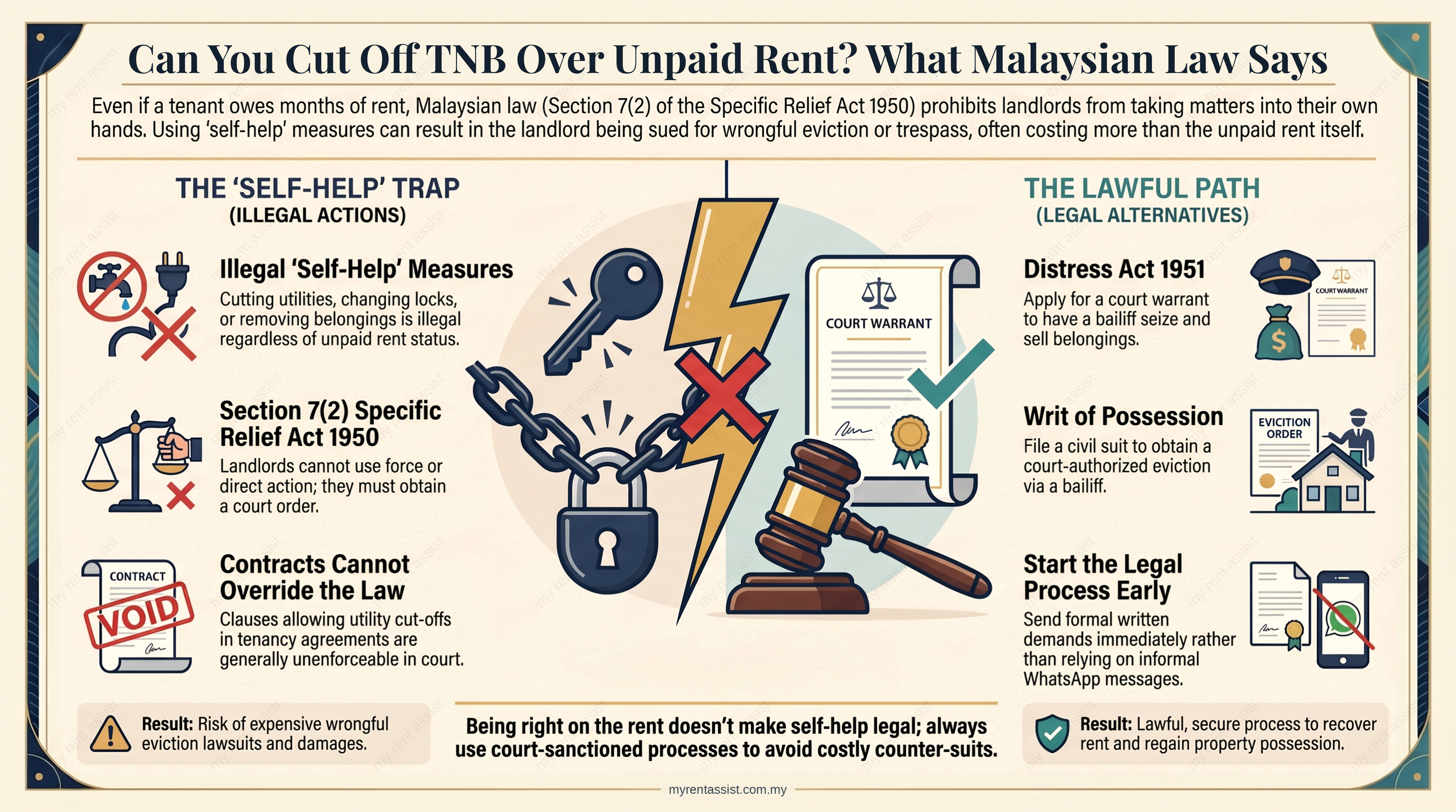
Tenant hasn't paid rent in two months, isn't answering your calls, and you own the unit — so surely you can just switch off the TNB, or change the padlock while they're out at work? It feels less like breaking the law and more like taking back what's yours. Alamak, this is exactly the trap that catches out otherwise careful landlords, because Malaysian law doesn't see it that way at all.
Ringkasnya, no matter how far behind on rent a tenant is, or how airtight your tenancy agreement seems, Malaysian law does not let a landlord take matters into their own hands to force a tenant out. Doing so — cutting the power, changing the locks, or removing the tenant's belongings — is what the law calls "self-help," and it's illegal regardless of who's actually in the wrong on the rent. Here's exactly what the law says, what can happen if you ignore it, and what you should do instead.
Why Landlords Reach for This — And Why It Backfires
It's an understandable impulse. Going to court over unpaid rent feels slow, expensive, and uncertain, while cutting the power or swapping the lock feels immediate and within your rights as the property owner. Plenty of landlords assume that because the tenancy agreement is already broken — rent hasn't been paid — their obligations under it are void too, so nothing stops them from acting directly.
That assumption is exactly what turns a straightforward rent-arrears case into a legal headache. A tenant who is genuinely behind on rent and gets locked out or has their power cut can turn around and sue the landlord for wrongful eviction, trespass, or breach of the tenancy agreement — and in many of these disputes, the tenant's claim succeeds even though they were the one who stopped paying. The unpaid rent doesn't disappear from the picture, but it stops being the only issue in the case.
The Law: Section 7(2) of the Specific Relief Act 1950
The relevant law is Section 7(2) of the Specific Relief Act 1950. In plain English, it says that even a landlord who is legally entitled to get their property back cannot use their own force or actions to do so — they have to go through the proper legal process. This applies whether the tenant is a saint or has never paid a single month of rent on time.
This is also why a clause in your tenancy agreement that says something like "landlord may disconnect utilities or repossess the unit if rent is unpaid for X days" doesn't actually protect you. Courts treat this kind of clause as unenforceable — a private contract cannot override a statute, and acting on it still exposes you to the same liability as if the clause didn't exist.
What Actually Counts as Illegal Self-Help
"Self-help" covers more than just physically dragging a tenant's belongings onto the street. The following are all treated the same way under the law, even if they feel more passive than confrontational:
- Disconnecting or asking to disconnect electricity or water — even if the TNB or Air Selangor account is still in your name and you're technically entitled to manage your own account.
- Changing the locks — whether the tenant is out at the time or not, and even if you leave a note explaining why.
- Removing or holding the tenant's belongings — including as informal "leverage" to force a conversation about the arrears.
- Blocking access to the unit in any other way — for example, physically preventing entry, or getting someone else to do it on your behalf.
- Publicly posting the tenant's personal details — such as their IC number or photos — to pressure them, which raises separate exposure under Malaysia's data protection rules on top of the self-help issue.
None of these require a court to have already ruled against you. All of them can expose you to a civil claim the moment they happen — regardless of how many months of rent are outstanding.
What Happens If You Do It Anyway
A tenant who's been locked out or had their power cut has a genuine legal claim against the landlord, on top of whatever claim the landlord has against them for unpaid rent. In practice, this usually plays out as a civil suit for damages — covering things like the cost of alternative accommodation, damaged or lost belongings, and general damages for the inconvenience and distress caused.
Beyond the civil exposure, actions like forcing entry, damaging the tenant's property, or threatening them to leave can also cross into criminal territory — offences like criminal trespass, mischief, or intimidation are handled under the Penal Code, separately from the tenancy dispute itself. That's a police report the tenant can make against you, not the other way around.
The Lawful Alternatives: Distress and Eviction
The good news is that Malaysian law does give landlords real tools to recover unpaid rent and, eventually, the property itself — they just have to go through the courts rather than acting directly.
Distress Act 1951 — seizing the tenant's belongings, legally
If the tenant is still occupying the unit, or has left belongings behind, a landlord can apply to the Magistrate's Court for a warrant of distress under the Distress Act 1951. Once granted, a court bailiff — not the landlord — attends the property, inventories the tenant's movable belongings, and can have them sold at auction to recover up to 12 months of arrears. This is the lawful version of "seizing the tenant's stuff," and the difference is entirely about who's doing the seizing and under what authority.
Eviction via a Writ of Possession
To actually get the tenant out and reclaim the unit, a landlord needs to file a civil suit for repossession and obtain a Writ of Possession from the court. It's this writ — not the landlord — that authorises a court bailiff to remove the tenant and formally hand back possession. It takes longer than cutting the power, but it's the only route that doesn't expose the landlord to a counter-claim.
| What you want to do | Illegal self-help version | Lawful route |
|---|---|---|
| Recover unpaid rent | Hold belongings or threaten cut-off until tenant pays | Warrant of distress (Distress Act 1951) or civil suit for the debt |
| Get the tenant out | Change the locks or cut electricity/water | Civil suit for possession → Writ of Possession → court bailiff |
| Stop rent from piling up further | Force tenant out immediately, "settle later" | File early — the court process can run in parallel with continuing arrears |
What To Actually Do When a Tenant Stops Paying
Most guides at this point tell you to "communicate with your tenant" and "check your tenancy agreement" — advice most landlords already know and have already tried by the time they're searching this. The genuinely non-obvious part is timing: the biggest mistake isn't skipping communication, it's waiting two or three months, getting frustrated, and only then acting — often by then reaching for self-help out of sheer impatience.
-
1Send a formal written demand as soon as rent is late — not after months of informal chasing A dated, written record of the demand matters if this ends up in front of a Magistrate later. Informal WhatsApp reminders alone are weaker evidence than a proper notice.
-
2Start the legal process in parallel with — not after — further attempts to collect Filing for distress or possession doesn't stop you from also negotiating a payment plan. Landlords who wait until they've "given up" on negotiation before filing lose valuable time, since court processes take weeks regardless of when you start.
-
3Engage a lawyer for the distress or possession application Both processes involve court filings and, for distress, coordination with a bailiff — this isn't a DIY form-filling exercise, and mistakes in the application can delay recovery further.
Frequently Asked Questions
Quick Summary: What's Legal and What Isn't
| Action | Legal? | What to do instead |
|---|---|---|
| Cutting off electricity or water | No | Apply for a warrant of distress or file a civil suit for the arrears |
| Changing the locks | No | File for possession and obtain a Writ of Possession |
| Removing tenant's belongings | No | Use the Distress Act 1951 process via the Magistrate's Court |
| Sending a formal written demand for rent | Yes | Do this early and keep dated records |
| Filing a civil suit or distress application | Yes | This is the only lawful path to repossession or seizure |
What To Do Next?
The whole reason self-help feels tempting is that chasing rent every month is exhausting long before it ever gets to the point of arrears. Ringkasnya, if the monthly "eh, you bayar dah ke?" texts and manual bank statement checks are what's wearing you down, MyRentAssist automates that entire cycle before it ever reaches the stage where you're tempted to cut anyone's power.
- WhatsApp rent reminders sent automatically every month
- Full payment history and dated records — useful evidence if a dispute ever escalates
- Official receipts generated and sent without you lifting a finger
- Utility bill monitoring so accounts don't quietly lapse in your name
Try it free for 3 months, or WhatsApp us and we'll walk you through it — no pressure, no credit card.
This article is for general guidance only and does not constitute legal advice. Laws and their application can vary by case — consult a qualified lawyer before taking any action against a tenant, including filing for distress or possession.