In this guide
- What Is Cukai Pintu (And How Is It Different From Cukai Tanah)?
- How Much Is Cukai Pintu? Rates by State & Council
- Payment Deadlines: The 31 August Rush
- What Happens If You Don't Pay
- How to Check and Pay Your Cukai Pintu
- Is Cukai Pintu Tax-Deductible for Landlords?
- FAQ
- Quick Summary: Cukai Pintu at a Glance
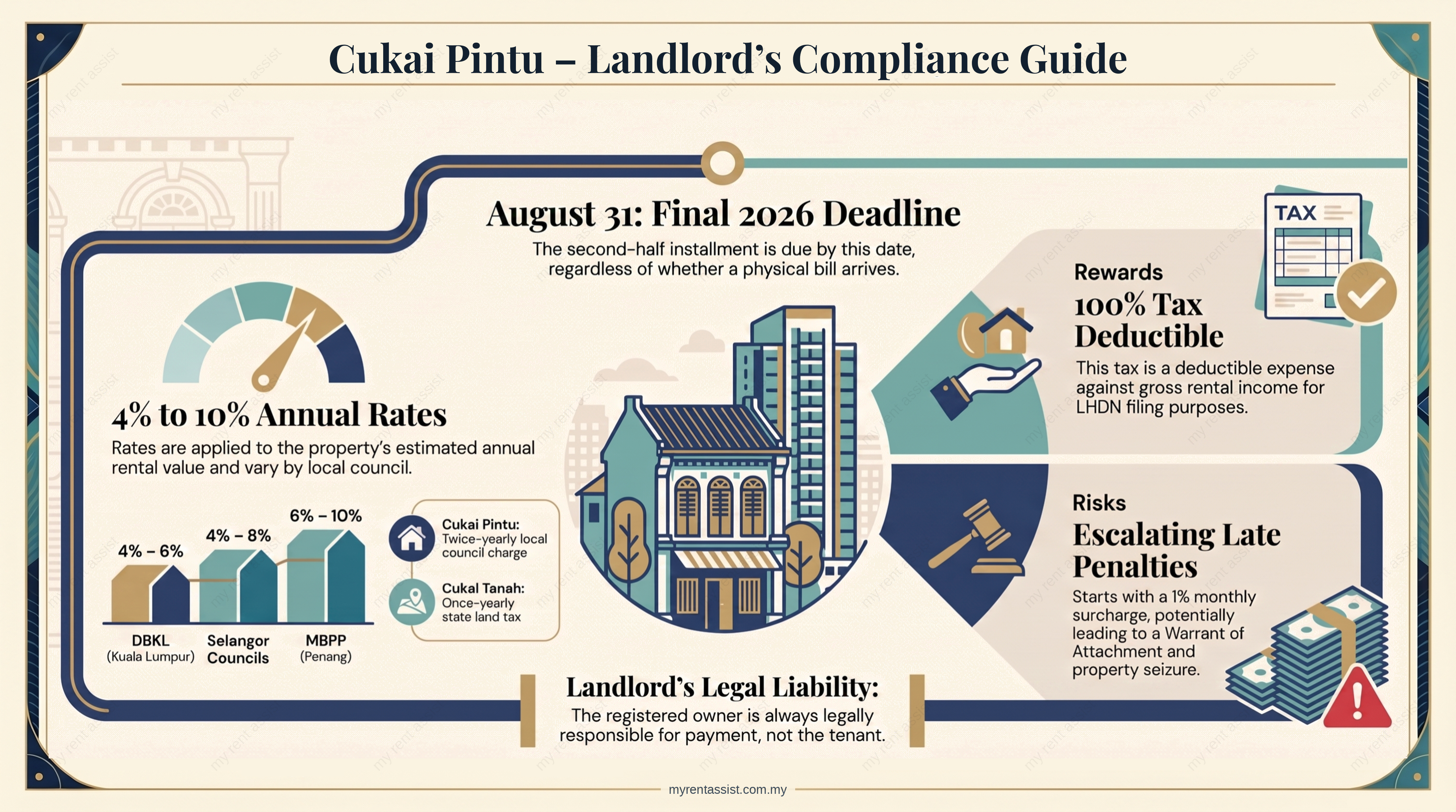
If you haven't checked your mailbox — or your local council's e-billing portal — this is the week to do it. The second half of Malaysia's cukai pintu (assessment tax) for 2026 falls due on 31 August, and every registered property owner is on the hook whether or not a physical bill ever arrived. Miss it, and the surcharges start almost immediately.
Most landlords lump "council tax," "cukai tanah," and "cukai pintu" together as one vague annual expense. They're actually two separate charges, from two different government bodies, on two different payment cycles — and mixing them up is exactly how landlords end up paying one and quietly forgetting the other for months. Here's the full picture: what cukai pintu is, how much you'll owe, what happens if you're late, and how it fits into your LHDN filing.
What Is Cukai Pintu (And How Is It Different From Cukai Tanah)?
Cukai pintu — also called cukai taksiran or "assessment tax" — is the half-yearly charge your local council (Pihak Berkuasa Tempatan, or PBT) levies on your property's Annual Value, which is the council's estimate of what your unit could rent for over a year. It funds local services: rubbish collection, street lighting, drains, parks, and council upkeep in your area.
Cukai tanah (quit rent) is a completely different tax, charged by the state Land Office rather than your local council, based on land area rather than rental value, and billed once a year rather than twice. Landlords who only track one of the two often discover the gap the hard way — usually when an arrears notice for the other one turns up.
| Cukai Pintu (Assessment Tax) | Cukai Tanah (Quit Rent) | |
|---|---|---|
| Charged by | Local council (DBKL, MBSJ, MBPJ, MPAJ, MBPP, etc.) | State Land Office |
| Based on | Property's Annual Value (estimated rental value) | Land area (rate per square metre) |
| Billed | Twice a year | Once a year |
| Typical cost | RM500–RM3,000/year for a residential unit | RM50–RM500/year |
How Much Is Cukai Pintu? Rates by State & Council
The rate is applied as a percentage of your property's Annual Value, and it varies by council and by whether the unit is classified residential or commercial. For a typical residential rental unit:
- DBKL (Kuala Lumpur): around 4%–6% of Annual Value
- Selangor councils (MBSJ, MBPJ, MPAJ, MPS and others): roughly 4%–8%, varying by district
- MBPP (Penang): among the higher end, around 6%–10%
Worked example: a unit with an Annual Value of RM6,000 in DBKL at a 6% rate works out to RM360 a year — billed as two instalments of RM180 each. Your exact Annual Value and rate are printed on your assessment bill, and can also be checked on your council's e-billing portal using your property's holding or account number.
Payment Deadlines: The 31 August Rush
Cukai pintu is billed in two halves every year: the first covering 1 January to 28 February, and the second covering 1 July to 31 August. There's no grace period built in — the due date is the due date, regardless of whether your council's reminder notice actually reached you.
What Happens If You Don't Pay
The consequences escalate faster than most landlords expect, and further than a simple late fee:
- Immediately after the due date: a surcharge of around 1% per month starts accruing on the outstanding amount.
- After sustained non-payment (typically around 6 months of arrears): the council can issue a Notice of Demand (Form E) under Section 148 of the Local Government Act 1976, giving you 15 days to settle before further action.
- If still unpaid: the council may issue a Warrant of Attachment, allowing its officers to seize movable property found on the premises to cover the arrears — and ultimately, in the most extreme and prolonged cases, apply to attach and auction the property itself.
How to Check and Pay Your Cukai Pintu
-
1Identify your local council Assessment tax is collected by whichever council covers your property's address — DBKL, MBSJ, MBPJ, MPAJ, MBI, MBPP, and so on. Each has its own portal and account numbering.
-
2Find your assessment account or holding number This is printed on any previous assessment bill, or can usually be looked up on your council's e-billing portal using your property address and owner details.
-
3Pay through your council's own e-billing portal, or PBTPay PBTPay is a one-stop platform covering cukai taksiran and other bills for a number of participating councils. Where it's not supported, pay directly on your council's own website, at a service counter, or via online banking bill payment.
-
4Save the receipt Keep the payment receipt with your other property records — you'll need it as supporting documentation when claiming it against your rental income at tax time.
Is Cukai Pintu Tax-Deductible for Landlords?
Yes. For a landlord taxed under Section 4(d) (rental income), cukai pintu is a deductible expense against your gross rental income — alongside cukai tanah, fire insurance, repairs and maintenance, and loan interest on the property. Ringkasnya, it directly reduces the rental income LHDN taxes you on, so it's worth keeping every receipt rather than letting them pile up unfiled in a drawer.
The catch is that the deduction only helps if you can actually produce the paperwork when you file. Landlords managing a handful of units across different councils, with instalments due twice a year, are the ones most likely to misplace a receipt or lose track of which unit's assessment tax was actually paid.
Frequently Asked Questions
Quick Summary: Cukai Pintu at a Glance
| Question | Answer |
|---|---|
| Who pays? | The registered property owner (landlord), always |
| Due dates | 28 February (1st half) and 31 August (2nd half) |
| Typical rate | 4%–10% of Annual Value, depending on council |
| Late payment penalty | ~1% per month, escalating to Notice of Demand and Warrant of Attachment after prolonged arrears |
| Deductible against rental income? | Yes — keep the receipt for LHDN filing |
What To Do Next?
Cukai pintu is just one of several deductible expenses that only actually save you money at tax time if you can put your hands on the paperwork when LHDN asks. Between assessment tax, rent collected, receipts issued, and utility bills paid across every unit you manage, that paper trail gets messy fast if it's scattered across WhatsApp chats, bank statements, and a drawer full of council notices.
- Annual LHDN-ready summary — every month's rent and receipts organised in one place
- Official receipts generated and sent automatically for every rent collection
- Utility bill monitoring across TNB, Air Selangor, and IWK — one less bill to track by hand
- WhatsApp reminders sent to tenants every month, so rent collection stays on schedule too
Try it free for 3 months, or WhatsApp us and we'll walk you through it — no pressure, no credit card.
This article is for general guidance only and does not constitute tax or legal advice. Assessment tax rates, deadlines, and enforcement procedures are set by individual local councils and can change. Confirm your exact Annual Value, rate, and due dates with your specific local council, and consult a licensed tax agent for advice on your LHDN filing.