In This Guide
Your tenant WhatsApps you: "Hi Landlord, please assist to change the tariff to TOU." And you're not sure whether you should help, whether it's even your job to do it, or whether switching is actually a good idea.
You're not alone. Since July 2025, TNB rolled out its Time of Use (TOU) tariff to all Malaysian residential customers — and a lot of landlords and tenants are still confused about what it is, whether to switch, and whether it actually saves money.
This guide breaks it all down simply. By the end, you'll know exactly what TOU is, how the rates work, whether your tenant's unit should be on it, and — importantly — whether it's even your responsibility as a landlord to help.
What Is TNB's Time of Use (TOU) Tariff?
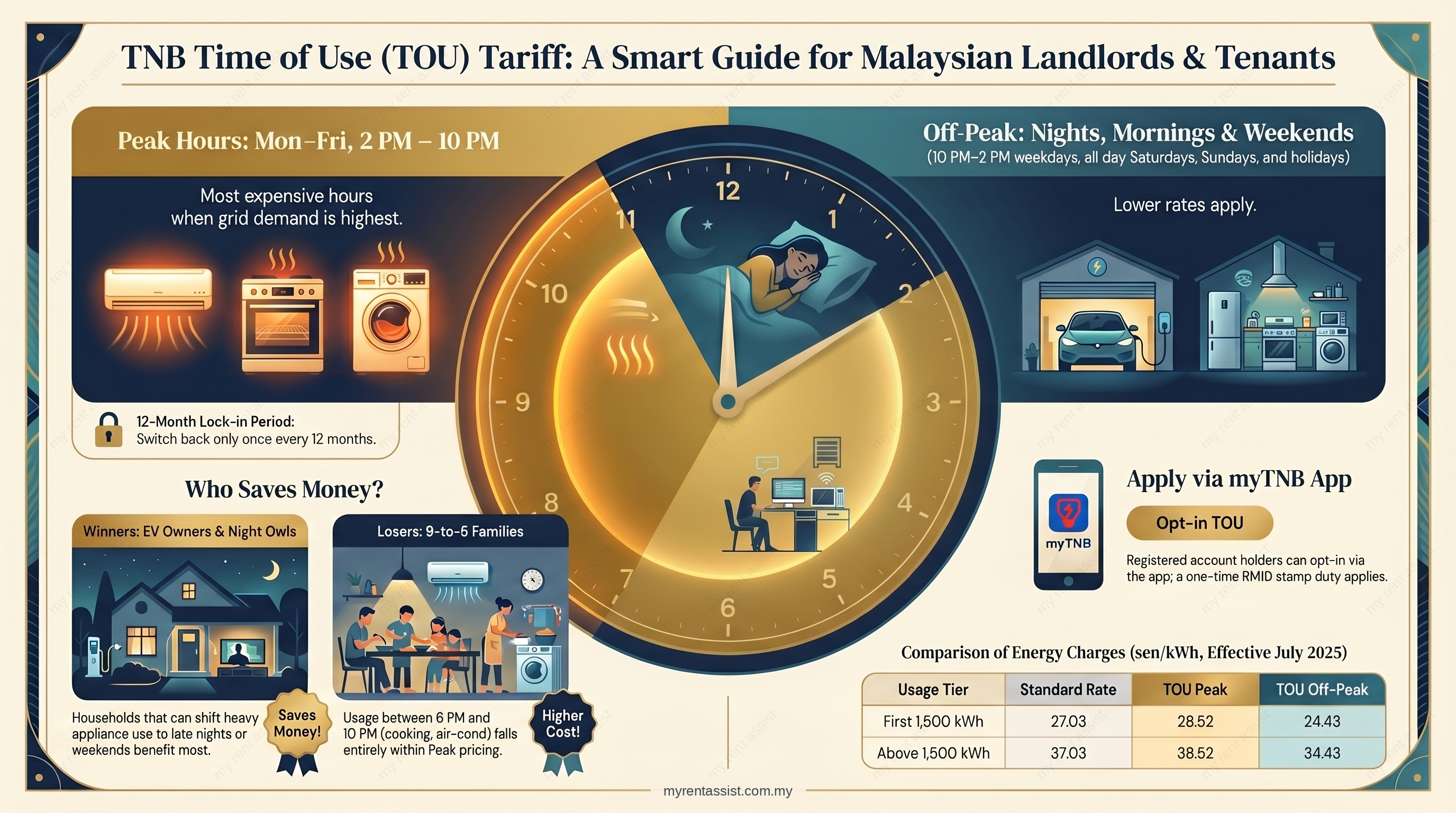
The standard TNB tariff charges you a flat rate per kWh regardless of when you use electricity. TOU changes that. Under TOU, the price you pay depends on the time of day — electricity is cheaper when demand on the grid is low (off-peak), and slightly more expensive when demand is high (peak).
Think of it like Grab surge pricing, but in reverse — use electricity when everyone else isn't, and you pay less. The goal is to shift consumption away from the hours when the national grid is under the most strain.
TNB officially opened TOU to all residential customers from 1 July 2025, as part of the RP4 regulatory period running until 31 December 2027. It was previously only available to commercial and industrial users.
Peak vs. Off-Peak Hours: The Full Breakdown
This is the part that actually matters. Here's when peak and off-peak apply:
| Period | Days | Hours | Rate Type |
|---|---|---|---|
| Peak | Monday – Friday | 2:00 PM – 10:00 PM | Higher rate |
| Off-Peak | Monday – Friday | 10:00 PM – 2:00 PM (next day) | Lower rate |
| Off-Peak (All Day) | Saturday, Sunday & 15 Public Holidays | All 24 hours | Lower rate |
So in simple terms: weekday afternoons and evenings are peak. Everything else — weekday mornings, nights, and all weekends — is off-peak.
TOU Rates vs. Standard Rates in 2026
Here's the actual numbers side by side, effective from 1 July 2025:
| Usage Band | Standard Rate (sen/kWh) | TOU Peak (sen/kWh) | TOU Off-Peak (sen/kWh) |
|---|---|---|---|
| First 1,500 kWh/month | 27.03 | 28.52 | 24.43 |
| Above 1,500 kWh/month | 37.03 | 38.52 | 34.43 |
On top of the energy charge, all accounts — standard or TOU — also pay these components:
- Capacity Charge: 4.55 sen/kWh
- Network Charge: 12.85 sen/kWh
- Retail Charge: RM10/month fixed (waived if usage is 600 kWh or below)
The TOU switch affects only the energy charge portion. The other components stay the same.
Who Actually Benefits from TOU?
TOU works well for households that can genuinely shift their heavy electricity use to off-peak hours. In practice, that means:
Good candidates for TOU:
- EV owners — charging overnight at off-peak rates can save significantly
- WFH households — if your tenant works from home but runs the washing machine and dishwasher at 11pm or on weekends
- Night-shift workers — home during the day (off-peak), sleep during peak
- Retirees or those at home all day — morning usage is off-peak until 2pm
Poor candidates for TOU:
- 9-to-5 families — come home at 6pm, cook, watch TV, run aircon until 10pm. That's pure peak hours.
- Households that can't change habits — if shifting laundry to midnight isn't realistic, the savings won't materialise
- Low-usage households — if the bill is already low, the savings from TOU are too small to matter
TNB's own estimate: shifting 400 kWh of usage to off-peak saves about RM10.40/month. Shifting 1,000 kWh saves around RM26/month. Those aren't huge numbers — but over a year, it adds up if the lifestyle fits.
To put those numbers in context: a typical 1-bedroom rental unit running a 1.5 HP non-inverter aircon for 8 hours a night uses roughly 288 kWh from the aircon alone. Add a fridge running 24 hours (~150 kWh), a washing machine used a few times a week (~25 kWh), and lights and fans throughout the day (~30 kWh) — and you're already looking at around 490–500 kWh per month for a single-bedroom unit. A 3-bedroom with two aircons running could easily hit 700–800 kWh. So when TNB talks about shifting 400 kWh to off-peak, that's essentially asking your tenant to shift roughly all their aircon usage to after 10pm or before 2pm — which, for most working tenants, simply isn't realistic.
How to Apply for TOU (Step by Step)
The application is done through the myTNB app or by visiting a Kedai Tenaga outlet. Here's the process:
-
1Open the myTNB app Log in to your account. Make sure the account you want to switch is listed under your profile.
-
2Go to Manage Account → Tariff → Switch to TOU Tap the Time of Use icon or navigate through the tariff settings menu.
-
3Select the eligible account and tap "Get Started" Review your contact details. Confirm the application.
-
4Wait for activation Smart meter holders: approximately 5 working days. Standard meter holders: up to 2 months (TNB may need to upgrade your meter first).
-
5RM10 Stamp Duty added to your next bill This is a one-time charge. Your tariff switch takes effect from the next billing cycle after activation.
-
6Can't find the option in the app? Email TNB directly This happens — the TOU option isn't always visible to all accounts in the app. If you've looked and can't find it, email [email protected] or visit your nearest Kedai Tenaga in person. Based on personal experience, emailing TNB is a reliable fallback when the app doesn't cooperate.
TOU Savings Calculator
Estimate whether TOU makes sense based on your household's usage pattern.
TOU vs. Standard — Monthly Estimate
Enter your monthly usage and the estimated split between peak and off-peak hours.
Energy charge only. Does not include Capacity, Network, or Retail charges (same for both tariffs). Assumes usage ≤ 1,500 kWh/month.
Quick FAQ
Can a tenant apply for TOU if the account is under the landlord's name?
No. Only the registered account holder can apply for TOU. If the TNB account is under the landlord's name, the landlord must be the one to apply — ideally after discussing it with the tenant. If the tenant wants control over their tariff, they'd need to transfer the account into their own name first.
Will TOU automatically kick in after the July 2025 tariff change?
No. TOU is an opt-in scheme. The July 2025 tariff change updated the base rates for everyone (standard tariff included), but TOU only applies if you actively apply for it through the myTNB app or at a Kedai Tenaga outlet.
My tenant's bill went up after July 2025. Is it because of TOU?
Probably not TOU — more likely the new base tariff rates that took effect 1 July 2025, which apply to everyone on the standard tariff. The new structure also introduced 8% SST on households consuming more than 600 kWh/month. Check whether your tenant's usage crossed that threshold.
What happens to TOU after the RP4 period ends in December 2027?
TNB hasn't announced changes beyond the current RP4 regulatory period. When RP4 ends, tariff structures will be reviewed. For now, TOU remains available until at least 31 December 2027.
What TOU Means for Your Rental Property
Here's where most landlord guides stop — and where this one starts getting useful.
If the TNB account is under your tenant's name
It's entirely your tenant's decision whether to switch to TOU. You don't need to do anything, and it doesn't affect your relationship with them. If they ask, just explain the peak/off-peak concept and let them decide based on their lifestyle.
If the TNB account is still under your name
This is exactly the situation from the opening scenario — your tenant asks you to switch to TOU, but the account is in your name. Here's what you need to know before you agree: once you switch, you can only revert back to the standard tariff once every 12 months. So if you switch today to fulfil your tenant's request and their bills go up (because their usage pattern doesn't actually suit TOU), you're locked in for a year. You can't undo it immediately.
The safer approach: have an honest conversation with your tenant first. Ask if they're home during the day, whether they charge an EV, and whether they can genuinely shift heavy appliance usage to after 10pm or weekends. If the answer is mostly no — politely explain that TOU may not benefit them given their lifestyle, and that you'd prefer to stay on standard to protect both parties. You are under no obligation to switch.
The bigger picture for landlords
TOU is one piece of a larger shift in how Malaysians pay for electricity. The new tariff structure since July 2025 has added more transparency — but also more complexity. As a landlord, the real risk isn't missing out on TOU savings. It's not knowing what's happening with your tenant's TNB account at all — unpaid bills accumulating, disconnections, arrears building up quietly.
That's a separate problem from TOU, and honestly a bigger one.
Now You Understand TOU — But Do You Know What's Happening with Your Tenant's Bill?
Understanding the tariff is one thing. Actually knowing whether your tenant's TNB is paid, how much they owe, and whether arrears are building up — that's a different story. MyRentAssist monitors your tenant's utility bills automatically, every month, so you're never caught off guard.
- TNB, Air Selangor & IWK bill monitoring
- Pay on behalf — deducted from rent collection
- Automated rent reminders via WhatsApp
- Receipts & tax summaries — automatic
This article is for general guidance only and does not constitute legal or financial advice. Tariff rates are based on TNB's published schedule effective 1 July 2025. Verify current rates at mytnb.com.my.