In This Guide
The tenant has moved out, keys returned, everything seems fine. You're going through the handover checklist when you notice the electricity account hasn't been settled. You log in to check — and there it is. RM3,000+ in unpaid TNB arrears, stacked up quietly over six months while you collected rent and assumed everything was in order.
Alamak. The tenant? Sudah gone. Phone not picked up. WhatsApp blocked.
This scenario plays out more often than most landlords want to admit. The TNB bill is one of the most overlooked risks in Malaysian property rental — not because landlords don't care, but because there's no obvious warning until it's too late. Rent comes in, so you assume the bills are paid. They're not always.
Who Is Actually Liable for the Unpaid TNB Bill?
The answer depends on one thing: whose name is the TNB account registered under?
| Situation | Who TNB chases for arrears | Your Risk Level |
|---|---|---|
| Account in landlord's name, tenant leaves with arrears | Landlord | High |
| Account transferred to tenant's name (Change of Tenancy done) — tenant is traceable | Tenant (legally) | Lower |
| Account in tenant's name, but tenant has left and is uncontactable | TNB may still approach owner as property holder | Medium |
| Tenant is registered user but landlord co-signed or is secondary account holder | Both (joint liability possible) | Medium |
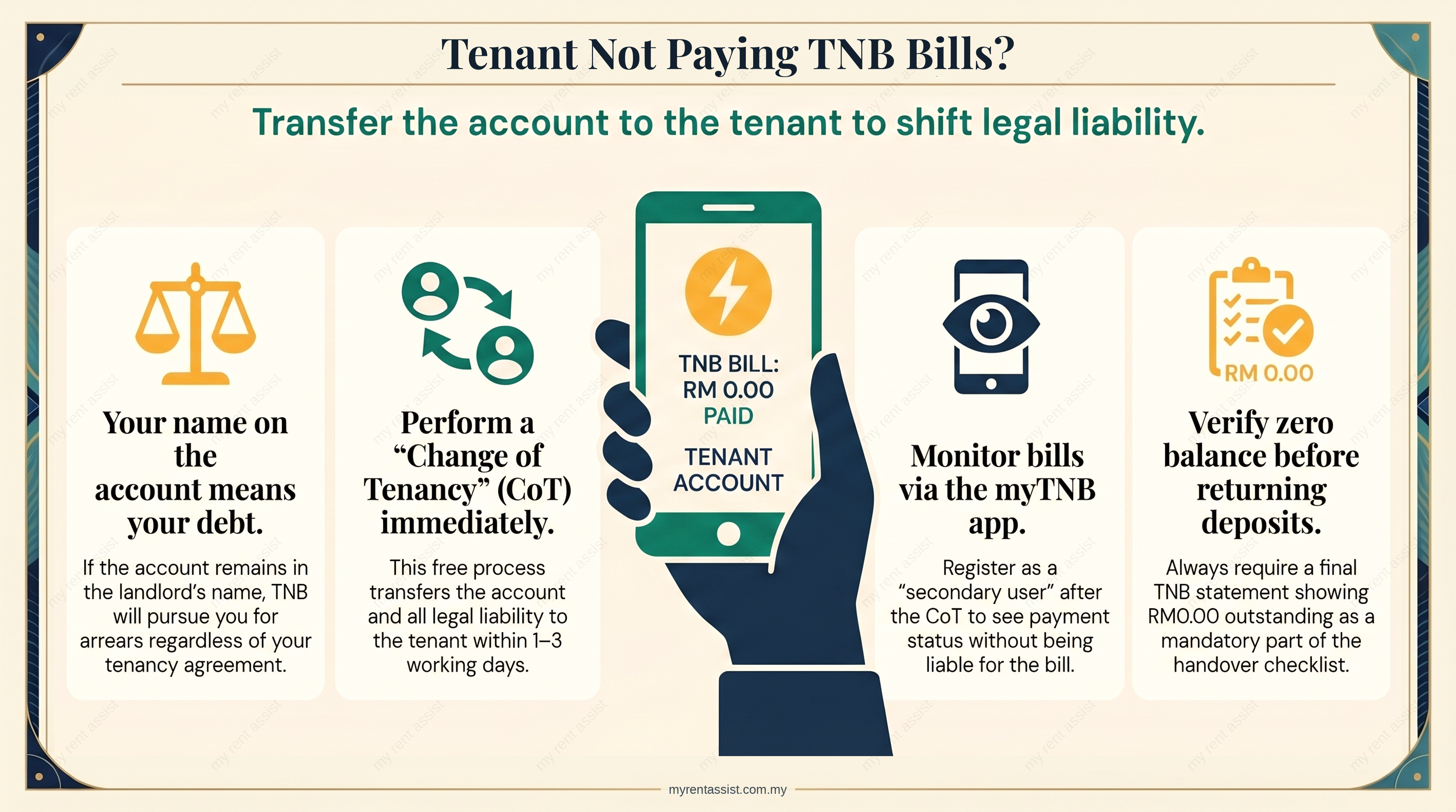
Officially, if the Change of Tenancy is done and the account is in your tenant's name, TNB pursues the tenant — not you. That's the legal position. But here's what landlords who've been through this will tell you: in practice, when TNB can't locate the tenant, they come back to the property owner. You own the asset, you're traceable, and TNB's collection team knows it.
This doesn't mean the Change of Tenancy is pointless — it's still the single most important step you can take. But it's not a complete firewall. If your tenant disappears with arrears and TNB can't find them, expect a call. The only real protection on top of CoT is monitoring the bills actively so the arrears never get large enough to be a serious problem.
And if the account is still in your name when your tenant leaves with unpaid bills, you're fully liable — no grey area. A clause in your tenancy agreement saying "tenant shall pay all utility bills" is enforceable between you and your tenant, but it doesn't stop TNB from billing whoever holds the account.
What TNB Does When Bills Go Unpaid
TNB follows a standard process before disconnecting supply. Here's what the timeline looks like once a bill goes overdue:
-
1Bill issued (monthly) Standard billing cycle. Payment due typically within 30 days of bill date.
-
2Disconnection notice issued TNB sends a written disconnection notice. The account holder (that's you, if your name is on the account) has 7 working days to settle the outstanding amount.
-
3Pre-disconnection notice A further notice of intention to disconnect is served 3 working days before the actual cut-off.
-
4Electricity disconnected Supply is cut. TNB will not disconnect on weekends or public holidays. Reconnection requires full arrears payment plus a reconnection fee.
How to Check If Your Tenant Is Paying Their TNB Bill
You don't have to wait until handover to find out. TNB's own tools let you keep an eye on things from a distance.
Option 1: Register on myTNB and monitor the account
If the TNB account is still in your name, you can register on the myTNB portal (mytnb.com.my) or download the myTNB app. From there, you can view the monthly bill amount, payment status, and usage history for your property. The multi-account feature lets you manage multiple units from a single dashboard — useful if you own more than one property.
Option 2: Periodic check-ins with your tenant
The low-tech approach: ask your tenant to screenshot the monthly myTNB payment confirmation and send it to you via WhatsApp. Build this into your tenancy agreement as a monthly requirement. Simple, and it creates a paper trail.
Option 3: Do a Change of Tenancy (and monitor from there)
After transferring the account to your tenant's name, you can still register as a secondary user on myTNB and monitor the account. You won't hold the liability, but you'll have visibility. This is the best of both worlds — and the approach most recommended by TNB itself.
Option 4: Let MyRentAssist monitor it for you
If you'd rather not log in to myTNB every month to manually check, MyRentAssist does this automatically. The platform monitors TNB, Air Selangor, and IWK for all your units and flags you when something looks off — a bill that's unusually high, a payment that hasn't come through, or usage that's spiked without explanation. You find out early, when the arrears are still small and a single WhatsApp to your tenant is enough to fix it. No surprises at handover.
What to Do If Your Tenant Has Unpaid TNB Arrears Right Now
Already in this situation? Here's how to handle it, step by step.
-
1Log in to myTNB immediately and check the exact amount owed Get the precise figure before any conversation with your tenant. You need facts, not estimates.
-
2Contact your tenant in writing — WhatsApp is fine, but keep a record State the amount clearly and give a specific deadline to settle. Written communication creates a paper trail if you later need to make a deduction from the security deposit.
-
3Check your tenancy agreement for the utility clause Does it state the tenant is responsible for all utility bills? If yes, you have grounds to deduct the arrears amount from the security deposit upon handover.
-
4If disconnection is imminent, pay TNB first — then recover from deposit An electricity cut affects your property's habitability and your next tenant. Settle first to protect the asset, then recover from the deposit. Document everything.
-
5If the tenant has vacated and arrears exceed the deposit, file a court claim Use Small Claims Court (Magistrate's Court) for amounts up to RM5,000 — no lawyer required, straightforward process. For larger amounts, consult a lawyer about civil proceedings through the Sessions or High Court. Note: the Tribunal Tuntutan Pengguna (Consumer Claims Tribunal) is for tenants making claims against landlords, not the other way around.
How to Protect Yourself Before the Next Tenant Moves In
The best time to fix this problem is before it starts. Three things every landlord should do at the start of every new tenancy:
1. Do a TNB Change of Tenancy
This transfers the TNB account into your tenant's name, making them the registered account holder — and the person liable for any arrears. The process is free, takes 1–3 working days, and can be done online via the myTNB portal or in person at any Kedai Tenaga. Your tenant will need a copy of the stamped tenancy agreement. After the transfer, register as a secondary user so you retain monitoring access.
2. Include a utility clause in your tenancy agreement
Your agreement should explicitly state that the tenant is responsible for all utility bills — TNB, Air Selangor, IWK — and that any outstanding amounts at handover may be deducted from the security deposit. This doesn't replace the Change of Tenancy, but it gives you legal recourse if needed.
3. Collect a utility deposit in addition to the rental deposit
Some landlords collect a separate utility deposit (typically one month of estimated bills) to cover exactly this scenario. It's not standard practice, but it's a legitimate protection worth considering, especially for units with high monthly usage.
The Real Cost of Doing Nothing
Here's what separates landlords who catch utility problems early from those who discover them at handover. It's not luck — it's whether they had any visibility in the first place.
The RM3,000+ handover surprise
- Zero visibility while tenancy is active
- Discover arrears only at handover
- Tenant may have already left — uncontactable
- Arrears may exceed security deposit amount
- Legal recovery costs can exceed what's owed
- Next tenant delayed while you sort the mess
Caught at RM200, not RM3,000
- Monthly visibility via myTNB or automated monitoring
- First missed payment flagged immediately
- One WhatsApp is usually enough to resolve it
- Arrears stay small, recoverable from deposit
- Tenant knows you're watching — better compliance
- Handover is clean, next tenant in faster
The math is simple. Monitoring costs you nothing — myTNB is free, and it takes minutes to set up. Not monitoring costs you time, money, and the kind of stress that makes you wonder why you became a landlord in the first place.
And the problem isn't always deliberate. Some tenants genuinely forget. A single reminder when you see the bill overdue by two weeks is often all it takes. But you can't send that reminder if you don't know the bill is overdue.
FAQ
Can TNB sue me as the landlord if my tenant didn't pay?
If the account is in your name, yes — TNB can pursue you for arrears. The key protection is doing a Change of Tenancy so the account is under your tenant's name. If the account has already been transferred and the tenant leaves with arrears, TNB pursues the tenant, not you.
My tenant is still living in the unit but isn't paying the TNB bill. What can I do?
Start with a written notice — WhatsApp is sufficient — clearly stating the outstanding amount and giving a deadline. If they continue to default, check whether your tenancy agreement allows you to treat this as a breach, which may give grounds to issue a Notice to Quit. Do not cut the electricity yourself — this is illegal under the Specific Relief Act 1950, and the tenant could take legal action against you.
How do I do a Change of Tenancy with TNB?
You can do it online via the myTNB portal or at any Kedai Tenaga branch. You'll need the TNB account number and a copy of the stamped tenancy agreement. The process is free and takes 1–3 working days.
If the Change of Tenancy is done, can I still monitor the bill?
Yes. Even after transferring the account to your tenant's name, you can register as a secondary account user on myTNB and retain read-only access to view bills and payment history. You lose the liability, but keep the visibility.
The tenant left with unpaid bills and the security deposit doesn't cover it. What now?
For amounts up to RM5,000, use the Small Claims Court (Magistrate's Court) — no lawyer required. Bring your tenancy agreement, written communications, and the TNB bill printout. For larger amounts, consult a lawyer about civil proceedings through the Sessions or High Court. Note: the Tribunal Tuntutan Pengguna is for tenants claiming against landlords, not the other way around — landlords cannot use it to recover unpaid bills from tenants.
Does the IWK (Indah Water) bill work the same way as TNB?
Similar principle — the owner of the property holds the primary liability if the account isn't transferred. From January 2026, IWK rates increased to RM15/month for most residential properties. It's worth adding IWK to your handover checklist alongside TNB and Air Selangor.
Know the Moment Your Tenant Misses a Bill
MyRentAssist monitors TNB, Air Selangor, and IWK for all your units — automatically. The moment something looks off, you know. No more handover surprises.
- Utility bill monitoring across all 3 providers
- Pay-on-behalf option — deducted from rent collection
- Automated rent reminders so the money arrives first
- Annual tax summary for LHDN — no more LHDN check how?
This article is for general guidance only and does not constitute legal or tax advice. For advice specific to your situation, consult a qualified legal professional.