In This Guide
If you signed or renewed a tenancy agreement in 2025 or 2026 and the stamp duty amount looks different from what you used to pay — you're not imagining things. The rules changed.
Under the Finance Act 2024, effective 1 January 2025, two things happened that directly affect every Malaysian landlord: the stamp duty rates were revised, and the old RM2,400 annual rent exemption was removed entirely. On top of that, from 1 January 2026, the old STAMPS portal was decommissioned and replaced by e-Duti Setem on MyTax.
So if your go-to stamping process suddenly stopped working, or if you're not sure how much you owe — this guide has all the answers.
What Changed in 2025 — and Why It Matters Now
Previously, tenancy agreements with annual rent below RM2,400 were exempt from stamp duty. Most landlords with modest rental units didn't have to worry about it at all.
That exemption? Gone. From 1 January 2025, stamp duty is charged on the full annual rent from the first ringgit — no minimum threshold, no free tier.
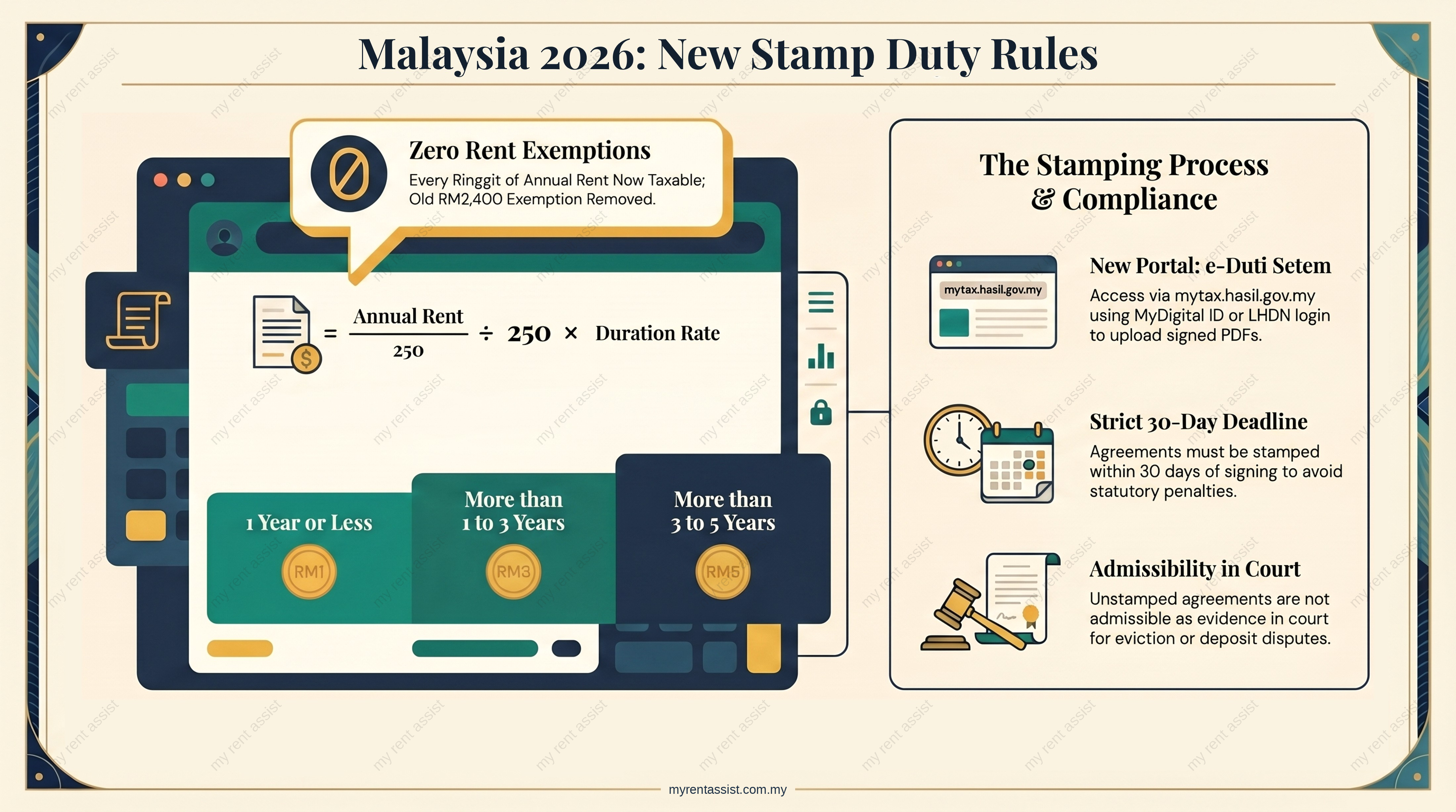
At the same time, the rates themselves were restructured based on tenancy duration. This means a 2-year tenancy now costs more to stamp than a 1-year tenancy at the same rent — not just proportionally, but at a higher per-RM250 rate.
The New 2026 Stamp Duty Rates
The rate you pay depends on how long your tenancy is. Here's the full table:
| Tenancy Duration | Rate per RM250 of Annual Rent | Example: RM1,800/month |
|---|---|---|
| 1 year or less | RM1 per RM250 | RM87 |
| More than 1 year, up to 3 years | RM3 per RM250 | RM261 |
| More than 3 years, up to 5 years | RM5 per RM250 | RM435 |
| More than 5 years | RM7 per RM250 | RM609 |
Minimum stamp duty: RM10 on all dutiable instruments. Each additional copy of the TA: flat RM10. Annual rent for RM1,800/month = RM21,600.
How the Calculation Works
The formula is straightforward:
The ⌈ ⌉ symbol means you round up to the next whole number.
Example: Monthly rent RM1,500, 1-year tenancy
Annual rent = RM1,500 × 12 = RM18,000
RM18,000 ÷ 250 = 72 (exact, no rounding needed)
72 × RM1 = RM72 stamp duty
Calculate Your Stamp Duty
Don't want to do the maths yourself? Use the calculator below — it applies the Finance Act 2024 rates automatically.
Stamp Duty Calculator
Based on Finance Act 2024 rates. Effective January 2025.
How to Stamp Online via e-Duti Setem (Step by Step)
From 1 January 2026, the old STAMPS portal is gone. Everything is now done through e-Duti Setem, which you access through MyTax at mytax.hasil.gov.my.
-
1Log in to MyTax Go to mytax.hasil.gov.my. Log in with your MyDigital ID or your existing LHDN account. If you've never logged in before, register first — it takes about 5 minutes with your IC.
-
2Find the e-Duti Setem Module Once logged in, look for "e-Duti Setem" in the services menu. This is where all stamp duty submissions now live.
-
3Select "Tenancy Agreement" as Document Type Choose the correct instrument type — for rental properties it's the Tenancy/Lease Agreement option under the residential category.
-
4Fill In the Tenancy Details Enter the landlord's IC, tenant's IC, property address, monthly rent, tenancy start and end dates. The system calculates the stamp duty amount automatically based on what you enter.
-
5Upload Your Signed Tenancy Agreement Upload a clear PDF of the signed agreement. Make sure both parties have already signed before you upload — you cannot amend the document after stamping.
-
6Pay via FPX or Online Banking Payment is made directly through the portal via FPX. Have your online banking ready. The payment is usually processed instantly.
-
7Download Your e-Stamp Certificate Once payment is confirmed, download the stamp certificate immediately and attach it to your physical tenancy agreement. Save a digital copy too — both landlord and tenant should have one.
-
8Done — Keep Both Copies Safe You typically need two stamped copies — one for the landlord, one for the tenant. The first copy is stamped at the full calculated rate. Each additional copy is a flat RM10.
Late Stamping Penalties
If you miss the 30-day window, LHDN will charge you a penalty on top of the stamp duty owed. The penalty scales up the longer you wait:
| How Late You Are | Penalty |
|---|---|
| Within 3 months after deadline | RM50 or 10% of deficient duty — whichever is higher |
| More than 3 months after deadline | RM100 or 20% of deficient duty — whichever is higher |
The penalties are non-negotiable and statutory — LHDN won't waive them for first-timers or "didn't know" excuses. Just stamp on time, pendek kata.
Who Pays — Landlord or Tenant?
Legally, the obligation to stamp falls on whoever holds the instrument — which in practice is usually the tenant, who holds the original tenancy agreement.
In real life, most landlords specify in the tenancy agreement itself that the tenant bears the stamp duty cost. This is the most common arrangement in Malaysia. But it's negotiable — some landlords split it 50/50, some absorb it fully as a goodwill gesture when the market is slow.
Whoever pays, make sure it's clearly stated in your tenancy agreement. Ambiguity here is a common source of disputes, especially when tenants later claim they didn't know they had to pay.
What Happens If You Don't Stamp?
This is the part most landlords underestimate until it's too late.
An unstamped tenancy agreement is not admissible as evidence in court. What this means practically:
- Tenant stops paying rent and you want to evict? You can't rely on the TA in court without a stamped copy.
- Tenant damages your property and denies it? Your TA as the basis of the claim is inadmissible.
- Deposit dispute? Same problem — the agreement that spells out the deposit terms can't be used.
- Tenant abandons the unit? Enforcement becomes extremely difficult without a valid stamped document.
Quick FAQ
Does stamp duty apply to month-to-month rentals with no formal agreement?
If there's no written tenancy agreement, there's nothing to stamp. But then again, there's also nothing to protect you legally. A written, stamped TA is always the safer option.
My tenant is renewing — do I stamp the renewal agreement too?
Yes. A renewal is a new instrument and must be stamped separately. Use the current 2026 rates — don't assume it's the same as last time.
Can the tenant stamp it themselves without involving the landlord?
Yes. Either party can initiate the e-Duti Setem process. You just need the signed agreement and both parties' IC numbers. Only one payment is required per instrument.
What if the monthly rent changes mid-tenancy?
If the rent changes and you draw up a supplementary agreement, that new instrument may need to be stamped separately. Consult your solicitor or check with LHDN directly.
My last TA was stamped via STAMPS portal — is it still valid?
Yes, fully valid. The switch to e-Duti Setem only affects new stamping from 1 January 2026 onwards. Your existing stamped agreement remains legally binding.
Stamp Duty Sorted.
What About the Rent Itself?
You've done the hard part — proper TA, stamped and ready. Now comes the monthly part that most landlords actually dread: chasing rent, monitoring utility bills, and keeping track of it all.
- Automated rent reminders to your tenant every month
- TNB, Air Selangor & IWK — collected and paid on your behalf
- Official receipt generated and sent after every payment
- Annual tax summary ready for LHDN — no digging through statements
- Nett rental transferred straight to your bank account
No more awkward "eh, you bayar dah ke?" texts. No more unpaid utility bills you find out about 3 months too late. MyRentAssist handles the whole monthly cycle automatically — and the service fee comes out of what your tenant pays, so nothing comes out of your pocket.