In This Guide
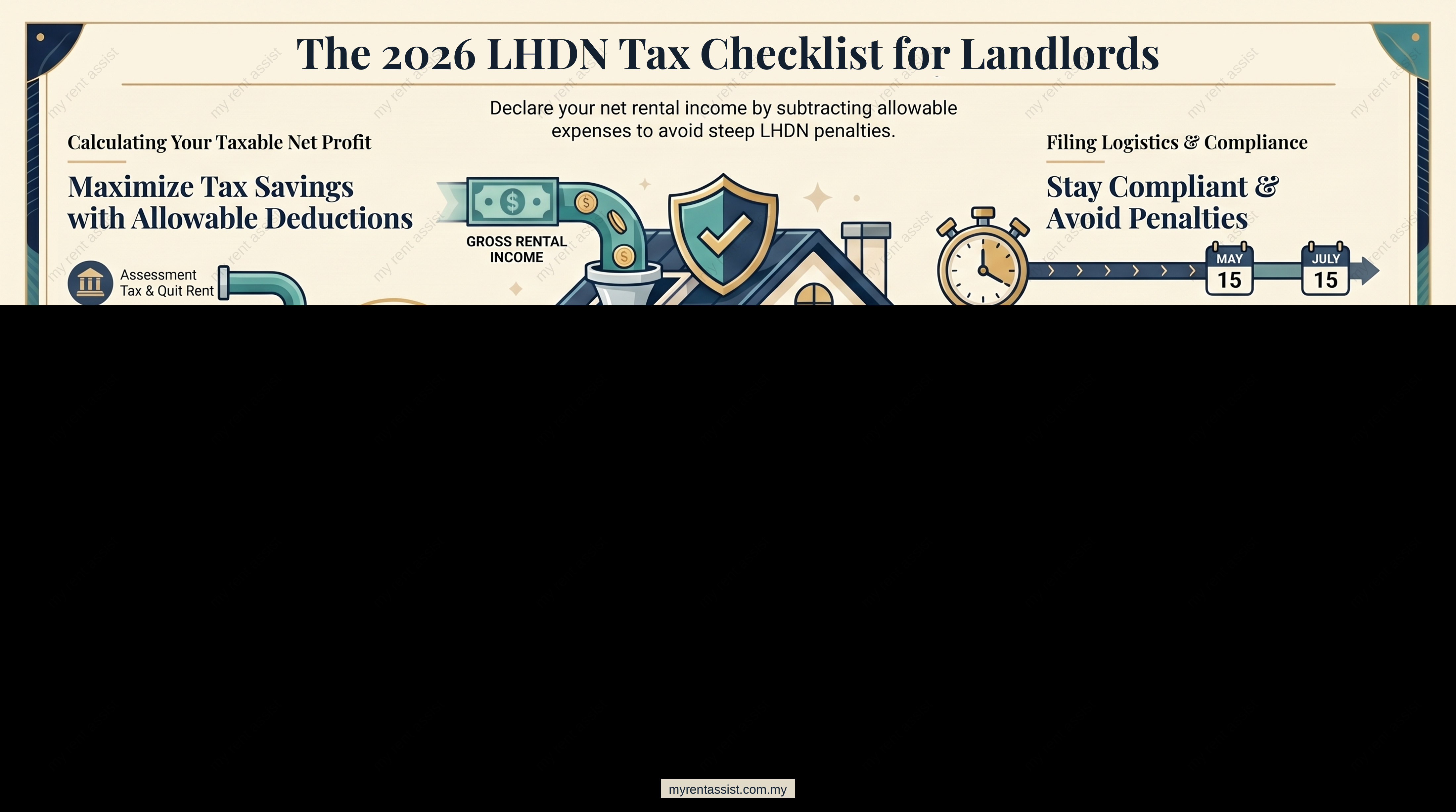
It's tax season, and somewhere between checking your tenant's latest payment and trying to remember which months they actually paid — you start to wonder: do I need to declare all this? If yes, LHDN check how?
You're not alone. Most Malaysian landlords know rental income is taxable in theory, but the actual how — which form, what to deduct, where to click — that part is murky. And with new e-invoice rules rolling out in 2026, there's even more to keep track of.
This guide answers it all, plainly, without the legal jargon. Grab your teh tarik — let's get through this together.
Do you actually need to declare rental income?
Short answer: yes, if your total income (including rent) exceeds the tax-exempt threshold.
Rental income is taxable under Section 4(d) of the Income Tax Act 1967 as "statutory income from rents." It doesn't matter whether you collect it in cash, online transfer, or FPX — if someone is paying you to stay in your property, LHDN considers it income.
The key question is whether your total chargeable income (your salary + rental profit + any other income, minus all reliefs) exceeds the tax-free threshold. For resident individuals in 2026, the first RM5,000 of chargeable income is taxed at 0%, so if your net rental income is small and your employment income is modest, you may end up owing very little — but you still need to declare it.
Which LHDN form to use
Most landlords who are employees or retirees will use Form BE. Landlords who run a business (sole proprietors, partnerships) use Form B. Here's how to tell which applies to you:
| Your situation | Form to use | Section for rental income |
|---|---|---|
| Employed + renting out property on the side | Form e-BE | Part 4(d) — "Other Income" |
| Retired, no other active income | Form e-BE | Part 4(d) — "Other Income" |
| Self-employed / sole proprietor | Form e-B | Business income section |
| Company or Sdn Bhd holding the property | Form e-C | Consult your accountant |
Filing deadlines for Year of Assessment 2025 (filing in 2026)
- Form e-BE (employees) — deadline: 15 May 2026
- Form e-B (self-employed) — deadline: 15 July 2026
Estimate your rental income tax
Use this calculator to get a rough sense of how much tax your rental income might add to your bill. Remember — it's your net rental income (after deductible expenses) that matters, not the gross rent collected.
Rental Income Tax Estimator
For resident individuals. Estimate only — for exact figures, consult a tax professional.
What expenses you can deduct
This is where most landlords leave money on the table — they declare the gross rent without subtracting anything. LHDN allows a range of deductions against your rental income. Every ringgit deducted reduces your taxable amount.
Allowable deductions
- Assessment tax (cukai taksiran) — the annual bill from your local council. Fully deductible in the year you pay it.
- Quit rent (cukai tanah) — land tax payable to the state. Deductible.
- Fire insurance premium — your building/fire insurance for the rental property.
- Loan interest — the interest portion of your housing loan payments, not the principal repayment. Keep your annual loan statement from the bank.
- Repair and maintenance — genuine repairs to restore the property to its original working condition. This covers plumbing, electrical work, repainting, aircon servicing, appliance repairs.
- Property management fees — if you're paying a property manager or a platform to manage your rental. This includes platforms like MyRentAssist — your subscription fees are deductible too.
- Utility bills (in landlord's name) — if TNB, water, or IWK bills are under your name and you're paying them on the tenant's behalf.
What you cannot deduct
- Renovation and improvement costs — building a new room, installing new cabinets, upgrading fixtures. These are capital expenditure.
- New furniture and appliances — buying a new sofa or fridge for the tenant counts as capital expenditure, not maintenance.
- Loan principal repayment — only the interest is deductible, not the portion that reduces the loan balance.
- Personal expenses of any kind.
Step-by-step: how to file on e-Filing
Filing your rental income on LHDN's e-Filing system (MyTax portal) takes about 30–45 minutes once you have your documents ready. Here's the process:
-
1Log in to MyTax (mytax.hasil.gov.my) Use your MyKad number and e-Filing password. If you've never registered, go to the nearest LHDN office or register online — you'll need your MyKad and a valid email address.
-
2Select "e-Filing" → "Form BE" (or Form B) Choose the Year of Assessment 2025 (for income earned in 2025, filed in 2026).
-
3Fill in your employment income first Your employer's EA Form data may auto-populate. Verify the figures before proceeding.
-
4Navigate to Part 4(d) — Other Income This is where you declare rental income. Enter your gross rental receipts in the relevant field.
-
5Enter your allowable deductions There is a section to enter deductible expenses against your rental income. Enter the total of all qualifying expenses for the year. The system will calculate your net statutory income automatically.
-
6Claim your personal reliefs Self relief (RM9,000), spouse relief, child relief, lifestyle relief, EPF contribution, and so on. These reduce your total chargeable income.
-
7Review, confirm, and submit Check the tax payable figure. If you have MTD (Potongan Cukai Bulanan) from your employer that covers it, you may get a refund. Submit and save your acknowledgment number.
New in 2026: e-Invoice rules for landlords
Malaysia's MyInvois e-invoicing system has been rolling out in phases since August 2024. Here's what it means for landlords specifically:
| Annual rental income | Mandatory from | Notes |
|---|---|---|
| Above RM5 million | August 2024 | Already active |
| RM1 million – RM5 million | January 2026 | Already active |
| RM500,000 – RM1 million | Exempt | Cancelled — Cabinet raised threshold to RM1M (Dec 2025) |
| Below RM1 million | Exempt | Cabinet raised threshold to RM1M (Dec 2025) |
What this means in plain terms: if your annual rental income is below RM1 million, you are exempt from the e-invoice requirement. In December 2025, the Cabinet permanently raised the exemption threshold from RM500,000 to RM1 million, meaning the planned July 2026 mandate for the RM500k–RM1M band was cancelled entirely. The vast majority of individual landlords are not affected.
If your income is above RM1 million — typically through multiple commercial or high-value residential properties — you'll need to issue e-invoices via the LHDN MyInvois system. Penalties for non-compliance can range from RM200 to RM20,000 per instance.
Penalties for not declaring
LHDN has been actively cross-checking rental income data, especially with the new e-invoicing trail and data from platforms. Not declaring is a real risk — and the penalties are steep.
| Offence | Penalty |
|---|---|
| Late filing (after deadline) | 10% penalty on tax payable |
| Under-declaration of income | 45%–100% of tax undercharged |
| Failure to file entirely | Fine of RM200–RM20,000 and/or imprisonment up to 6 months |
| Wilful tax evasion | Fine of RM1,000–RM20,000 and/or imprisonment up to 3 years |
What records to keep (and for how long)
LHDN can audit you for up to 7 years back. Keep all of the following, organised by year:
- Tenancy agreements
- Monthly rent receipts (proof of collection)
- Assessment tax receipts (cukai taksiran)
- Quit rent receipts (cukai tanah)
- Fire insurance policy and premium receipts
- Annual bank loan statement (to extract the interest portion)
- Repair invoices and contractor receipts
- Property management fees paid
- TNB / water / IWK bills (if in landlord's name)
If LHDN audits you and you can't produce these documents — even if the deductions are legitimate — you lose the right to claim them. Keeping records isn't optional; it's the only thing standing between you and a much larger tax bill.
FAQ
My tenant pays in cash. Do I still need to declare?
Yes. The method of payment doesn't change the tax treatment. Cash, bank transfer, FPX, e-wallet — all rental receipts are taxable income. The responsibility to declare is yours regardless of how payment arrives.
Can I deduct the rental commission I paid to an agent?
Generally, no — a one-time agent's commission to find a tenant is considered a capital cost of setting up the tenancy, not a recurring expense deductible under Section 4(d). However, if you pay ongoing property management fees (monthly), those are deductible. Ask your accountant to confirm based on your specific arrangement.
My property was vacant for 3 months. Do I declare nothing for those months?
You only declare income actually received. If the unit was vacant and no rent was collected, there's no income to declare for those months. However, some expenses (assessment tax, insurance, loan interest) during vacancy periods may still be partially deductible — your accountant can advise.
I own the property jointly with my spouse. How do we declare?
Each co-owner declares their proportionate share of the net rental income. If you own 50/50, each person declares 50% of the net profit in their respective tax returns. Keep this consistent year on year.
Is there a way to simplify tracking rent payments and receipts for LHDN?
This is the biggest practical headache for most landlords — especially those managing more than one unit. Without a proper system, you're manually checking bank statements, chasing missing receipts, and trying to reconstruct records during tax season. The landlords who have the least stress during LHDN season are the ones who kept clean records all year — knowing exactly when each tenant paid and having a receipt to show for every transaction.
LHDN check how? Use MyRentAssist lah.
If LHDN ever comes knocking, the landlords who sleep easy are the ones with clean records — every payment logged, every receipt issued, every month. That's exactly what MyRentAssist is built for.
Instead of scrambling through bank statements come tax season, your entire rental income history is already there. Organised. Ready to declare.
- Annual tax summary generated automatically — no manual tallying
- Official receipts sent to tenant every month, automatically
- FPX rent collection with a full, auditable payment trail
- e-Invoice ready (Corporate plan, via MyInvois) — ahead of the mandate
- Platform fees are tax-deductible — MyRentAssist pays for itself
Try it free for 3 months. No credit card needed. Setup takes 5 minutes.
This article is for general guidance only and does not constitute legal or tax advice. Tax rules may change — consult a licensed tax consultant or chartered accountant for advice specific to your situation.